
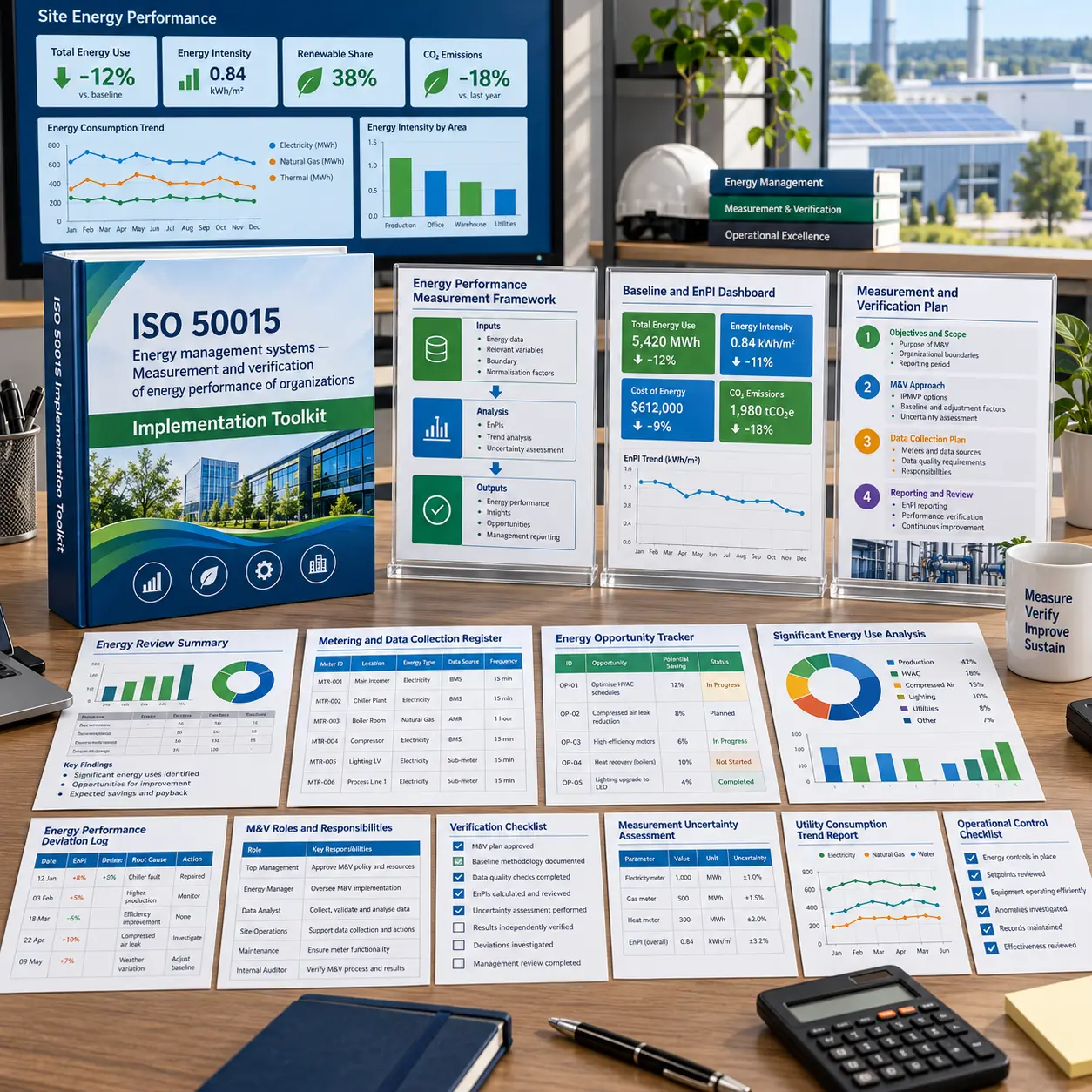
ISO 50015:2014 Measurement & Verification of Energy Performance Implementation Toolkit
The ISO 50015:2014 Measurement and Verification of Energy Performance Implementation Toolkit provides a comprehensive, practical set of premium templates and structured implementation resources to help organizations plan, execute, verify, document, and improve measurement and verification (M&V) of energy performance.
Aligned with ISO 50015:2014, the toolkit translates M&V principles into usable procedures, M&V plans, measurement-boundary records, energy data workbooks, EnPI and energy-baseline tools, relevant-variable analyses, metering and calibration controls, regression models, adjustment calculations, uncertainty assessments, verification checklists, reporting templates, and continual-improvement resources.
ISO 50015 Toolkit Value & Pricing
Implementing a robust measurement and verification process aligned with ISO 50015:2014 can require significant technical and cross-functional effort, especially when organizations must define measurement boundaries, establish energy baselines and EnPIs, qualify data, select M&V methods, control metering systems, normalize performance, manage adjustments, quantify uncertainty, calculate savings, verify results, and retain defensible evidence.
The ISO 50015:2014 Measurement and Verification of Energy Performance Implementation Toolkit provides a comprehensive collection of easy to use templates and structured implementation documents in Word, Excel, and PowerPoint formats. It helps your organization accelerate M&V implementation, improve energy-data quality, standardize calculations and models, strengthen metering and calibration controls, manage uncertainty, support independent verification, and produce traceable energy-performance reports with greater consistency.

ISO 50015 Toolkit Document Index
Below is the structured list of documents included in the package. Expand each part to review the files before downloading the index file.
 Part 1. ISO 50015 Implementation Governance and Project Initiation
 ISO 50015 Implementation Project Charter.docx Energy MandV Governance Framework.docx ISO 50015 Implementation Plan.docx Energy MandV Team Terms of Reference.docx Energy MandV Roles Responsibilities and Authorities.docx Energy MandV Document and Record Control Procedure.docx
 ISO 50015 Project RACI Matrix.xlsx ISO 50015 Stakeholder Register.xlsx ISO 50015 Project Schedule and Milestone Tracker.xlsx ISO 50015 Requirements Traceability Matrix.xlsx ISO 50015 Baseline Gap Assessment.xlsx Energy MandV Document Register.xlsx
 ISO 50015 Project Kickoff Presentation.pptx ISO 50015 Executive Awareness Presentation.pptx
Part 2. M&V Purpose, Principles, Scope and Intended Use
Energy MandV Purpose and Objectives Definition.docx Energy MandV Scope Definition.docx Energy MandV Intended Use and Decision Context.docx Energy MandV Principles and Quality Criteria.docx Energy MandV Stakeholder and User Requirements.docx Energy MandV Independence and Competence Requirements.docx Energy MandV Scope and Objectives Register.xlsx Energy MandV Stakeholder Requirements Matrix.xlsx Energy MandV Principles Compliance Check.xlsx Energy MandV Assumptions and Constraints Register.xlsx Energy MandV Scoping Workshop.pptxPart 3. Energy Performance Improvement Action and Measurement Boundary Definition
Energy Performance Improvement Action Description.docx Energy MandV Measurement Boundary Definition.docx Energy Flow and System Boundary Description.docx Affected Energy Uses and Processes Assessment.docx Interactive Effects Assessment.docx Boundary Change Assessment Form.docx Energy Performance Improvement Action Register.xlsx Measurement Boundary Register.xlsx Energy Flow and Meter Boundary Matrix.xlsx Interactive Effects Register.xlsx Boundary Change Log.xlsx Measurement Boundary Definition Workshop.pptxPart 4. Energy Data, Significant Energy Uses and Energy Performance Context
Energy Data Requirements Specification.docx Energy Use and Consumption Data Collection Procedure.docx Significant Energy Use Data Assessment.docx Energy Performance Context Assessment.docx Energy Data Source Qualification Record.docx Energy Data Master Register.xlsx Energy Use and Consumption Workbook.xlsx Significant Energy Use Register.xlsx Energy Source and Tariff Register.xlsx Energy Data Source and Owner Matrix.xlsx Energy Performance Context Register.xlsx Energy Data and SEU Review Presentation.pptxPart 5. Energy Performance Indicators and Energy Baseline Definition
Energy Performance Indicator Definition Procedure.docx Energy Baseline Definition Procedure.docx EnPI Selection and Justification Form.docx Energy Baseline Selection and Justification Form.docx EnPI and EnB Review and Approval Record.docx EnPI Register.xlsx Energy Baseline Register.xlsx EnPI Calculation Workbook.xlsx Baseline Period Data Workbook.xlsx EnPI and EnB Traceability Matrix.xlsx EnPI and Baseline Trend Analysis.xlsx EnPI and Energy Baseline Review Presentation.pptxPart 6. Relevant Variables, Static Factors and Normalization Inputs
Relevant Variable Identification Procedure.docx Static Factor Identification Procedure.docx Relevant Variable Selection and Justification Form.docx Static Factor Assessment and Change Record.docx Normalization Input Data Requirements.docx Relevant Variable Register.xlsx Static Factor Register.xlsx Relevant Variable Correlation Analysis.xlsx Normalization Input Data Workbook.xlsx Static Factor Change Tracker.xlsx Relevant Variable and Static Factor Review.pptxPart 7. M&V Approach, Method and Calculation Strategy Selection
Energy MandV Approach Selection Procedure.docx Energy MandV Method Selection and Justification.docx Whole Facility MandV Method Assessment.docx System Component MandV Method Assessment.docx Engineering Calculation Method Assessment.docx Statistical Modeling Method Assessment.docx Energy MandV Method Approval Record.docx Energy MandV Method Selection Matrix.xlsx MandV Method Applicability and Risk Assessment.xlsx MandV Calculation Method Register.xlsx MandV Method Selection Workshop.pptxPart 8. M&V Plan Development and Approval
Energy MandV Plan Template.docx Energy MandV Plan Development Procedure.docx MandV Plan Assumptions and Exclusions.docx MandV Plan Data Requirements.docx MandV Plan Roles and Responsibilities.docx MandV Plan Review and Approval Checklist.docx MandV Plan Action and Deliverable Tracker.xlsx MandV Plan Data Requirement Matrix.xlsx MandV Plan Approval and Revision Register.xlsx MandV Plan Evidence Index.xlsx Energy MandV Plan Review Presentation.pptxPart 9. Measurement and Data Collection Planning
Energy Data Collection Plan.docx Measurement Point Selection and Justification.docx Metering and Submetering Plan.docx Sampling and Data Frequency Plan.docx Manual Data Collection Work Instruction.docx Automated Data Collection and Integration Procedure.docx Measurement Point Register.xlsx Energy Data Collection Schedule.xlsx Metering and Submetering Matrix.xlsx Sampling and Data Frequency Register.xlsx Manual Data Collection Log.xlsx Automated Data Interface Register.xlsx Measurement and Data Collection Training.pptxPart 10. Metering, Instrumentation, Calibration and Measurement System Control
Energy Metering System Control Procedure.docx Energy Measurement Instrument Calibration Procedure.docx Meter Installation and Commissioning Checklist.docx Measurement System Accuracy Assessment.docx Meter Failure and Data Substitution Procedure.docx Metering System Change Control Form.docx Energy Meter Master Register.xlsx Calibration Master Schedule and Status Register.xlsx Meter Accuracy and Tolerance Register.xlsx Meter Installation and Commissioning Log.xlsx Meter Failure and Substituted Data Register.xlsx Metering System Change Register.xlsx Metering and Calibration Control Training.pptxPart 11. Baseline Period, Reporting Period and Data Quality Management
Baseline Period Selection Procedure.docx Reporting Period Definition Procedure.docx Energy Data Quality Management Procedure.docx Missing and Invalid Data Handling Procedure.docx Data Outlier Review and Disposition Form.docx Data Validation and Completeness Checklist.docx Baseline and Reporting Period Register.xlsx Energy Data Quality Assessment Workbook.xlsx Missing and Invalid Data Register.xlsx Data Outlier Analysis Workbook.xlsx Data Completeness and Validation Log.xlsx Baseline and Reporting Period Review.pptxPart 12. Energy Performance Modeling, Normalization and Regression Analysis
Energy Performance Model Development Procedure.docx Energy Normalization Methodology.docx Regression Model Selection and Validation Procedure.docx Model Assumptions and Limitations Record.docx Model Validation and Fitness Assessment.docx Energy Performance Model Workbook.xlsx Regression Analysis Workbook.xlsx Normalized Energy Consumption Calculator.xlsx Model Parameter and Coefficient Register.xlsx Model Goodness of Fit and Diagnostic Check.xlsx Normalized Baseline and Reporting Period Comparison.xlsx Energy Performance Model Review Presentation.pptxPart 13. Routine and Non-Routine Adjustments
Energy Performance Adjustment Procedure.docx Routine Adjustment Methodology.docx Non Routine Adjustment Methodology.docx Static Factor Change Evaluation Form.docx Non Routine Adjustment Approval Record.docx Adjustment Evidence and Justification Record.docx Routine Adjustment Calculation Workbook.xlsx Non Routine Adjustment Calculation Workbook.xlsx Static Factor Change and Adjustment Register.xlsx Adjustment Assumption and Evidence Register.xlsx Adjustment Approval Tracker.xlsx Routine and Non Routine Adjustment Review.pptxPart 14. Measurement Uncertainty, Accuracy and Sensitivity Analysis
Measurement Uncertainty Assessment Procedure.docx Energy MandV Accuracy Requirements.docx Sampling Uncertainty Assessment Method.docx Model Uncertainty Assessment Method.docx Uncertainty Acceptance and Escalation Criteria.docx Sensitivity Analysis Plan.docx Measurement Uncertainty Workbook.xlsx Metering Accuracy Contribution Analysis.xlsx Sampling Uncertainty Calculation.xlsx Model Uncertainty and Confidence Interval Workbook.xlsx Sensitivity Analysis Workbook.xlsx Uncertainty and Accuracy Risk Register.xlsx Energy MandV Uncertainty Review Presentation.pptxPart 15. M&V Execution, Energy Performance Change and Savings Calculation
Energy MandV Execution Procedure.docx Energy Performance Change Calculation Method.docx Energy Savings Calculation Method.docx Energy Performance Improvement Verification Record.docx Interactive Effect Calculation Record.docx MandV Execution Exception and Deviation Form.docx Energy Performance Change Calculation Workbook.xlsx Energy Savings Calculation Workbook.xlsx Baseline vs Reporting Period Comparison.xlsx Interactive Effect Calculation Workbook.xlsx MandV Execution Data and Result Register.xlsx MandV Deviation and Exception Register.xlsx Energy MandV Execution Review Presentation.pptxPart 16. Verification, Technical Review and Result Validation
Energy MandV Verification Procedure.docx Energy MandV Technical Review Checklist.docx Independent Verifier Competence and Independence Declaration.docx MandV Result Validation Record.docx Calculation and Model Review Checklist.docx Verification Finding and Response Form.docx MandV Verification Findings Register.xlsx Calculation and Model Verification Matrix.xlsx Verification Evidence and Sampling Register.xlsx Verification Comment and Response Tracker.xlsx MandV Result Approval Register.xlsx Energy MandV Verification Review Presentation.pptxPart 17. M&V Reporting, Communication and Record Retention
Energy MandV Report Template.docx Energy MandV Executive Summary Template.docx Energy Performance Result Statement.docx MandV Methodology Assumptions and Limitations Statement.docx MandV Report Review and Approval Checklist.docx Energy MandV Record Retention and Archiving Procedure.docx MandV Report Result Tables.xlsx MandV Report Evidence Index.xlsx Energy Performance Result Trend Workbook.xlsx MandV Report Approval and Distribution Register.xlsx MandV Record Retention Schedule.xlsx Energy MandV Executive Results Presentation.pptx Energy MandV Technical Results Presentation.pptxPart 18. Change Control, Periodic Review, Improvement and Implementation Closeout
Energy MandV Change Control Procedure.docx MandV Plan Change Impact Assessment Form.docx Energy MandV Periodic Review Procedure.docx MandV Method and Model Reassessment Procedure.docx Energy MandV Continual Improvement Procedure.docx ISO 50015 Implementation Closeout Report.docx Energy MandV System Handover and Ownership Record.docx Energy MandV Lessons Learned Record.docx Energy MandV Change Control Register.xlsx MandV Periodic Review Schedule.xlsx MandV Model and Method Reassessment Register.xlsx MandV Improvement Action Register.xlsx Energy MandV Lessons Learned Register.xlsx ISO 50015 Implementation Closeout Checklist.xlsx Energy MandV Continual Improvement Roadmap.pptx ISO 50015 Project Closeout and Handover.pptxReview the complete file index, preview free sample templates, or check the purchase and payment guide.
ISO 50015 Toolkit Package & Download Information
| Date File Updated | 25/03/2025 |
| File Format | pdf, xls, doc, docx, xlsx, pptx |
| No. of files | 223 File; 18 Folders |
| File download size | 43.30 MB (rar). |
| Language |
 English
|
| Purchase code | ISO50015-Toolkits |
Ready to Implement ISO 50015:2014?
Start with the complete ISO 50015 energy-performance M&V toolkit or review the free sample before purchasing.
The M&V plan and baseline workbooks gave our energy team a much clearer structure for project documentation.
The relevant-variable and correlation tools helped us justify which operating factors should be included in our energy model.
We adapted the metering register, calibration schedule and data-quality checklist for our building portfolio with only minor changes.
The baseline-versus-reporting-period and savings calculation workbooks were useful for explaining project results to management.
The toolkit helped us document assumptions, exclusions and evidence in a more disciplined way before technical verification.
A strong package for teams that need both procedures and the Excel workbooks used to perform the actual M&V calculations.
The uncertainty and sensitivity analysis section was particularly helpful for improving the quality of our savings reports.
We used the measurement-boundary and meter matrix templates to align engineering drawings with our M&V documentation.
The missing-data, outlier and substitution procedures were practical for handling gaps in our historical energy dataset.
The verification checklist and evidence index made independent technical review more efficient and easier to track.
The reporting templates gave us a consistent way to present M&V methods, assumptions, limitations and verified results.
The change-control and periodic-review documents helped us manage model updates after operating conditions changed.