
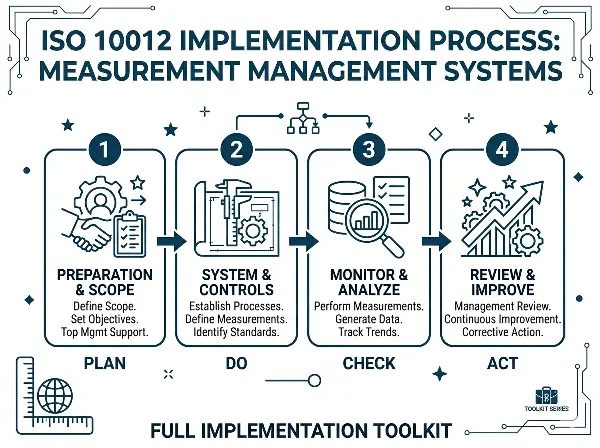
The ISO 10012 Measurement Management Systems Implementation Toolkit provides a comprehensive, easy to use set of professional templates, practical working documents, and implementation guidance to help organizations establish, control, and continually improve an effective measurement management system.
Aligned with ISO 10012 requirements, this toolkit translates measurement management expectations into actionable policies, procedures, registers, workbooks, slides, and tracking tools. It helps organizations strengthen measurement reliability, improve traceability, standardize metrological confirmation activities, control measuring equipment, support calibration and verification processes, and maintain consistent confidence in the validity of measurement results across operations.
Implementing a Measurement Management System aligned with ISO 10012 can be complex and time-consuming, especially for organizations that require structured documentation, controlled measuring equipment, calibration governance, traceability records, metrological confirmation workflows, and consistent measurement reliability across operational, technical, quality, and compliance functions.
The ISO 10012 Measurement Management Systems Implementation Toolkit provides a comprehensive collection of easy to use templates and structured implementation documents in Word, Excel, and PowerPoint formats. It helps your organization accelerate implementation, standardize documentation, strengthen measurement governance, improve equipment and calibration control, support traceability assurance, and build ready for implementation measurement management practices with greater confidence.

Below is the structured list of documents included in the package. Use the quick navigation or expand each part to review the files before downloading the index file.
 Part 1. Measurement Management Program Initiation & Governance
Objective: To establish the governance model, scope, metrological direction, leadership accountability, implementation priorities, and organizational structure required to launch and control the Measurement Management System effectively.
 Measurement Management Program Charter.docx Measurement Management Governance Framework.docx Measurement Management Scope Definition.docx Measurement Policy Framework Structure.docx Measurement Management Policy (Master).docx Measurement Objectives & Quality Targets.docx Roles, Responsibilities & Authorities for Metrology.docx Measurement Management Implementation Roadmap.docx
 Stakeholder Register.xlsx Measurement Governance RACI Matrix.xlsx Measurement Objectives & KPI Register.xlsx Governance Meeting Schedule.xlsx Program Budget Tracker.xlsx
 Measurement Management Kickoff Slides.pptx Executive Awareness Deck for ISO 10012.pptx
Part 2. Measurement Requirements & Process Planning
Objective: To define measurement requirements, acceptance criteria, operational tolerances, process interfaces, and technical planning controls so that measurements are consistently fit for their intended purpose.
Measurement Requirements Identification Procedure.docx Measurement Process Planning Methodology.docx Product & Process Measurement Criteria.docx Tolerance & Acceptance Limit Definition Guidelines.docx Measurement Method Selection Procedure.docx Process Control Points Definition.docx Measurement Requirements Register.xlsx Critical Measurement Points Register.xlsx Measurement Process Mapping Matrix.xlsx Tolerance & Acceptance Limits Register.xlsx Measurement Planning Workshop Slides.pptx
Part 3. Measuring Equipment Control & Asset Register
Objective: To identify, classify, assign ownership, and control measuring equipment throughout its lifecycle so that each device remains suitable, traceable, and available for approved measurement activities.
Measuring Equipment Control Policy.docx Measuring Equipment Lifecycle Procedure.docx Equipment Identification & Labeling Standard.docx Equipment Handling, Storage & Protection Procedure.docx Equipment Fitness-for-Use Assessment Guidelines.docx Measuring Equipment Master Register.xlsx Equipment Ownership Register.xlsx Equipment Status Control Log.xlsx Equipment Location Tracking Register.xlsx Equipment Preservation Checklist.xlsx Measuring Equipment Control Overview Slides.pptx
Part 4. Calibration, Verification & Metrological Confirmation
Objective: To ensure all applicable measuring equipment is calibrated, verified, adjusted where necessary, and formally confirmed as metrologically suitable before use in controlled measurement processes.
Calibration & Verification Policy.docx Metrological Confirmation Procedure.docx Calibration Interval Determination Guidelines.docx Out-of-Tolerance Equipment Management Procedure.docx Calibration Certificate Review Procedure.docx Measurement Traceability Requirements.docx Calibration Register.xlsx Verification Schedule.xlsx Metrological Confirmation Log.xlsx Calibration Certificate Tracker.xlsx Out-of-Tolerance Investigation Log.xlsx Calibration & Confirmation Awareness Slides.pptx
Part 5. Measurement Traceability & Reference Standards
Objective: To establish traceability chains, control reference standards, and document supporting evidence so that measurement results can be trusted, defended, and linked to recognized references where required.
Measurement Traceability Policy.docx Reference Standards Control Procedure.docx Traceability Chain Documentation Guidelines.docx External Calibration Provider Evaluation Criteria.docx Traceability Matrix.xlsx Reference Standards Register.xlsx Calibration Service Provider Register.xlsx Traceability Evidence Log.xlsx Traceability Assurance Slides.pptx
Part 6. Measurement Uncertainty, Accuracy & Method Validation
Objective: To define how measurement uncertainty, method capability, repeatability, reproducibility, accuracy, and resolution are evaluated and validated to support dependable decision making.
Measurement Uncertainty Evaluation Procedure.docx Method Validation & Suitability Procedure.docx Repeatability & Reproducibility Study Guidelines.docx Accuracy, Bias & Resolution Assessment Template.docx Measurement System Capability Assessment.docx Measurement Uncertainty Register.xlsx Method Validation Log.xlsx Gauge Capability Study.xlsx Repeatability & Reproducibility Analysis.xlsx Measurement Capability Review Slides.pptx
Part 7. Measurement Risk Management & Decision Integrity
Objective: To identify and control risks arising from inaccurate, unreliable, delayed, or inappropriate measurements that may affect product conformity, compliance, customer outcomes, or operational decisions.
Measurement Risk Management Policy.docx Measurement Risk Assessment Procedure.docx Decision Risk & False Acceptance Guidelines.docx Control of Measurement Failure Impacts.docx Containment Actions for Suspect Measurements.docx Measurement Risk Register.xlsx Suspect Result Investigation Log.xlsx Decision Rule Matrix.xlsx Measurement Failure Impact Assessment.xlsx Measurement Risk Review Slides.pptx
Part 8. Competence, Training & Authorization
Objective: To ensure personnel performing measurement, calibration, verification, review, and technical approval activities are competent, trained, authorized, and periodically re-evaluated.
Measurement Competence Policy.docx Competence & Qualification Procedure.docx Training & Requalification Guidelines.docx Authorized Measurement Personnel Matrix.docx Competence Matrix.xlsx Training Attendance Register.xlsx Personnel Authorization Log.xlsx Requalification Schedule.xlsx Measurement Competence Awareness Slides.pptx
Part 9. Operational Control of Measurement Processes
Objective: To establish disciplined operational controls for executing measurement activities, reviewing results, controlling environmental conditions, managing work instructions, and preserving measurement integrity in day-to-day operations.
Measurement Process Control Procedure.docx Standard Work Instructions for Measurement Activities.docx Environmental Conditions Control Procedure.docx Result Review & Technical Approval Procedure.docx Handling of Invalid or Suspect Results.docx Measurement Process Checklist.xlsx Environmental Monitoring Log.xlsx Measurement Results Review Log.xlsx Suspect Results Register.xlsx Operational Measurement Control Slides.pptx
Part 10. Supplier, Laboratory & External Service Control
Objective: To ensure external laboratories, calibration providers, and metrology-related service partners are selected, evaluated, approved, and monitored using risk-based and performance-based controls.
External Metrology Service Control Policy.docx Supplier Qualification & Approval Procedure.docx Calibration Supplier Evaluation Checklist.docx Outsourced Measurement Service Agreement Template.docx Approved Supplier Register.xlsx Supplier Performance Review Log.xlsx External Service Assessment Tracker.xlsx External Metrology Services Review Slides.pptx
Part 11. Audit, Compliance & Corrective Action
Objective: To support internal audit, compliance verification, nonconformity management, corrective action, evidence collection, and assurance over the effectiveness of the Measurement Management System.
Internal Audit Policy for Measurement Management.docx Measurement System Audit Procedure.docx Nonconformity & Corrective Action Procedure.docx Audit Reporting Template.docx Root Cause Analysis Template.docx Internal Audit Plan.xlsx Measurement Audit Checklist.xlsx Nonconformity Register.xlsx Corrective Action Tracker.xlsx Audit Evidence Register.xlsx Audit & Assurance Results Slides.pptx
Part 12. Monitoring, Analysis, Management Review & Continual Improvement
Objective: To define the reviews, performance indicators, trend analysis, management reporting, and improvement mechanisms required to sustain the effectiveness, reliability, and maturity of the Measurement Management System over time.
Monitoring & Performance Reporting Procedure.docx Management Review Procedure.docx Continual Improvement Procedure.docx Measurement System Maturity Assessment Guidelines.docx Measurement KPI Dashboard.xlsx Calibration Performance Dashboard.xlsx Measurement Error Trend Analysis.xlsx Management Review Minutes Log.xlsx Continual Improvement Register.xlsx Improvement Action Tracker.xlsx Management Review Slides.pptx Measurement Improvement Roadmap Slides.pptxUse these quick links to review the full file list and payment instructions.


| Date File Updated | 25/03/2025 |
| File Format | pdf, xls, doc, docx, xlsx, pptx |
| No. of files | 128 Files, 12 Folders |
| File download size | 36.46 MB (.rar) |
| Language |
 English
|
| Purchase code | ISO10012-Toolkits |
The ISO Toolkit has helped us structure our implementation work clearly. It gave our team practical templates, organized procedures, and a reliable starting point for building our management system documentation.
After using the ISO Toolkit, our ISO preparation became much more organized. The documents are professional, easy to adapt, and helpful for aligning internal teams around clear compliance requirements.
Our consultants and internal managers found the toolkit very practical. It saved time, improved documentation consistency, and gave us a better framework for ISO implementation across departments.
The toolkit provides a strong foundation for ISO best practices. It helped us organize policies, procedures, records, and improvement actions in a way that is simple to maintain.
The ISO Toolkit brought structure to our compliance documentation and reduced the workload for our implementation team. It allowed us to focus more on improving processes instead of starting documents from scratch.
The ISO Toolkit is practical, well arranged, and easy to customize. It helped replace scattered files with a more complete document set for managing our ISO implementation activities.
The toolkit is very straightforward to use. It gave our team a clear implementation path, helped define responsibilities, and made ISO documentation easier for non-specialists to understand.
The ISO Toolkit gave us a better understanding of management system requirements and provided a user-friendly way to improve processes, controls, and internal documentation.
The toolkit helped me organize our ISO training, document review, and implementation planning. It made the entire preparation process more focused and easier to communicate with the team.
Excellent ISO Toolkit. It is highly useful for managers, consultants, and implementation teams who need practical documents to support ISO certification readiness.
A very useful toolkit and one of the most practical document sets I have used. It provides clear templates that can be adapted quickly for different ISO implementation needs.
These ISO Toolkits increased my confidence in managing implementation work. They helped us prepare documentation, assign responsibilities, and move toward a more mature management system.