
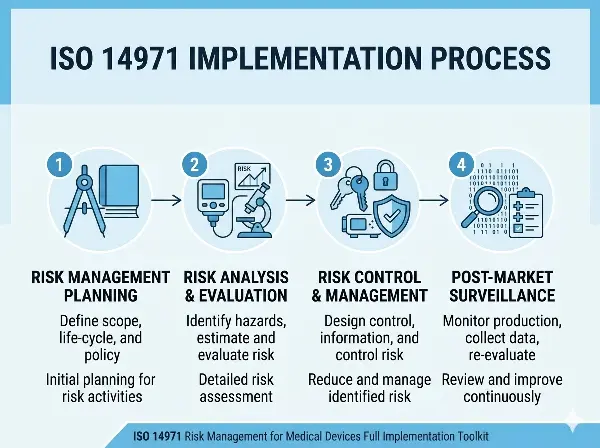
The ISO 14971 Medical Devices Risk Management Implementation Toolkits provide a comprehensive, Ready to use suite of premium templates and practical resources to help organizations establish, implement, maintain, and continually improve a robust risk management process for medical devices with greater consistency, traceability, and regulatory confidence.
Aligned with ISO 14971 requirements,this toolkit translates medical device risk management principles into actionable policies, procedures, plans, analyses, records, and monitoring tools enabling organizations to identify hazards, evaluate and control risks, strengthen product safety, support design and lifecycle decision making, and enhance audit and regulatory readiness across medical device operations.
Implementing risk management requirements aligned with ISO 14971 can be complex and time-consuming, especially for medical device organizations that must identify hazards, assess risks throughout the product life cycle, and maintain robust documentation to support safety, regulatory expectations, and design control activities.
The ISO 14971 Risk Management for Medical Devices Toolkit package provides a comprehensive set of easy to use templates, procedures, forms, registers, and practical implementation documents in Word and Excel formats, helping your organization standardize risk management documentation, strengthen control over product safety activities, and accelerate implementation with greater confidence, efficiency, and professional rigor.

Below is the complete list of documents included in the package. Click the index file button to review the full contents in spreadsheet format.
 Part 1. Risk Management Program Governance & Planning
Objective: To establish the governance model, scope, policy structure, risk management planning approach, intended use alignment, regulatory linkage, and leadership oversight required to launch and sustain a robust medical device risk management program across the product lifecycle.
 Risk Management Program Charter.docx Medical Device Risk Management Policy.docx Risk Management Procedure.docx Risk Management Plan Template.docx Intended Use & Safety Context Definition.docx Roles & Responsibilities for Risk Management.docx Risk Acceptability Policy Framework.docx Regulatory & Standards Mapping for Risk Management.docx
 Product Risk Management Master Register.xlsx Risk Management Team RACI Matrix.xlsx Applicable Regulatory Requirements Register.xlsx Risk Management Plan Tracker.xlsx
 Risk Management Program Kickoff Slides.pptx Executive Risk Governance Slides.pptx
Part 2. Intended Use, Safety Characteristics & Device Context
Objective: To define the medical device's intended use, reasonably foreseeable misuse, user profile, operating environment, essential performance, and safety-related characteristics that form the baseline for structured risk analysis and lifecycle risk evaluation.
Intended Use Statement Template.docx Reasonably Foreseeable Misuse Assessment.docx Device Safety Characteristics Checklist.docx User, Patient & Use Environment Profile.docx Essential Performance Definition.docx Interface & Operational Conditions Summary.docx Intended Use & Indications Register.xlsx Safety Characteristics Matrix.xlsx User Environment & Use Scenario Register.xlsx Foreseeable Misuse Log.xlsx Device Context Review Slides.pptx
Part 3. Hazard Identification & Hazard Analysis
Objective: To systematically identify hazards, sequences of events, hazardous situations, foreseeable causes, and potential harms associated with the medical device, including product design, usability, biological, electrical, software, labeling, and environmental dimensions.
Hazard Identification Procedure.docx Hazard Analysis Methodology.docx Preliminary Hazard Analysis Template.docx Sequence of Events Analysis Guide.docx Hazardous Situation Definition Guide.docx Harm Categorization Framework.docx Hazard Source Library for Medical Devices.docx Hazard Analysis Worksheet.xlsx Hazardous Situations Register.xlsx Sequence of Events Matrix.xlsx Harms Classification Register.xlsx Risk Source Reference Library.xlsx Hazard Analysis Workshop Slides.pptx
Part 4. Risk Estimation, Evaluation & Risk Acceptability
Objective: To provide the criteria, scoring logic, evaluation rules, and decision framework required to estimate risks, determine acceptability, support consistency in risk-based decisions, and document the rationale for further control action or acceptance.
Risk Estimation Methodology.docx Severity Ranking Criteria.docx Probability Estimation Guidance.docx Risk Evaluation & Acceptability Criteria.docx Risk Decision Rationale Template.docx Uncertainty & Assumption Documentation Guide.docx Risk Evaluation Matrix.xlsx Severity & Probability Scoring Table.xlsx Risk Acceptability Decision Log.xlsx Residual Risk Status Register.xlsx Risk Evaluation Review Slides.pptx
Part 5. Risk Control Measures & Implementation
Objective: To define, prioritize, implement, and document risk control measures in accordance with the established hierarchy, including inherent safety by design, protective measures, and information for safety, while maintaining traceability to identified risks and design outputs.
Risk Control Strategy.docx Risk Control Measure Specification.docx Inherent Safety by Design Guidance.docx Protective Measures Implementation Guide.docx Information for Safety Content Template.docx Residual Risk Communication Justification.docx Risk Control Verification Planning Template.docx Risk Control Measures Register.xlsx Risk Control Implementation Tracker.xlsx Labeling & IFU Risk Control Register.xlsx Design Change vs Risk Control Matrix.xlsx Risk Control Decision Slides.pptx
Part 6. Verification of Risk Controls & Residual Risk Review
Objective: To confirm that risk controls are effectively implemented, perform as intended, do not introduce unacceptable new risks, and support a documented review of individual and overall residual risks before product release.
Risk Control Verification Procedure.docx Verification Evidence Review Guide.docx New Hazard Introduction Assessment.docx Individual Residual Risk Review Template.docx Overall Residual Risk Evaluation Report.docx Benefit-Risk Analysis Template.docx Risk Management Review & Release Memo.docx Risk Control Verification Log.xlsx Residual Risk Assessment Register.xlsx Benefit-Risk Evaluation Tracker.xlsx Risk Review Approval Matrix.xlsx Residual Risk Review Slides.pptx
Part 7. Usability, Use Error & Human Factors Risk Toolkit
Objective: To address risks arising from user interaction, foreseeable use error, operating workflow, labeling comprehension, training assumptions, and human factors considerations that can lead to hazardous situations and patient or user harm.
Use-Related Risk Assessment Procedure.docx Use Scenario Analysis Template.docx Use Error Identification Guide.docx Labeling Comprehension Risk Review.docx Training Dependency Assessment.docx Use Error Hazard Log.xlsx User Interface Risk Register.xlsx Critical Task Analysis Worksheet.xlsx Human Factors Observation Log.xlsx Use-Related Risk Workshop Slides.pptx
Part 8. Software, Cybersecurity & Connected Device Risk Toolkit
Objective: To manage risk scenarios associated with software-controlled functions, embedded systems, network connectivity, cybersecurity threats, anomalous behavior, data integrity, and update-related changes that can affect medical device safety and performance.
Software Risk Management Procedure.docx Cybersecurity Risk Assessment Guidance.docx Software Failure Modes Analysis Template.docx Connected Device Threat Scenario Guide.docx Security Risk Control Planning Template.docx Software Change Impact Risk Review.docx Software Risk Register.xlsx Cybersecurity Hazard Log.xlsx Threat, Vulnerability & Harm Matrix.xlsx Security Control Verification Tracker.xlsx Software & Cyber Risk Review Slides.pptx
Part 9. Biological, Electrical, Mechanical & Environmental Risk Toolkit
Objective: To structure specialized risk evaluation for biological contact, electrical hazards, mechanical failure, thermal effects, contamination, packaging integrity, transport stress, storage conditions, and environmental exposure relevant to the device and its intended application.
Biological Risk Assessment Template.docx Electrical Safety Risk Review.docx Mechanical Failure Risk Analysis Template.docx Packaging & Sterile Barrier Risk Review.docx Transport & Storage Condition Risk Assessment.docx Environmental Exposure Risk Guide.docx Biological Hazard Register.xlsx Electrical & Mechanical Risk Log.xlsx Packaging Risk Control Tracker.xlsx Environmental Stress Risk Matrix.xlsx Specialized Safety Risk Review Slides.pptx
Part 10. Production, Process Change & Supplier-Related Risk Control
Objective: To extend risk management into manufacturing, supplier control, process validation, nonconforming product handling, change assessment, and outsourced activities so that production realities remain aligned with the approved risk management file.
Production Risk Management Procedure.docx Process Change Risk Assessment Template.docx Supplier Risk Evaluation Procedure.docx Nonconforming Product Risk Review.docx Manufacturing Process Hazard Review.docx Outsourced Process Risk Control Guide.docx Production Risk Monitoring Log.xlsx Supplier Risk Register.xlsx Process Change Assessment Tracker.xlsx Nonconformance Risk Escalation Log.xlsx Production Risk Control Slides.pptx
Part 11. Post-Market Surveillance, Feedback & Field Risk Review
Objective: To capture, analyze, and act upon production and post-production information including complaints, adverse events, service data, trend signals, literature findings, field actions, and real-world performance feedback that may affect ongoing risk acceptability.
Post-Production Information Procedure.docx Post-Market Risk Review Procedure.docx Complaint Trend Risk Escalation Guide.docx Field Safety Corrective Action Risk Review.docx Vigilance Signal Assessment Template.docx Real-World Feedback Integration Guide.docx Complaint & Adverse Event Risk Log.xlsx Post-Market Risk Trend Register.xlsx CAPA to Risk Linkage Matrix.xlsx Field Action Risk Assessment Tracker.xlsx Production & Post-Production Feedback Register.xlsx Post-Market Risk Review Slides.pptx
Part 12. Risk Management File, Traceability & Management Review
Objective: To maintain a complete, reviewable, and ready for implementation risk management file that preserves traceability from intended use and hazard analysis through controls, verification, residual risk decisions, and lifecycle feedback, with formal management review and controlled updates.
Risk Management File Index.docx Risk File Compilation Procedure.docx Traceability Matrix Guidance.docx Periodic Risk Management Review Procedure.docx Management Review Summary Template.docx Risk File Change Control Procedure.docx Risk Management Report Template.docx End-to-End Risk Traceability Matrix.xlsx Risk Management File Document Register.xlsx Review & Approval Log.xlsx Open Risk Actions Tracker.xlsx Lifecycle Risk Review Schedule.xlsx Risk Management File Overview Slides.pptx Management Review Presentation Slides.pptxUse these quick links to review the full file list and payment instructions.


| Date File Updated | 25/03/2025 |
| File Format | pdf, xls, doc, docx, xlsx, pptx |
| No. of files | 142 Files, 12 Folders |
| File download size | 32.81 MB (.rar) |
| Language |
 English
|
| Purchase code | ISO14971-Toolkits |
The ISO Toolkit has helped us structure our implementation work clearly. It gave our team practical templates, organized procedures, and a reliable starting point for building our management system documentation.
After using the ISO Toolkit, our ISO preparation became much more organized. The documents are professional, easy to adapt, and helpful for aligning internal teams around clear compliance requirements.
Our consultants and internal managers found the toolkit very practical. It saved time, improved documentation consistency, and gave us a better framework for ISO implementation across departments.
The toolkit provides a strong foundation for ISO best practices. It helped us organize policies, procedures, records, and improvement actions in a way that is simple to maintain.
The ISO Toolkit brought structure to our compliance documentation and reduced the workload for our implementation team. It allowed us to focus more on improving processes instead of starting documents from scratch.
The ISO Toolkit is practical, well arranged, and easy to customize. It helped replace scattered files with a more complete document set for managing our ISO implementation activities.
The toolkit is very straightforward to use. It gave our team a clear implementation path, helped define responsibilities, and made ISO documentation easier for non-specialists to understand.
The ISO Toolkit gave us a better understanding of management system requirements and provided a user-friendly way to improve processes, controls, and internal documentation.
The toolkit helped me organize our ISO training, document review, and implementation planning. It made the entire preparation process more focused and easier to communicate with the team.
Excellent ISO Toolkit. It is highly useful for managers, consultants, and implementation teams who need practical documents to support ISO certification readiness.
A very useful toolkit and one of the most practical document sets I have used. It provides clear templates that can be adapted quickly for different ISO implementation needs.
These ISO Toolkits increased my confidence in managing implementation work. They helped us prepare documentation, assign responsibilities, and move toward a more mature management system.