
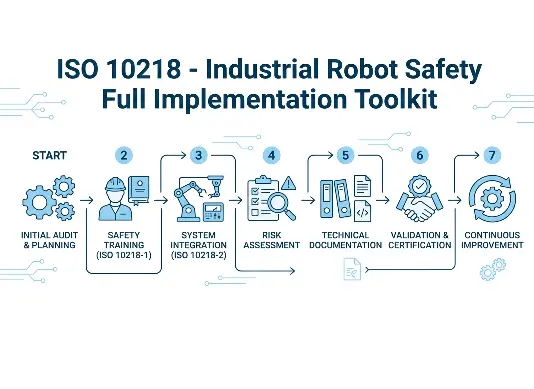
The ISO 10218 Industrial Robot Safety Implementation Toolkit provides a comprehensive, easy to use set of professional templates and practical guidance to help organizations design, integrate, operate, and maintain industrial robot systems with greater safety, control, and compliance confidence.
Aligned with the principles of ISO 10218, this toolkit translates complex robot safety expectations into actionable policies, procedures, checklists, registers, workbooks, slides, and tracking tools. It helps teams strengthen robot cell safety, standardize safeguarding practices, improve maintenance and intervention controls, support safer human-robot interaction, and maintain ready for implementation robot safety documentation.
Implementing industrial robot safety aligned with ISO 10218 can be complex and highly technical, especially for organizations that require structured risk assessments, safeguarding measures, safe robot cell integration, commissioning evidence, maintenance controls, and documented intervention practices across industrial automation environments.
The ISO 10218 Industrial Robot Safety Implementation Toolkit provides a comprehensive collection of easy to use templates and structured implementation documents in Word, Excel, and PowerPoint formats. It helps your organization standardize robot safety documentation, strengthen safeguarding controls, improve commissioning and validation discipline, support safer human-robot interaction, and enhance compliance confidence across robot applications and robot cells.

Below is the structured list of documents included in the package. Use the quick navigation or expand each part to review the files before downloading the index file.
 Part 1. Robot Safety Governance & Program Setup
Objective: To establish the governance structure, safety policy framework, scope, responsibilities, communication mechanisms, and implementation controls required to manage industrial robot safety systematically across robot systems and robot cells.
 Industrial Robot Safety Program Charter.docx Robot Safety Governance Framework.docx Robot Safety Policy (Master).docx Scope Definition for Robot Applications & Cells.docx Robot Safety Roles & Responsibilities.docx Safety Communication & Escalation Plan.docx Robot Safety Implementation Roadmap.docx
 Stakeholder Register.xlsx Robot Safety RACI Matrix.xlsx Governance Meeting Schedule.xlsx Robot Safety Budget Tracker.xlsx
 Robot Safety Program Kickoff Slides.pptx Executive Robot Safety Awareness Slides.pptx
Part 2. Hazard Identification & Risk Assessment
Objective: To provide the methodology, hazard libraries, assessment criteria, and analysis tools needed to identify hazardous situations, evaluate risk, and define suitable risk reduction measures for industrial robots and robot cells.
Robot Hazard Identification Procedure.docx Robot Risk Assessment Methodology.docx Hazardous Situation Reference Guide.docx Risk Evaluation Criteria.docx Risk Reduction Planning Template.docx Robot Task-Based Risk Review Guide.docx Robot Risk Assessment Register.xlsx Hazard Analysis Worksheet.xlsx Risk Reduction Action Plan.xlsx Hazard Tracking Matrix.xlsx Robot Risk Assessment Workshop Slides.pptx Risk Review Reporting Slides.pptx
Part 3. Safeguarding Design & Protective Measures
Objective: To define the safeguarding strategy, protective devices, safety distances, interlocking arrangements, emergency functions, and complementary protective measures required to reduce robot-related risks effectively.
Safeguarding Design Standard.docx Protective Measures Selection Guide.docx Emergency Stop & Protective Stop Procedure.docx Interlock & Guarding Specification.docx Perimeter Protection Design Guide.docx Safe Access & Intervention Control Procedure.docx Safeguarding Register.xlsx Guarding Inspection Checklist.xlsx Protective Device Verification Log.xlsx Safety Distance Review Worksheet.xlsx Safeguarding Design Review Slides.pptx
Part 4. Robot Cell Integration, Installation & Commissioning
Objective: To provide the integration controls, installation requirements, commissioning records, and acceptance activities needed to bring industrial robot applications and robot cells into safe operational service.
Robot Cell Integration Procedure.docx Installation Safety Requirements.docx Commissioning Safety Verification Plan.docx Integrated System Acceptance Checklist.docx End Effector Safety Review Template.docx Integration Change Control Procedure.docx Commissioning Tracker.xlsx Installation Inspection Log.xlsx Acceptance Test Record.xlsx Integration Issue Log.xlsx Robot Cell Commissioning Slides.pptx
Part 5. Safe Operation, Supervision & Routine Use
Objective: To establish the operating procedures, supervision rules, authorized access controls, and routine safety checks needed for the safe day-to-day use of industrial robots and robot cells.
Safe Operating Procedure for Industrial Robots.docx Operator Safety Rules.docx Start-Up, Shutdown & Restart Procedure.docx Authorized Access Protocol.docx Routine Safety Check Instructions.docx Abnormal Condition Response Guide.docx Daily Safety Check Log.xlsx Operator Authorization Register.xlsx Start-Up Verification Checklist.xlsx Routine Operation Inspection Log.xlsx Robot Operation Safety Slides.pptx
Part 6. Maintenance, Intervention & Lockout Controls
Objective: To define safe maintenance practices, energy isolation requirements, intervention controls, teach-mode precautions, and restart authorization steps for work performed inside or around robot cells.
Robot Maintenance Safety Procedure.docx Lockout/Tagout Procedure for Robot Systems.docx Intervention Access Control Procedure.docx Teach Pendant Safe Use Guide.docx Controlled Restart Authorization Procedure.docx Maintenance Hazard Review Template.docx LOTO Register.xlsx Maintenance Activity Log.xlsx Intervention Permit Tracker.xlsx Restart Approval Log.xlsx Maintenance Safety Awareness Slides.pptx
Part 7. Human-Robot Interaction & Collaborative Safety Controls
Objective: To provide the controls, review tools, and interaction safeguards needed where persons can be exposed to robot movement, including collaborative operating modes and controlled shared workspaces where applicable.
Human-Robot Interaction Safety Guide.docx Collaborative Operation Review Template.docx Shared Workspace Safety Procedure.docx Manual Load/Unload Safety Checklist.docx Interaction Zone Definition Guide.docx Operator Proximity Risk Review.docx Human-Robot Interaction Assessment.xlsx Shared Workspace Register.xlsx Collaborative Safety Review Log.xlsx Interaction Zone Monitoring Tracker.xlsx Human-Robot Safety Review Slides.pptx
Part 8. Validation, Verification & Safety Testing
Objective: To define the validation, functional testing, verification activities, and acceptance evidence required to demonstrate that safety measures for robot systems and robot cells have been correctly implemented and remain effective.
Safety Validation Procedure.docx Functional Safety Test Plan.docx Verification Sampling Guide.docx Acceptance Test Protocol.docx Safety Performance Review Template.docx Revalidation Trigger Criteria.docx Validation Checklist.xlsx Functional Test Record.xlsx Verification Log.xlsx Revalidation Tracker.xlsx Safety Validation Slides.pptx
Part 9. Incident Response, Change Control & Continuous Improvement
Objective: To support incident reporting, root cause analysis, engineering change control, corrective action, and continual improvement of robot safety performance throughout the lifecycle of the application.
Robot Safety Incident Response Procedure.docx Root Cause Analysis Template.docx Engineering Change Control Procedure.docx Corrective Action Procedure.docx Continuous Improvement Plan.docx Incident Register.xlsx Corrective Action Tracker.xlsx Change Control Log.xlsx Improvement Opportunity Register.xlsx Safety Performance Dashboard.xlsx Safety Improvement Review Slides.pptx
Part 10. Documentation, Records & Compliance Evidence
Objective: To define the document control practices, recordkeeping requirements, evidence structures, and retention arrangements necessary to maintain complete, traceable, and ready for implementation industrial robot safety documentation.
Document Control Procedure.docx Record Retention & Disposal Policy.docx Compliance Evidence Collection Guide.docx Technical File Structure Template.docx Restricted Access Record Protocol.docx Document Register.xlsx Evidence Collection Register.xlsx Version Control Log.xlsx Safety File Archive Index.xlsx Access Audit Log.xlsx Documentation Control Awareness Slides.pptxUse these quick links to review the full file list and payment instructions.


| Date File Updated | 25/03/2025 |
| File Format | pdf, xls, doc, docx, xlsx, pptx |
| No. of files | 113 Files, 10 Folders |
| File download size | 28.80 MB (.rar) |
| Language |
 English
|
| Purchase code | ISO10218-Toolkits |
The ISO Toolkit has helped us structure our implementation work clearly. It gave our team practical templates, organized procedures, and a reliable starting point for building our management system documentation.
After using the ISO Toolkit, our ISO preparation became much more organized. The documents are professional, easy to adapt, and helpful for aligning internal teams around clear compliance requirements.
Our consultants and internal managers found the toolkit very practical. It saved time, improved documentation consistency, and gave us a better framework for ISO implementation across departments.
The toolkit provides a strong foundation for ISO best practices. It helped us organize policies, procedures, records, and improvement actions in a way that is simple to maintain.
The ISO Toolkit brought structure to our compliance documentation and reduced the workload for our implementation team. It allowed us to focus more on improving processes instead of starting documents from scratch.
The ISO Toolkit is practical, well arranged, and easy to customize. It helped replace scattered files with a more complete document set for managing our ISO implementation activities.
The toolkit is very straightforward to use. It gave our team a clear implementation path, helped define responsibilities, and made ISO documentation easier for non-specialists to understand.
The ISO Toolkit gave us a better understanding of management system requirements and provided a user-friendly way to improve processes, controls, and internal documentation.
The toolkit helped me organize our ISO training, document review, and implementation planning. It made the entire preparation process more focused and easier to communicate with the team.
Excellent ISO Toolkit. It is highly useful for managers, consultants, and implementation teams who need practical documents to support ISO certification readiness.
A very useful toolkit and one of the most practical document sets I have used. It provides clear templates that can be adapted quickly for different ISO implementation needs.
These ISO Toolkits increased my confidence in managing implementation work. They helped us prepare documentation, assign responsibilities, and move toward a more mature management system.