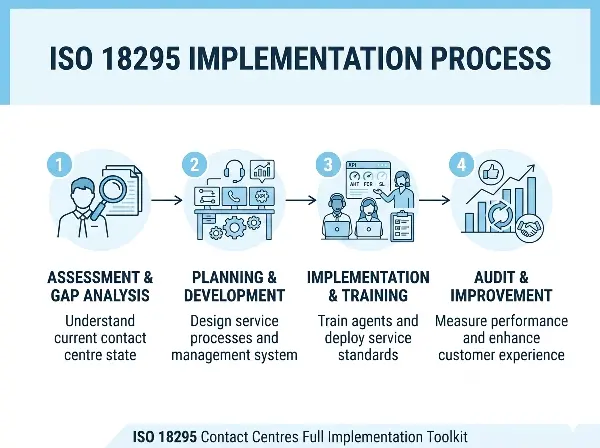
The ISO 18295 Contact Centres Implementation Full Package Toolkits provide a comprehensive, Ready to use suite of professional templates, implementation documents, and practical working tools to help organizations establish, operate, monitor, and continually improve customer contact centre processes in a structured and effective manner.
Developed in alignment with ISO 18295 best practices for customer contact centres,this toolkit converts service requirements into actionable procedures, performance controls, governance documents, and operational records that enable organizations to strengthen service quality, improve customer experience, standardize service delivery, and enhance management control with confidence and audit readiness.
Implementing a professional contact centre management system aligned with ISO 18295 can be challenging and requires significant resources, particularly for organizations that need consistent service quality, structured processes, and well-documented customer interaction controls.
The ISO 18295 Contact Centres Full Implementation Toolkit provides a comprehensive set of easy to use templates, procedures, forms, and operational records in Word and Excel formats to help you establish service consistency, strengthen customer experience governance, standardize contact centre documentation, and accelerate implementation with greater confidence and efficiency.

Below is the complete list of documents included in the package. Click the index file button to review the full contents in spreadsheet format.
 Part 1. Contact Centre Governance & Service Strategy
Objective: To establish the governance model, service vision, operating scope, customer service commitments, leadership accountability, channel strategy, and implementation direction required to launch and control the ISO 18295 contact centre program with executive discipline.
 Contact Centre Program Charter.docx Contact Centre Governance Framework.docx Service Strategy & Operating Model.docx Customer Contact Scope Definition.docx Customer Service Policy (Master).docx Service Commitments & Objectives Definition.docx Multichannel Service Delivery Principles.docx Contact Centre Roles & Responsibilities.docx Client Governance Requirements Framework.docx ISO 18295 Implementation Roadmap.docx
 Stakeholder Register.xlsx Governance RACI Matrix.xlsx Service Objectives & KPI Register.xlsx Channel Scope Register.xlsx Governance Meeting Schedule.xlsx Program Budget Tracker.xlsx
 Contact Centre Program Kickoff Slides.pptx Executive Alignment Slides.pptx
Part 2. Customer Experience Design & Journey Management
Objective: To define how customer journeys, contact reasons, service expectations, accessibility, response standards, and experience design principles are translated into a consistent and measurable service model across all customer contact channels.
Customer Experience Policy.docx Customer Journey Mapping Methodology.docx Contact Reason Taxonomy Standard.docx Service Accessibility & Inclusion Guidelines.docx Omnichannel Experience Design Procedure.docx Customer Communication Tone & Language Guide.docx Service Level Commitment Framework.docx Customer Journey Register.xlsx Contact Reason Analysis Register.xlsx Service Standards Matrix.xlsx Channel Experience Scorecard.xlsx Customer Pain Point Log.xlsx Customer Journey Design Workshop Slides.pptx Service Experience Blueprint Slides.pptx
Part 3. Contact Centre Operations Management
Objective: To establish the operational policies, procedures, schedules, workflow controls, escalation paths, and service execution disciplines required to run the contact centre efficiently and consistently on a day-to-day basis.
Contact Centre Operations Policy.docx Operational Control Procedure.docx Contact Handling Procedure.docx Escalation Management Procedure.docx Queue Management & Prioritization Rules.docx Call/Email/Chat Handling Standards.docx Business Hours & Coverage Model.docx Daily Operations Checklist.xlsx Shift Handover Log.xlsx Escalation Register.xlsx Contact Volume Tracker.xlsx Service Disruption Log.xlsx Operations Management Overview Slides.pptx Team Leader Operations Slides.pptx
Part 4. Workforce Planning, Competence & Scheduling
Objective: To ensure the contact centre is adequately staffed, competently resourced, and operationally prepared through structured workforce planning, role profiling, training control, scheduling methods, and performance support arrangements.
Workforce Planning Policy.docx Resource Capacity Planning Methodology.docx Competency Framework for Contact Centre Roles.docx Recruitment & Onboarding Procedure.docx Training & Certification Procedure.docx Scheduling & Adherence Management Procedure.docx Knowledge Readiness Requirements.docx Workforce Capacity Plan.xlsx Competency Matrix.xlsx Training Attendance Register.xlsx Shift Schedule Planner.xlsx Schedule Adherence Tracker.xlsx Agent Certification Log.xlsx Workforce Planning Slides.pptx Agent Induction Slides.pptx
Part 5. Customer Interaction Handling & Service Delivery Controls
Objective: To standardize how customer interactions are received, authenticated, processed, resolved, documented, and followed up so that service delivery remains reliable, respectful, compliant, and aligned with defined customer expectations.
Customer Interaction Handling Policy.docx Voice Interaction Standard.docx Email & Written Response Standard.docx Chat & Digital Messaging Standard.docx Customer Verification Procedure.docx First Contact Resolution Guidelines.docx Vulnerable Customer Handling Procedure.docx Interaction Quality Checklist.xlsx Resolution Tracking Log.xlsx Repeat Contact Analysis.xlsx Authentication Exception Log.xlsx Follow-Up Commitment Tracker.xlsx Customer Handling Standards Slides.pptx Service Excellence Coaching Slides.pptx
Part 6. Quality Monitoring, Coaching & Service Assurance
Objective: To define the quality assurance framework, evaluation criteria, review mechanisms, calibration methods, coaching disciplines, and service assurance records necessary to monitor and improve contact quality and service consistency.
Quality Monitoring Policy.docx Quality Assurance Framework.docx Interaction Evaluation Procedure.docx Evaluator Calibration Procedure.docx Coaching & Feedback Procedure.docx Quality Improvement Action Protocol.docx Quality Monitoring Scorecard.xlsx Calibration Log.xlsx Coaching Session Register.xlsx Agent Quality Trend Dashboard.xlsx Service Assurance Findings Log.xlsx Quality Monitoring Framework Slides.pptx Coaching for Performance Slides.pptx
Part 7. Complaint Handling & Service Recovery
Objective: To establish a controlled approach for receiving, classifying, investigating, resolving, escalating, and learning from complaints while protecting fairness, timeliness, transparency, and customer trust.
Complaint Handling Policy.docx Complaint Management Procedure.docx Complaint Classification & Severity Matrix.docx Service Recovery Procedure.docx Customer Redress & Resolution Guidelines.docx Escalated Complaint Review Procedure.docx Root Cause & Preventive Action Template.docx Complaint Register.xlsx Complaint Aging Tracker.xlsx Service Recovery Log.xlsx Complaint Root Cause Analysis.xlsx Corrective Action Tracker.xlsx Complaint Handling Awareness Slides.pptx Service Recovery Leadership Slides.pptx
Part 8. Knowledge Management & Information Control
Objective: To ensure agents and service teams operate with accurate, current, approved, and accessible information through structured knowledge ownership, content review, version control, and information publication practices.
Knowledge Management Policy.docx Knowledge Base Governance Procedure.docx Content Authoring & Approval Standard.docx Script Management & Review Procedure.docx FAQ & Resolution Article Structure Guide.docx Controlled Information Publication Rules.docx Knowledge Article Register.xlsx Script Review Log.xlsx Knowledge Gap Tracker.xlsx Content Approval Matrix.xlsx Knowledge Usage Analytics.xlsx Knowledge Management Overview Slides.pptx Script Governance Slides.pptx
Part 9. Technology, Channel Platforms & Data Protection
Objective: To define the control environment for contact centre platforms, telephony, CRM, recording systems, chat tools, data protection, access rights, and service continuity enablers that support secure and dependable service delivery.
Contact Centre Technology Policy.docx Channel Platform Control Standard.docx Call Recording & Retention Procedure.docx Customer Data Protection Procedure.docx System Access & User Administration Procedure.docx Business Continuity Requirements for CCC Platforms.docx Screen Recording & Monitoring Notice Template.docx Contact Centre Application Register.xlsx Recording Retention Schedule.xlsx Access Rights Register.xlsx Platform Incident Log.xlsx Channel Availability Dashboard.xlsx Contact Centre Technology Controls Slides.pptx Data Protection for CCC Teams Slides.pptx
Part 10. Client Management & Outsourced Contact Centre Control
Objective: To define the governance, contracting, oversight, reporting, and performance control arrangements needed when services are delivered for clients or when organizations rely on outsourced contact centre providers.
Client Governance Policy.docx Outsourced Contact Centre Oversight Procedure.docx Client Service Agreement Requirements.docx Statement of Work Control Template.docx Client Communication & Escalation Protocol.docx Third-Party Performance Review Procedure.docx Transition & Service Change Management Procedure.docx Client Register.xlsx Contractual Obligation Matrix.xlsx Client SLA Tracker.xlsx Governance Review Minutes Log.xlsx Service Change Request Register.xlsx Client Governance Review Slides.pptx Outsourcing Control Overview Slides.pptx
Part 11. KPI Reporting, Performance Analytics & Management Review
Objective: To provide the metrics framework, dashboard structures, trend reporting, review routines, and management oversight tools required to monitor service effectiveness, operational efficiency, customer outcomes, and improvement priorities.
Performance Measurement Policy.docx Contact Centre KPI Framework.docx Reporting & Data Validation Procedure.docx Management Review Procedure.docx Customer Satisfaction Measurement Methodology.docx Service Improvement Prioritization Rules.docx KPI Register.xlsx Monthly Performance Dashboard.xlsx SLA & Response Time Tracker.xlsx Customer Satisfaction Analysis.xlsx Complaint Trend Report.xlsx Action Tracking Dashboard.xlsx Monthly KPI Review Slides.pptx Executive Performance Review Slides.pptx
Part 12. Compliance, Internal Audit & Continual Improvement
Objective: To support ongoing conformity with ISO 18295 requirements through structured audit planning, evidence management, nonconformity control, corrective action tracking, service maturity review, and continual improvement governance.
ISO 18295 Compliance Policy.docx Internal Audit Procedure.docx Audit Report Template.docx Nonconformity & Corrective Action Procedure.docx Continual Improvement Framework.docx Document & Evidence Control Procedure.docx ISO 18295 Compliance Register.xlsx Internal Audit Plan.xlsx Audit Checklist.xlsx Nonconformity Register.xlsx Corrective Action Tracker.xlsx Improvement Roadmap.xlsx Document Version Control Register.xlsx ISO 18295 Internal Audit Slides.pptx Continual Improvement Review Slides.pptxUse these quick links to review the full file list and payment instructions.


| Date File Updated | 25/03/2025 |
| File Format | pdf, xls, doc, docx, xlsx, pptx |
| No. of files | 172 Files, 12 Folders |
| File download size | 37.76 MB (.rar) |
| Language |
 English
|
| Purchase code | ISO18295-Toolkits |
The ISO Toolkit has helped us structure our implementation work clearly. It gave our team practical templates, organized procedures, and a reliable starting point for building our management system documentation.
After using the ISO Toolkit, our ISO preparation became much more organized. The documents are professional, easy to adapt, and helpful for aligning internal teams around clear compliance requirements.
Our consultants and internal managers found the toolkit very practical. It saved time, improved documentation consistency, and gave us a better framework for ISO implementation across departments.
The toolkit provides a strong foundation for ISO best practices. It helped us organize policies, procedures, records, and improvement actions in a way that is simple to maintain.
The ISO Toolkit brought structure to our compliance documentation and reduced the workload for our implementation team. It allowed us to focus more on improving processes instead of starting documents from scratch.
The ISO Toolkit is practical, well arranged, and easy to customize. It helped replace scattered files with a more complete document set for managing our ISO implementation activities.
The toolkit is very straightforward to use. It gave our team a clear implementation path, helped define responsibilities, and made ISO documentation easier for non-specialists to understand.
The ISO Toolkit gave us a better understanding of management system requirements and provided a user-friendly way to improve processes, controls, and internal documentation.
The toolkit helped me organize our ISO training, document review, and implementation planning. It made the entire preparation process more focused and easier to communicate with the team.
Excellent ISO Toolkit. It is highly useful for managers, consultants, and implementation teams who need practical documents to support ISO certification readiness.
A very useful toolkit and one of the most practical document sets I have used. It provides clear templates that can be adapted quickly for different ISO implementation needs.
These ISO Toolkits increased my confidence in managing implementation work. They helped us prepare documentation, assign responsibilities, and move toward a more mature management system.