
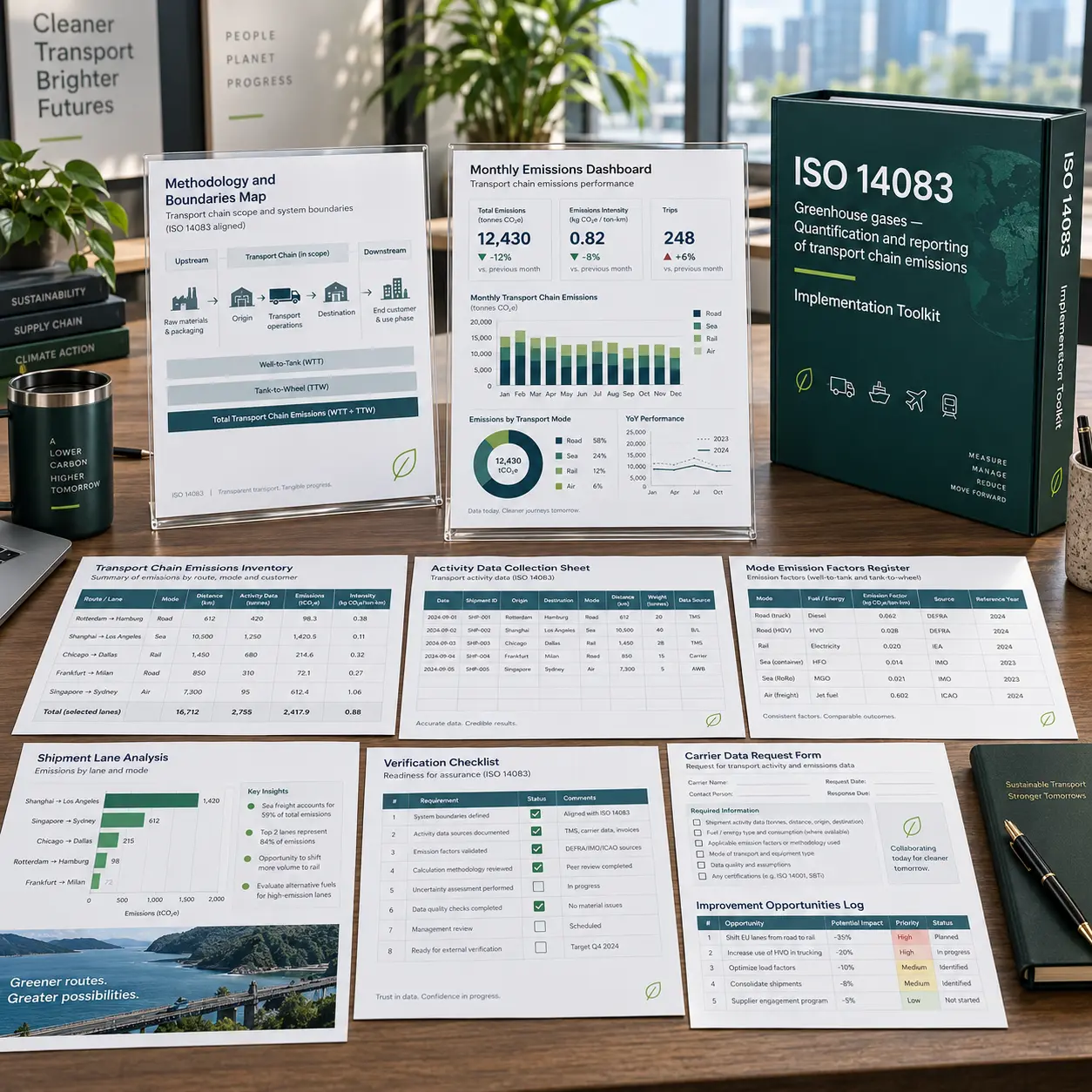
The ISO 14083:2023 Transport Chain GHG Emissions Implementation Toolkit provides a structured set of practical templates, calculation workbooks, registers, checklists, and reporting resources to help organizations quantify and report greenhouse gas emissions arising from transport chain operations.
Aligned with ISO 14083:2023, the toolkit supports transport chain mapping, reporting boundaries, activity and energy data collection, emission factor management, transport operation category calculations, transport chain element allocation, hub and transfer emissions, multimodal aggregation, data quality controls, reporting, assurance readiness, periodic review, and continual improvement.
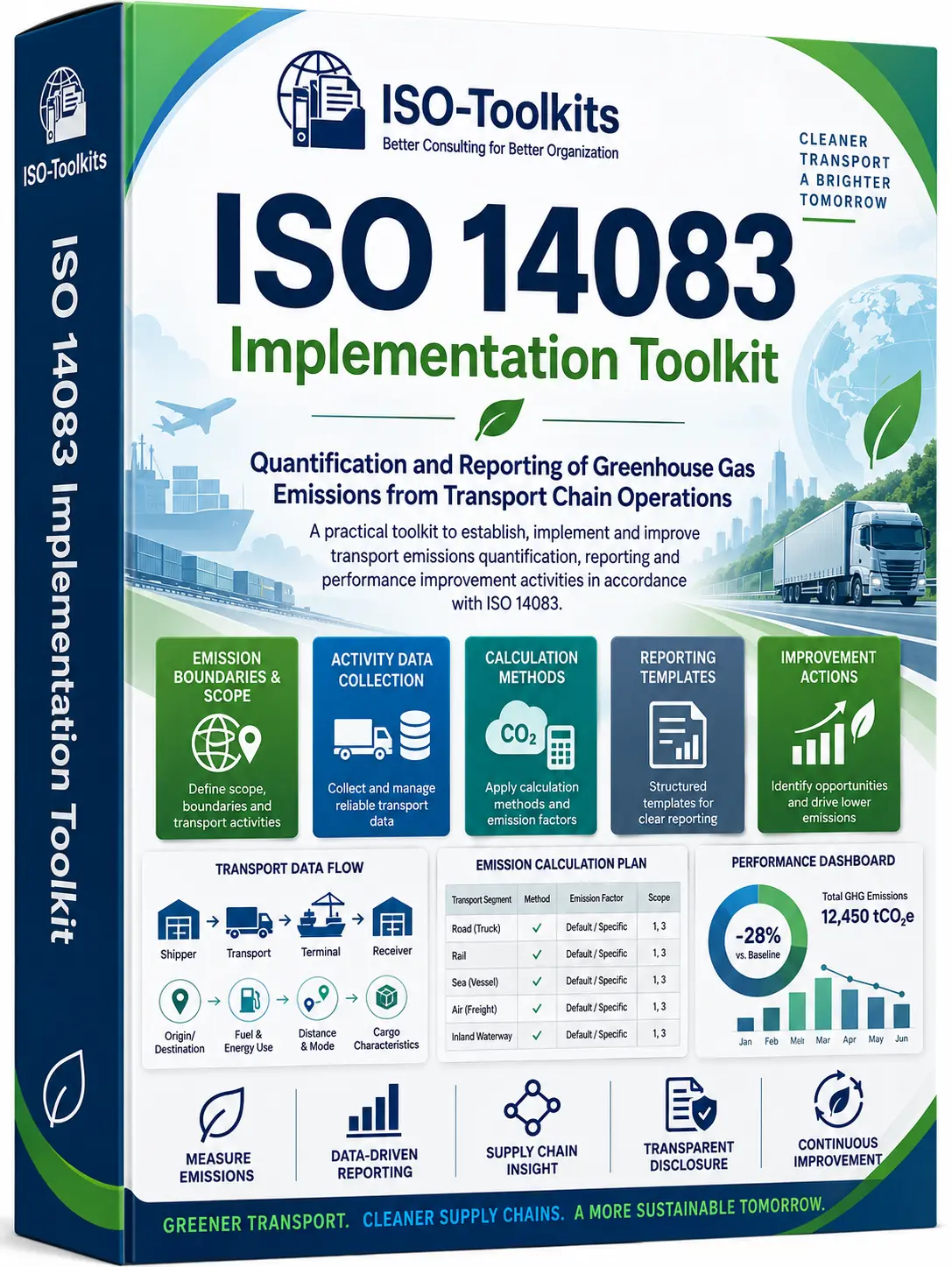
Quantifying greenhouse gas emissions across transport chains can be demanding because organizations must define reporting boundaries, collect and reconcile transport activity and energy data, select appropriate emission factors, apply allocation methods, aggregate multimodal results, and retain a transparent evidence trail.
The ISO 14083:2023 Transport Chain GHG Emissions Implementation Toolkit provides a comprehensive collection of editable templates, registers, calculation workbooks, review checklists, and reporting documents in Word, Excel, and PowerPoint formats. It helps your organization establish a repeatable transport GHG accounting process, improve data quality, standardize calculation controls, support reporting and disclosure, and strengthen assurance readiness.

Below is the structured list of documents included in the package. Use the quick navigation or expand each part to review the files before downloading the index file.
 Part 1. Program Initiation & ISO 14083 Applicability
 ISO 14083 Implementation Charter.docx
 Transport GHG Accounting Applicability Assessment.xlsx Transport Operations Scope Register.xlsx Current Transport Emissions Accounting Assessment.xlsx Existing Data & Methodology Review.xlsx ISO 14083 Gap & Improvement Action Plan.xlsx Implementation Roadmap.xlsx Transport GHG Roles & RACI Matrix.xlsx
 Project Kick-off Slide.pptx
Part 2. Reporting Objective, Boundaries & Transport Chain Mapping
Transport GHG Reporting Objective Template.docx Transport Chain Boundary Definition Worksheet.xlsx Passenger & Freight Applicability Matrix.xlsx Transport Chain Mapping Workbook.xlsx Transport Chain Element Register.xlsx Transport Mode & Service Register.xlsx Transport Hub Register.xlsx Origin Destination & Route Register.xlsx Included Excluded Operations Matrix.xlsx Reporting Period & Organizational Boundary Register.xlsx Boundary Assumptions & Limitations Register.xlsx Scope & Boundary Approval Record.docx
Part 3. Quantification Methodology & Data Governance
ISO 14083 Quantification Methodology.docx Transport GHG Calculation Method Selection Matrix.xlsx Data Source Hierarchy & Preference Matrix.xlsx Primary Secondary & Default Data Register.xlsx Transport Activity Data Requirements Matrix.xlsx Data Owner & Responsibility Matrix.xlsx Data Collection Plan.xlsx Data Evidence & Source Register.xlsx Calculation Assumptions Register.xlsx Methodological Deviation Register.xlsx GHG Calculation Control Checklist.xlsx
Part 4. Transport Activity, Energy & Fuel Data Collection
Transport Activity Data Collection Workbook.xlsx Freight Mass & Distance Data Template.xlsx Passenger & Distance Data Template.xlsx Vehicle Vessel Aircraft & Train Activity Register.xlsx Fuel Consumption Data Template.xlsx Electricity Consumption Data Template.xlsx Energy Carrier Consumption Register.xlsx Trip Journey & Leg Activity Register.xlsx Load Factor & Capacity Utilization Workbook.xlsx Empty Running & Repositioning Activity Register.xlsx Distance Determination Workbook.xlsx Data Completeness & Reconciliation Checklist.xlsx
Part 5. Emission Factors & Energy Carrier Parameters
Emission Factor Management Procedure.docx GHG Emission Factor Register.xlsx Energy Carrier Emission Factor Register.xlsx Fuel & Energy Specification Register.xlsx Emission Factor Source & Version Register.xlsx Well-to-Tank Emission Factor Register.xlsx Tank-to-Wheel / Vehicle Operation Emission Factor Register.xlsx Electricity Emission Factor Register.xlsx Default Value Applicability Assessment.xlsx Emission Factor Selection & Approval Checklist.xlsx Emission Factor Update Tracker.xlsx
Part 6. Transport Operation Category Quantification
Transport Operation Category Definition Workbook.xlsx Transport Operation Category Register.xlsx TOC Activity Consolidation Workbook.xlsx TOC Energy Consumption Calculation.xlsx TOC GHG Emissions Calculation Workbook.xlsx TOC Transport Activity Calculation.xlsx TOC GHG Emission Intensity Workbook.xlsx TOC Load Factor & Utilization Assessment.xlsx TOC Empty Trip Allocation Assessment.xlsx TOC Data Quality Assessment.xlsx TOC Calculation Review Checklist.xlsx TOC Results Approval Record.docx
Part 7. Transport Chain Element Quantification & Allocation
Transport Chain Element Quantification Workbook.xlsx TCE Activity Data Worksheet.xlsx TCE Emissions Assignment Workbook.xlsx TCE Allocation Method Selection Matrix.xlsx Freight Allocation Workbook.xlsx Passenger Allocation Workbook.xlsx Shared Capacity Allocation Workbook.xlsx Multi-Customer Shipment Allocation Workbook.xlsx TCE Distance & Activity Validation.xlsx TCE Emission Intensity Application Workbook.xlsx TCE Results Register.xlsx TCE Quantification Review Checklist.xlsx
Part 8. Transport Hub & Transfer Operation Emissions
Transport Hub Emissions Data Collection Workbook.xlsx Hub Energy Consumption Register.xlsx Hub Equipment & Fuel Consumption Register.xlsx Hub Electricity Consumption Register.xlsx Hub Throughput Activity Data Workbook.xlsx Hub GHG Emissions Calculation Workbook.xlsx Hub Emission Intensity Calculation.xlsx Hub Emissions Allocation Workbook.xlsx Transfer & Transshipment Activity Register.xlsx Hub Data Quality Assessment.xlsx Hub Calculation Review Checklist.xlsx
Part 9. Multimodal Transport Chain Aggregation
Multimodal Transport Chain Calculation Workbook.xlsx Transport Chain Element Aggregation Register.xlsx End-to-End Freight Emissions Calculation.xlsx End-to-End Passenger Emissions Calculation.xlsx Intermodal Transfer Emissions Workbook.xlsx Transport Chain GHG Emission Intensity Workbook.xlsx Shipment Consignment Emissions Statement Workbook.xlsx Journey Passenger Emissions Statement Workbook.xlsx Transport Service Emissions Summary.xlsx Chain Calculation Reconciliation Checklist.xlsx Transport Chain Results Approval Record.docx
Part 10. Data Quality, Uncertainty & Calculation Controls
Transport GHG Data Quality Framework.docx Data Quality Assessment Matrix.xlsx Data Completeness Assessment.xlsx Data Representativeness Assessment.xlsx Primary vs Secondary Data Quality Review.xlsx Data Gap & Estimation Register.xlsx Uncertainty & Sensitivity Assessment.xlsx Calculation Validation Checklist.xlsx Calculation Reperformance Workbook.xlsx Data Exception & Correction Register.xlsx GHG Results Consistency Review.xlsx Quality Control Review Record.docx
Part 11. GHG Reporting, Disclosure & Assurance Readiness
ISO 14083 Transport GHG Report Template.docx Transport GHG Statement Template.docx Methodology & Boundary Disclosure Checklist.xlsx Data Sources & Emission Factors Disclosure Register.xlsx Allocation Method Disclosure Register.xlsx Assumptions Limitations & Exclusions Register.xlsx Transport Chain Results Reporting Workbook.xlsx Customer Transport Emissions Report Template.docx Internal Management Reporting Dashboard.xlsx GHG Reporting Review Checklist.xlsx Evidence & Audit Trail Index.xlsx Independent Review / Verification Readiness Checklist.xlsx Transport GHG Results Presentation Slide.pptx
Part 12. Periodic Review, Update, Improvement & Handover
ISO 14083 Methodology Review Checklist.xlsx Transport Emissions Data Review Calendar.xlsx Emission Factor Update Review.xlsx Transport Chain Change Impact Assessment.xlsx Methodology Change Request Form.docx Calculation Model Version & Change Log.xlsx Transport GHG Improvement Opportunities Register.xlsx Data Quality Improvement Plan.xlsx Annual Transport GHG Performance Review.xlsx Transport GHG Lessons Learned Register.xlsx Operational Handover Checklist.xlsx Consultant Handover Checklist.xlsx Final Implementation Report.docx Final Executive Handover Slide.pptxUse these quick links to review the full file list and payment instructions.


| Date File Updated | 25/03/2025 |
| File Format | pdf, xls, doc, docx, xlsx, pptx |
| No. of files | 140 File; 12 Folders |
| File download size | 9.06 MB (rar). |
| Language |
 English
|
| Purchase code | ISO14083-Toolkits |
The transport activity data templates gave our team a clear structure for collecting fuel, distance, load and route information from different operating units.
The ISO 14083 toolkit is practical for consulting work. The boundary worksheets and methodology registers make client workshops much easier to organize.
We used the multimodal calculation files to consolidate road and ocean freight emissions. The structure made our monthly reporting process more consistent.
The hub and transfer operation templates were especially useful because our logistics network includes terminals, warehousing and transshipment activities.
The emission factor registers helped us control source references and version changes instead of keeping assumptions across separate spreadsheets.
I found the allocation workbooks and chain element registers easy to adapt to customer shipments and shared transport capacity.
The data quality matrices highlighted gaps in our carrier data and helped us prioritize where primary data collection should be improved.
The reporting templates are clear and professional. We were able to connect calculation evidence, assumptions and final transport emissions statements in one structure.
The toolkit reduced the amount of time we spent designing calculation controls. The review checklists are useful for internal quality checks.
We adapted the methodology and transport chain mapping files for several business units without changing the overall document structure.
The assurance-readiness checklist and evidence index helped us prepare a much cleaner audit trail for internal verification.
The periodic review and handover documents are a strong addition. They make the toolkit useful beyond the first calculation cycle.