
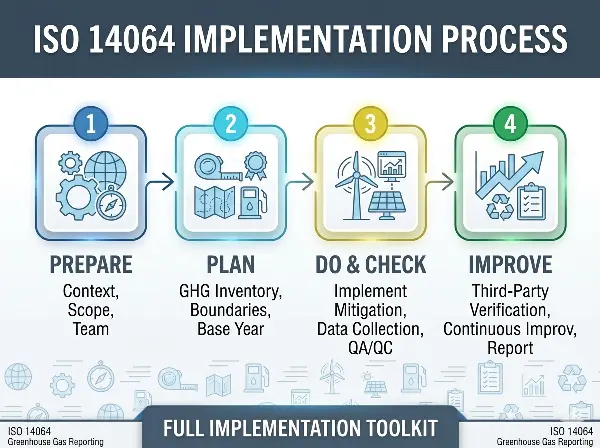
The ISO 14064 Greenhouse Gases Quantification, Reporting and Verification Implementation Toolkits provide a comprehensive, easy to use suite of premium templates and practical resources to help organizations establish, implement, manage, and improve greenhouse gas quantification, reporting, and verification activities with greater consistency, credibility, and operational confidence.
Aligned with ISO 14064 requirements and guidance, this toolkit translates greenhouse gas management principles into actionable policies, procedures, inventories, calculation workbooks, reporting formats, and tracking tools enabling organizations to strengthen emissions data integrity, support climate-related disclosures, enhance verification readiness, and advance environmental accountability across enterprise operations and value chains.
Implementing greenhouse gas management requirements aligned with ISO 14064 can be complex and time-consuming, especially for organizations seeking to establish credible emissions quantification, strengthen climate-related reporting, and maintain consistent documentation across operational boundaries.
The ISO 14064 Greenhouse Gases Toolkits package provides a comprehensive set of easy to use templates, procedures, registers, calculation support documents, and practical implementation files in Word and Excel formats, helping your organization standardize greenhouse gas documentation, improve reporting consistency, and accelerate implementation with greater confidence, efficiency, and professional rigor.

Below is the complete list of documents included in the package. Click the index file button to review the full contents in spreadsheet format.
 Part 1. GHG Program Initiation & Governance Setup
Objective: To establish the governance structure, implementation scope, organizational boundaries, reporting intent, stakeholder responsibilities, strategic objectives, and executive oversight required to launch and control the ISO 14064 greenhouse gas management program effectively.
 GHG Program Charter.docx GHG Governance Framework.docx Organizational & Operational Boundary Definition.docx GHG Accounting Policy.docx GHG Objectives, Targets & Commitments.docx Roles & Responsibilities for GHG Management.docx GHG Communication & Reporting Plan.docx Applicable GHG Program & Regulatory Mapping.docx ISO 14064 Implementation Roadmap.docx
 GHG Stakeholder Register.xlsx GHG RACI Matrix.xlsx GHG Objectives & KPI Register.xlsx GHG Compliance Obligations Register.xlsx Governance Meeting Schedule.xlsx GHG Program Budget Tracker.xlsx
 GHG Program Kickoff Slides.pptx Executive Climate Accountability Slides.pptx
Part 2. GHG Inventory Framework & Emission Source Mapping
Objective: To define how greenhouse gas sources, sinks, reservoirs, emission categories, facilities, activities, and data streams are identified, mapped, categorized, and structured into a consistent organization-level GHG inventory framework.
GHG Inventory Methodology.docx Emission Source Identification Procedure.docx Scope 1, Scope 2 & Scope 3 Classification Guidance.docx Facility & Activity Mapping Standard.docx Base Year Establishment Procedure.docx Recalculation & Structural Change Rules.docx GHG Consolidation Approach Guidance.docx Emission Source Register.xlsx Facility Boundary Register.xlsx Scope Classification Matrix.xlsx GHG Source-to-Data Mapping Register.xlsx Base Year & Recalculation Log.xlsx GHG Inventory Structure Overview Slides.pptx
Part 3. Activity Data Collection & Data Management
Objective: To establish robust processes for collecting, validating, approving, storing, and maintaining activity data, operational records, assumptions, and supporting evidence required for accurate greenhouse gas quantification.
Activity Data Management Procedure.docx Data Collection Protocol.docx Metering & Measurement Guidance.docx Data Validation & Approval Procedure.docx Missing Data & Estimation Rules.docx Evidence Retention & Traceability Standard.docx Activity Data Collection Template.xlsx Utility Consumption Register.xlsx Fuel Usage Register.xlsx Transport & Logistics Activity Log.xlsx Refrigerant Tracking Log.xlsx Data Quality Review Log.xlsx Activity Data Collection Training Slides.pptx
Part 4. Emission Factors, Calculations & Quantification Control
Objective: To define the emission factors, global warming potential references, calculation formulas, conversion logic, quantification controls, and review mechanisms needed to produce consistent and defendable GHG emissions and removals calculations.
Emissions Quantification Methodology.docx Emission Factor Selection Guidance.docx GWP Reference & Conversion Rules.docx Calculation Review & Approval Procedure.docx Estimation Technique Guidance.docx Quantification Assumptions Register Guidance.docx Emissions Calculation Workbook.xlsx Emission Factor Library.xlsx Conversion Factor Register.xlsx Calculation Assumptions Log.xlsx Quantification Review Checklist.xlsx Monthly Emissions Summary Dashboard.xlsx GHG Calculation Method Overview Slides.pptx Emission Factor Governance Slides.pptx
Part 5. Uncertainty Assessment & Data Quality Assurance
Objective: To support the evaluation of uncertainty, completeness, consistency, transparency, and accuracy of greenhouse gas data and calculations through structured quality assurance and quality control activities.
GHG Data Quality Management Procedure.docx Uncertainty Assessment Methodology.docx QA/QC Plan for GHG Inventory.docx Sampling & Reasonableness Check Guidance.docx Correction & Restatement Procedure.docx Data Quality Assessment Register.xlsx Uncertainty Evaluation Matrix.xlsx QA/QC Checklist.xlsx Error Correction Log.xlsx Evidence Traceability Index.xlsx GHG Data Quality Awareness Slides.pptx
Part 6. Organizational GHG Inventory Reporting
Objective: To prepare complete, transparent, and management-approved organization-level greenhouse gas statements, disclosures, summary analyses, and reporting packages aligned with ISO 14064-1 requirements.
GHG Reporting Procedure.docx Organizational GHG Statement Template.docx GHG Reporting Boundary Disclosure Note.docx Management Representation for GHG Report.docx GHG Narrative Commentary Template.docx Annual GHG Inventory Summary.xlsx Emissions by Scope Dashboard.xlsx Emissions by Facility Dashboard.xlsx Year-on-Year Trend Analysis.xlsx Reporting Disclosure Checklist.xlsx Annual GHG Reporting Slides.pptx Board-Level Emissions Summary Slides.pptx
Part 7. GHG Project Quantification & Baseline Management
Objective: To define the methodologies, baseline scenarios, project boundaries, source and sink relevance, monitoring logic, and documentation required to quantify greenhouse gas project emission reductions or removal enhancements in line with ISO 14064-2.
GHG Project Methodology Framework.docx Project Boundary Definition Procedure.docx Baseline Scenario Development Guidance.docx SSR Identification & Relevance Assessment.docx Additionality Assessment Guidance.docx Project Monitoring Plan Template.docx GHG Project Register.xlsx Baseline Assumptions Register.xlsx Project SSR Mapping Matrix.xlsx Project Quantification Workbook.xlsx Monitoring Parameter Register.xlsx GHG Project Quantification Slides.pptx
Part 8. Verification & Validation Support Toolkit
Objective: To prepare the organization and its greenhouse gas statements for independent verification or validation through structured evidence control, readiness reviews, issue resolution, and coordinated support for assurance activities.
Verification & Validation Readiness Procedure.docx Verifier Engagement Guidance.docx Evidence Submission Protocol.docx Management Representation Letter Template.docx Verification Issue Resolution Procedure.docx Corrective Action for Verification Findings.docx Verification Readiness Checklist.xlsx Evidence Request Log.xlsx Verification Findings Register.xlsx Interview & Site Visit Schedule.xlsx Assurance Action Tracker.xlsx Verification Readiness Slides.pptx Closing Meeting Presentation.pptx
Part 9. Emissions Reduction Planning & Decarbonization Actions
Objective: To identify, evaluate, prioritize, and govern emissions reduction opportunities, operational improvements, technology actions, and transition initiatives that support measurable greenhouse gas performance improvement.
GHG Reduction Strategy.docx Decarbonization Opportunity Assessment Method.docx Emissions Reduction Action Planning Procedure.docx Internal Carbon Initiative Proposal Template.docx Abatement Cost Analysis Guidance.docx Reduction Project Business Case Template.docx Emissions Reduction Opportunity Register.xlsx Reduction Action Plan.xlsx Abatement Cost Curve Workbook.xlsx Decarbonization Project Tracker.xlsx Reduction KPI Dashboard.xlsx Decarbonization Roadmap Slides.pptx Emissions Reduction Business Case Slides.pptx
Part 10. Internal Audit, Review & Management Assurance
Objective: To support internal review, compliance checks, methodological conformity, corrective action management, and executive oversight of the greenhouse gas inventory, project quantification, and reporting framework.
GHG Internal Audit Procedure.docx GHG Management Review Procedure.docx Nonconformity & Corrective Action Procedure.docx Methodology Change Control Procedure.docx GHG Assurance Review Checklist Guidance.docx GHG Internal Audit Plan.xlsx GHG Audit Checklist.xlsx Nonconformity Register.xlsx Corrective Action Tracker.xlsx Methodology Change Log.xlsx Management Review Minutes Register.xlsx Management Review Slides.pptx
Part 11. Monitoring, Metrics & Performance Reporting
Objective: To monitor greenhouse gas performance, reporting trends, reduction progress, inventory stability, and strategic climate KPIs through structured dashboards, scorecards, and periodic management reporting.
GHG Performance Monitoring Strategy.docx KPI & KRI Definition Guide.docx Periodic Reporting Procedure.docx Management Dashboard Reporting Guidance.docx GHG KPI Dashboard.xlsx Emissions Intensity Tracker.xlsx Reduction Progress Dashboard.xlsx Site Performance Scorecard.xlsx Reporting Calendar.xlsx Monthly GHG Performance Slides.pptx Executive Climate Metrics Slides.pptx
Part 12. Documentation, Records Control & Continuous Improvement
Objective: To maintain disciplined control over greenhouse gas documentation, versioning, evidence retention, record traceability, lessons learned, and improvement actions so that the ISO 14064 system remains reliable, auditable, and scalable over time.
Document Control Procedure for GHG System.docx GHG Records Retention Policy.docx Version Control & Approval Workflow.docx Lessons Learned & Improvement Procedure.docx Annual Methodology Review Template.docx GHG Document Register.xlsx Record Retention Schedule.xlsx Document Approval Log.xlsx Version Change Log.xlsx Continuous Improvement Register.xlsx Lessons Learned Register.xlsx Continuous Improvement Roadmap Slides.pptxUse these quick links to review the full file list and payment instructions.


| Date File Updated | 25/03/2025 |
| File Format | pdf, xls, doc, docx, xlsx, pptx |
| No. of files | 153 Files, 12 Folders |
| File download size | 24.79 MB (.rar) |
| Language |  English English |
| Purchase code | ISO14064-Toolkits |
100% customizable. You can edit the templates as needed.
Instant download after completing your order. The download process takes less than 2 minutes.
We recommend downloading this file onto your computer.
Your payment information is processed securely.
After payment, if you require an invoice, please email us.
Support contact: support@iso-toolkits.org
The ISO Toolkit has helped us structure our implementation work clearly. It gave our team practical templates, organized procedures, and a reliable starting point for building our management system documentation.
After using the ISO Toolkit, our ISO preparation became much more organized. The documents are professional, easy to adapt, and helpful for aligning internal teams around clear compliance requirements.
Our consultants and internal managers found the toolkit very practical. It saved time, improved documentation consistency, and gave us a better framework for ISO implementation across departments.
The toolkit provides a strong foundation for ISO best practices. It helped us organize policies, procedures, records, and improvement actions in a way that is simple to maintain.
The ISO Toolkit brought structure to our compliance documentation and reduced the workload for our implementation team. It allowed us to focus more on improving processes instead of starting documents from scratch.
The ISO Toolkit is practical, well arranged, and easy to customize. It helped replace scattered files with a more complete document set for managing our ISO implementation activities.
The toolkit is very straightforward to use. It gave our team a clear implementation path, helped define responsibilities, and made ISO documentation easier for non-specialists to understand.
The ISO Toolkit gave us a better understanding of management system requirements and provided a user-friendly way to improve processes, controls, and internal documentation.
The toolkit helped me organize our ISO training, document review, and implementation planning. It made the entire preparation process more focused and easier to communicate with the team.
Excellent ISO Toolkit. It is highly useful for managers, consultants, and implementation teams who need practical documents to support ISO certification readiness.
A very useful toolkit and one of the most practical document sets I have used. It provides clear templates that can be adapted quickly for different ISO implementation needs.
These ISO Toolkits increased my confidence in managing implementation work. They helped us prepare documentation, assign responsibilities, and move toward a more mature management system.