
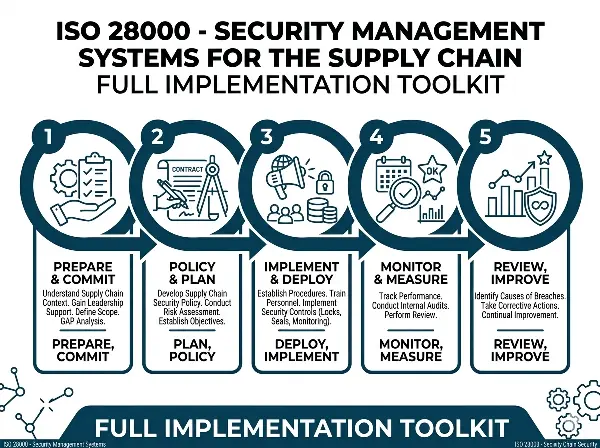
The ISO 28000 Security Management Systems for the Supply Chain Implementation Toolkits provide a comprehensive, easy to use set of professional templates and practical guidance to help organizations establish, implement, maintain, and continually improve an effective supply chain security management system with greater structure, control, and operational resilience.
Aligned with ISO 28000 requirements, this toolkit translates complex supply chain security expectations into actionable documents, procedures, registers, and tracking tools enabling teams to strengthen security governance, standardize risk-based controls, improve visibility across supply chain activities, support incident preparedness, and build a more resilient, disciplined, and ready for implementation organization with confidence.
Implementing a Security Management System for the Supply Chain aligned with ISO 28000 can be complex and time-consuming, especially for organizations that require structured documentation, coordinated risk control, and consistent security management across suppliers, logistics operations, facilities, and cross-border supply chain activities.
The ISO 28000 Security Management Systems for the Supply Chain Implementation Toolkits package provides a comprehensive collection of easy to use templates and structured implementation documents in Word, Excel, and PowerPoint formats. It helps your organization accelerate security management system implementation, standardize documentation, strengthen supply chain security governance, improve operational control, and support certification readiness with greater confidence and resilience.

Below is the structured list of documents included in the package. Use the quick navigation or expand each part to review the files before downloading the index file.
 Part 1. Program Initiation, Governance & Supply Chain Security Context
Objective: To establish the leadership mandate, governance framework, organizational context, security scope, strategic direction, implementation roadmap, and executive oversight required to launch and govern the ISO 28000 supply chain security management system at enterprise level.
 Supply Chain Security Program Charter.docx Supply Chain Security Governance Framework.docx Security Management System Scope Definition.docx Organizational Context & Interested Parties Assessment.docx Supply Chain Security Policy (Master).docx Security Objectives & Strategic Commitments.docx Security Roles, Authorities & Escalation Matrix.docx Implementation Roadmap & Phase Plan.docx Internal & External Communication Plan.docx
 Interested Parties Register.xlsx Governance RACI Matrix.xlsx Security Objectives & KPI Register.xlsx Governance Meeting Calendar.xlsx Program Budget & Resource Tracker.xlsx
 Executive Kickoff Slides.pptx Leadership Awareness Slides.pptx
Part 2. Supply Chain Mapping, Critical Operations & Security Boundaries
Objective: To define the supply chain structure, critical flows, nodes, routes, assets, dependencies, and operating boundaries that must be understood in order to apply proportionate security controls across suppliers, transport, storage, handling, and distribution activities.
Supply Chain Mapping Methodology.docx Critical Operations Identification Procedure.docx Security Boundary Definition Standard.docx Product, Cargo & Asset Flow Description.docx Transport Modes & Route Security Overview.docx Supply Chain Map Register.xlsx Critical Node Register.xlsx Critical Route & Lane Register.xlsx Security Boundary Matrix.xlsx Dependency & Interdependency Register.xlsx Supply Chain Architecture Slides.pptx
Part 3. Security Risk Assessment, Threat Evaluation & Treatment Planning
Objective: To establish the methodology, criteria, scenario library, assessment records, and treatment planning mechanisms needed to identify, analyze, evaluate, prioritize, and treat security risks affecting the supply chain, facilities, cargo, personnel, partners, and supporting infrastructure.
Security Risk Management Policy.docx Security Risk Assessment Methodology.docx Threat Assessment Procedure.docx Vulnerability Assessment Procedure.docx Risk Evaluation Criteria.docx Risk Treatment Strategy.docx Risk Acceptance Criteria.docx Supply Chain Security Risk Register.xlsx Threat Scenario Library.xlsx Vulnerability Register.xlsx Risk Treatment Plan.xlsx Risk Heat Map.xlsx Risk Acceptance Log.xlsx Risk Workshop Slides.pptx Risk Reporting Slides.pptx
Part 4. Legal, Regulatory & Trade Security Compliance
Objective: To identify and manage the legal, regulatory, customs, contractual, and industry security obligations that influence supply chain security management, cross-border movement, cargo handling, partner obligations, and evidence of compliance.
Security Compliance Management Procedure.docx Legal & Regulatory Obligations Mapping.docx Customs & Border Security Requirements Guide.docx Contractual Security Clauses Template.docx Trade Documentation Security Standard.docx Regulatory Requirements Register.xlsx Compliance Obligations Tracker.xlsx Customs Security Checklist.xlsx Contract Security Obligations Matrix.xlsx Compliance Overview Slides.pptx
Part 5. Partner Assurance, Supplier Security & Outsourced Operations
Objective: To ensure that suppliers, logistics providers, contractors, brokers, warehouses, and other business partners are subject to defined security expectations, due diligence, onboarding review, contractual controls, and ongoing performance monitoring.
Partner Security Management Policy.docx Supplier Security Due Diligence Procedure.docx Business Partner Security Requirements Standard.docx Outsourced Operations Security Procedure.docx Partner Security Agreement Template.docx Approved Partner Register.xlsx Supplier Security Assessment.xlsx Due Diligence Checklist.xlsx Partner Performance Review Log.xlsx Third-Party Security Incident Log.xlsx Partner Assurance Slides.pptx
Part 6. Cargo Security, Container Integrity & Shipment Control
Objective: To define the controls, inspection practices, sealing requirements, documentation standards, and operational records needed to protect cargo, containers, trailers, packages, and consignments from tampering, theft, contamination, substitution, or unauthorized access.
Cargo Security Policy.docx Container & Trailer Inspection Procedure.docx Seal Management Standard.docx Shipment Verification & Release Procedure.docx High-Value Cargo Protection Procedure.docx Chain of Custody Guidelines.docx Container Inspection Log.xlsx Seal Register.xlsx Shipment Verification Log.xlsx Chain of Custody Register.xlsx Cargo Security Incident Log.xlsx Cargo Security Awareness Slides.pptx
Part 7. Facility Security, Site Access & Physical Protection
Objective: To secure warehouses, yards, terminals, offices, checkpoints, and restricted areas through physical barriers, surveillance, access controls, visitor management, patrol routines, and protective operating procedures.
Facility Security Policy.docx Site Access Control Procedure.docx Restricted Area Management Standard.docx Visitor & Contractor Control Procedure.docx Perimeter Security & Surveillance Procedure.docx Security Guard Operations SOP.docx Physical Access Register.xlsx Visitor Log.xlsx Facility Security Inspection Checklist.xlsx CCTV Coverage Review.xlsx Physical Security Incident Register.xlsx Facility Security Awareness Slides.pptx
Part 8. Personnel Security, Competence & Security Awareness
Objective: To ensure employees, contractors, drivers, temporary labor, and security-sensitive personnel are screened where appropriate, assigned clear responsibilities, trained on security requirements, and monitored for competence and compliance throughout their engagement lifecycle.
Personnel Security Policy.docx Background Verification Procedure.docx Security Roles & Personnel Responsibilities.docx Security Training & Competence Procedure.docx Driver & Field Personnel Security Instructions.docx Employee Security Code of Conduct.docx Training Attendance Register.xlsx Competency Assessment Matrix.xlsx Personnel Screening Log.xlsx Security Awareness Campaign Calendar.xlsx Security Awareness Training Slides.pptx Driver Security Briefing Slides.pptx
Part 9. Transport Security, Routing Control & In-Transit Protection
Objective: To establish secure transport planning, dispatch authorization, routing controls, handover procedures, escort rules, incident escalation, and in-transit monitoring requirements for protecting shipments across road, sea, air, rail, or multimodal environments.
Transport Security Policy.docx Dispatch & Handover Security Procedure.docx Route Risk Assessment Procedure.docx In-Transit Security Monitoring Standard.docx Vehicle Security Inspection Checklist.docx Emergency Diversion & Delay Procedure.docx Route Risk Register.xlsx Dispatch Authorization Log.xlsx Handover Chain Register.xlsx Vehicle Inspection Log.xlsx In-Transit Incident Log.xlsx Transport Security Slides.pptx
Part 10. Security Incident Management, Crisis Response & Investigation
Objective: To establish a structured approach for identifying, reporting, classifying, responding to, investigating, documenting, and learning from security incidents, cargo losses, tampering events, unauthorized intrusions, and other supply chain security disruptions.
Security Incident Management Policy.docx Incident Response Plan.docx Crisis Management Procedure.docx Incident Classification Matrix.docx Investigation & Evidence Handling Procedure.docx Corrective & Preventive Action Procedure.docx Incident Register.xlsx Crisis Escalation Log.xlsx Investigation Tracker.xlsx Lessons Learned Register.xlsx CAPA Tracker.xlsx Incident Response Training Slides.pptx Crisis Management Slides.pptx
Part 11. Business Continuity, Resilience & Recovery Readiness
Objective: To define resilience strategies, continuity arrangements, recovery priorities, alternate operating methods, and testing mechanisms necessary to maintain or restore critical supply chain activities after disruptive security events.
Supply Chain Continuity Policy.docx Business Continuity Strategy.docx Security Disruption Recovery Plan.docx Alternate Routing & Sourcing Procedure.docx Crisis Communication Plan.docx Continuity Exercise & Test Procedure.docx Critical Process Register.xlsx Recovery Priority Matrix.xlsx Alternate Supplier & Route Register.xlsx Continuity Test Plan.xlsx Continuity Test Report.xlsx Resilience Overview Slides.pptx
Part 12. Operational Control, Monitoring, Performance Metrics & Management Review
Objective: To define the operational control framework, inspection routines, monitoring methods, security performance indicators, review cycles, and reporting mechanisms needed to evaluate effectiveness and support evidence-based management decisions.
Operational Security Control Procedure.docx Monitoring & Measurement Procedure.docx Management Review Procedure.docx Security Reporting Standard.docx Control Effectiveness Evaluation Method.docx Operational Inspection Log.xlsx KPI & KRI Register.xlsx Security Performance Dashboard.xlsx Security Objectives Status Tracker.xlsx Management Review Action Log.xlsx Monthly Security Report Slides.pptx Management Review Slides.pptx
Part 13. Internal Audit, Corrective Action & Continual Improvement
Objective: To support internal audit, nonconformity management, corrective action, maturity development, and continual improvement of the supply chain security management system through structured review and disciplined follow-through.
Internal Audit Policy.docx Internal Audit Procedure.docx Nonconformity & Corrective Action Procedure.docx Continual Improvement Procedure.docx Audit Report Template.docx Internal Audit Plan.xlsx Audit Checklist.xlsx Nonconformity Register.xlsx Corrective Action Tracker.xlsx Improvement Opportunity Register.xlsx Audit Results Presentation Slides.pptx Improvement Roadmap Slides.pptx
Part 14. Controlled Documentation, Records & Evidence Management
Objective: To define the document control, record retention, evidence management, versioning, confidentiality, and archival requirements needed to maintain reliable, auditable, and management-approved security documentation across the ISO 28000 lifecycle.
Document Control Procedure.docx Record Retention & Evidence Management Policy.docx Template & Document Coding Standard.docx Confidential Record Handling Procedure.docx Master Document Register.xlsx Record Retention Schedule.xlsx Document Approval Log.xlsx Document Revision History.xlsx Evidence Register.xlsx Document Control Awareness Slides.pptxUse these quick links to review the full file list and payment instructions.


| Date File Updated | 25/03/2025 |
| File Format | pdf, xls, doc, docx, xlsx, pptx |
| No. of files | 170 Files, 14 Folders |
| File download size | 43.52 MB (.rar) |
| Language |
 English
|
| Purchase code | ISO28000-Toolkits |
The ISO Toolkit has helped us structure our implementation work clearly. It gave our team practical templates, organized procedures, and a reliable starting point for building our management system documentation.
After using the ISO Toolkit, our ISO preparation became much more organized. The documents are professional, easy to adapt, and helpful for aligning internal teams around clear compliance requirements.
Our consultants and internal managers found the toolkit very practical. It saved time, improved documentation consistency, and gave us a better framework for ISO implementation across departments.
The toolkit provides a strong foundation for ISO best practices. It helped us organize policies, procedures, records, and improvement actions in a way that is simple to maintain.
The ISO Toolkit brought structure to our compliance documentation and reduced the workload for our implementation team. It allowed us to focus more on improving processes instead of starting documents from scratch.
The ISO Toolkit is practical, well arranged, and easy to customize. It helped replace scattered files with a more complete document set for managing our ISO implementation activities.
The toolkit is very straightforward to use. It gave our team a clear implementation path, helped define responsibilities, and made ISO documentation easier for non-specialists to understand.
The ISO Toolkit gave us a better understanding of management system requirements and provided a user-friendly way to improve processes, controls, and internal documentation.
The toolkit helped me organize our ISO training, document review, and implementation planning. It made the entire preparation process more focused and easier to communicate with the team.
Excellent ISO Toolkit. It is highly useful for managers, consultants, and implementation teams who need practical documents to support ISO certification readiness.
A very useful toolkit and one of the most practical document sets I have used. It provides clear templates that can be adapted quickly for different ISO implementation needs.
These ISO Toolkits increased my confidence in managing implementation work. They helped us prepare documentation, assign responsibilities, and move toward a more mature management system.