
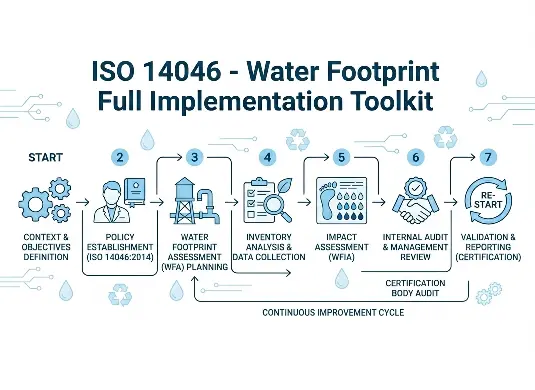
The ISO 14046 Water Footprint Assessment Implementation Toolkit provides a comprehensive, easy to use suite of premium templates and practical resources to help organizations assess, document, manage, and improve water footprint performance with greater consistency, transparency, and methodological confidence.
Aligned with ISO 14046 requirements and guidance, this toolkit translates water footprint assessment principles into actionable procedures, data collection templates, calculation workbooks, impact evaluation tools, and reporting formats enabling organizations to strengthen water-related environmental analysis, improve decision making, support credible sustainability disclosures, and enhance readiness for stakeholder, customer, and assurance expectations.
Implementing water footprint requirements aligned with ISO 14046 can be complex and time-consuming, especially for organizations seeking to assess water-related impacts, improve environmental transparency, and maintain consistent documentation across products, processes, and operational activities.
The ISO 14046 Water Footprint Toolkit provides a comprehensive set of easy to use templates, procedures, registers, assessment support documents, and practical implementation files in Word and Excel formats, helping your organization standardize water footprint documentation, improve evaluation consistency, and accelerate implementation with greater confidence, efficiency, and professional rigor.

Below is the structured list of documents included in the package. Use the quick navigation or expand each part to review the files before downloading the index file.
 Part 1. Water Footprint Program Initiation & Governance
Objective: To establish the governance structure, implementation mandate, assessment boundaries, leadership sponsorship, strategic objectives, stakeholder responsibilities, and management direction required to launch and control the ISO 14046 water footprint program effectively.
 Water Footprint Program Charter.docx Water Footprint Governance Framework.docx Water Footprint Policy.docx Water Stewardship Roles & Responsibilities.docx Assessment Scope & Boundary Definition.docx Water Footprint Objectives & Targets.docx Program Communication Plan.docx Legal & Context Review for Water Management.docx Water Footprint Implementation Roadmap.docx
 Stakeholder Register.xlsx Governance RACI Matrix.xlsx Objectives & KPI Register.xlsx Regulatory & Water Context Register.xlsx Governance Meeting Schedule.xlsx Program Budget Tracker.xlsx
 Water Footprint Program Kickoff Slides.pptx Executive Water Stewardship Awareness Slides.pptx
Part 2. Goal, Scope & Assessment Framework
Objective: To define the intended application, target audience, decision context, system boundaries, functional unit, reference flow, assumptions, limitations, and study design parameters for a consistent and credible water footprint assessment.
Goal & Scope Definition Procedure.docx Functional Unit & Reference Flow Guidance.docx System Boundary Setting Methodology.docx Cut-Off Criteria & Assumptions Guidance.docx Comparative Study Rules.docx Intended Use & Audience Definition.docx Allocation & Modelling Principles.docx Goal & Scope Register.xlsx System Boundary Mapping Matrix.xlsx Assumptions & Limitations Log.xlsx Functional Unit Register.xlsx Allocation Decision Log.xlsx Goal & Scope Alignment Slides.pptx
Part 3. Water Inventory & Data Collection
Objective: To identify, collect, validate, organize, and control the activity data, site data, water input and output data, source information, and supporting evidence required to build a robust water footprint inventory across products, processes, and organizational operations.
Water Inventory Data Collection Procedure.docx Primary & Secondary Data Selection Rules.docx Water Balance Development Guideline.docx Water Withdrawal & Consumption Method.docx Effluent & Water Quality Data Procedure.docx Site Sampling & Metering Guidance.docx Data Evidence Retention Guideline.docx Water Data Inventory Register.xlsx Water Input-Output Register.xlsx Water Source Register.xlsx Effluent & Discharge Register.xlsx Site Meter Reading Log.xlsx Data Collection Plan.xlsx Evidence Reference Index.xlsx Water Data Collection Workshop Slides.pptx Site Data Capture Awareness Slides.pptx
Part 4. Life Cycle Modelling & Data Quality Control
Objective: To structure the life cycle model, define data quality rules, assess representativeness, document assumptions, and control calculation integrity so that water footprint results are traceable, reproducible, and decision-grade.
Life Cycle Modelling Methodology.docx Data Quality Requirements Standard.docx Temporal, Geographic & Technological Representativeness Guide.docx Data Validation & Reconciliation Procedure.docx Missing Data Estimation Guidance.docx Calculation Review Protocol.docx Data Quality Assessment Matrix.xlsx Assumption Control Log.xlsx Data Source Validation Tracker.xlsx Model Version Control Register.xlsx Calculation Review Checklist.xlsx LCA Modelling Overview Slides.pptx
Part 5. Water Footprint Impact Assessment
Objective: To apply the selected impact assessment approach, characterize water-related potential impacts, consider water scarcity and degradation dimensions, and generate a structured profile of water footprint indicator results for analysis and reporting.
Water Footprint Impact Assessment Procedure.docx Impact Category Selection Guidance.docx Characterization Method Selection Memo.docx Water Scarcity Assessment Method.docx Water Quality Impact Evaluation Procedure.docx Impact Result Interpretation Notes.docx Impact Category Register.xlsx Characterization Factor Log.xlsx Water Scarcity Assessment Sheet.xlsx Water Quality Impact Register.xlsx Impact Results Dashboard.xlsx Impact Assessment Results Slides.pptx Water Scarcity Analysis Slides.pptx
Part 6. Interpretation, Hotspot Analysis & Decision Support
Objective: To interpret assessment results, identify significant water hotspots, evaluate sensitivity and uncertainty, confirm completeness and consistency, and translate technical findings into management decisions and priority actions.
Results Interpretation Procedure.docx Water Hotspot Identification Methodology.docx Sensitivity Analysis Guidance.docx Uncertainty Evaluation Procedure.docx Significance Assessment Criteria.docx Management Decision Support Template.docx Hotspot Register.xlsx Sensitivity Analysis Log.xlsx Uncertainty Assessment Sheet.xlsx Interpretation Findings Tracker.xlsx Priority Action Matrix.xlsx Hotspot Review Presentation.pptx
Part 7. Water Reduction Strategy & Improvement Programs
Objective: To convert assessment findings into practical reduction initiatives, efficiency projects, pollution prevention measures, reuse opportunities, supplier actions, and site-level improvement programs that measurably reduce water-related impacts.
Water Reduction Strategy.docx Water Efficiency Improvement Plan.docx Water Reuse & Recycling Guideline.docx Pollution Prevention Action Plan.docx Supplier Water Improvement Engagement Plan.docx Capital Project Justification Template.docx Water Performance Target Cascade.docx Improvement Opportunity Register.xlsx Water Reduction Action Tracker.xlsx Water Savings Calculation Sheet.xlsx CAPEX/OPEX Evaluation Tracker.xlsx Supplier Improvement Register.xlsx Water Improvement Roadmap Slides.pptx Water Reduction Business Case Slides.pptx
Part 8. Reporting, Disclosure & Technical Documentation
Objective: To prepare complete, accurate, and transparent study reports, technical files, result summaries, calculation records, review packages, and management reporting materials in line with ISO 14046 reporting requirements.
Water Footprint Reporting Procedure.docx Technical Study Report Template.docx Executive Summary Report Template.docx Results Disclosure Rules.docx Supporting Evidence Compilation Guide.docx Reporting Review & Approval Procedure.docx Water Footprint Study Dossier Structure.docx Reporting Checklist.xlsx Technical Document Index.xlsx Review Comment Log.xlsx Report Release Register.xlsx Management Reporting Slides.pptx Water Footprint Results Presentation.pptx
Part 9. Critical Review, Assurance & Compliance
Objective: To establish internal review, independent critical review, methodological assurance, compliance checks, and corrective action tracking mechanisms that strengthen the credibility, consistency, and defensibility of the water footprint study.
Critical Review Procedure.docx Methodology Assurance Checklist.docx Internal Review Protocol.docx Reviewer Independence Criteria.docx Corrective Action Procedure for Study Findings.docx Critical Review Plan.xlsx Review Findings Register.xlsx Compliance Check Matrix.xlsx Corrective Action Tracker.xlsx Reviewer Comment Resolution Log.xlsx Assurance Review Slides.pptx
Part 10. Stakeholder Communication & Claim Control
Objective: To control how water footprint results are communicated to customers, regulators, investors, communities, and internal stakeholders while ensuring that claims, summaries, and disclosures remain accurate, authorized, and aligned with approved reporting boundaries.
Stakeholder Communication Procedure.docx External Claim Review Rules.docx Public Disclosure Approval Matrix.docx Investor & Customer Reporting Guidance.docx Community & Site Communication Protocol.docx FAQ for Water Footprint Results.docx Communication Approval Log.xlsx Stakeholder Engagement Register.xlsx Disclosure Tracking Register.xlsx Claim Verification Checklist.xlsx Stakeholder Briefing Slides.pptx External Communication Slides.pptxUse these quick links to review the full file list and payment instructions.


| Date File Updated | 25/03/2025 |
| File Format | pdf, xls, doc, docx, xlsx, pptx |
| No. of files | 133 Files, 10 Folders |
| File download size | 42.01 MB (.rar) |
| Language |  English English |
| Purchase code | ISO14046-Toolkits |
The ISO Toolkit has helped us structure our implementation work clearly. It gave our team practical templates, organized procedures, and a reliable starting point for building our management system documentation.
After using the ISO Toolkit, our ISO preparation became much more organized. The documents are professional, easy to adapt, and helpful for aligning internal teams around clear compliance requirements.
Our consultants and internal managers found the toolkit very practical. It saved time, improved documentation consistency, and gave us a better framework for ISO implementation across departments.
The toolkit provides a strong foundation for ISO best practices. It helped us organize policies, procedures, records, and improvement actions in a way that is simple to maintain.
The ISO Toolkit brought structure to our compliance documentation and reduced the workload for our implementation team. It allowed us to focus more on improving processes instead of starting documents from scratch.
The ISO Toolkit is practical, well arranged, and easy to customize. It helped replace scattered files with a more complete document set for managing our ISO implementation activities.
The toolkit is very straightforward to use. It gave our team a clear implementation path, helped define responsibilities, and made ISO documentation easier for non-specialists to understand.
The ISO Toolkit gave us a better understanding of management system requirements and provided a user-friendly way to improve processes, controls, and internal documentation.
The toolkit helped me organize our ISO training, document review, and implementation planning. It made the entire preparation process more focused and easier to communicate with the team.
Excellent ISO Toolkit. It is highly useful for managers, consultants, and implementation teams who need practical documents to support ISO certification readiness.
A very useful toolkit and one of the most practical document sets I have used. It provides clear templates that can be adapted quickly for different ISO implementation needs.
These ISO Toolkits increased my confidence in managing implementation work. They helped us prepare documentation, assign responsibilities, and move toward a more mature management system.