The ISO/IEC 17025 Testing and Calibration Laboratories Implementation Toolkits provide a comprehensive, Ready to use suite of premium templates and practical resources to help laboratories establish, implement, maintain, and continually improve management system and technical competence requirements with consistency, precision, and operational confidence.
Aligned with ISO/IEC 17025 requirements,this toolkit translates laboratory quality, impartiality, and technical competence expectations into actionable policies, procedures, forms, records, and monitoring tools enabling organizations to strengthen laboratory governance, improve the reliability of testing and calibration results, enhance audit and accreditation readiness, and support sustained performance across laboratory operations.
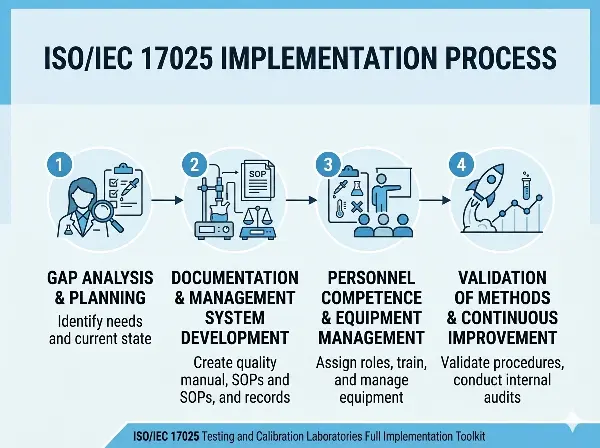
Implementing requirements aligned with ISO/IEC 17025 can be complex and time-consuming, particularly for testing and calibration laboratories seeking to strengthen technical competence, ensure reliable results, and maintain consistent documentation across laboratory operations.
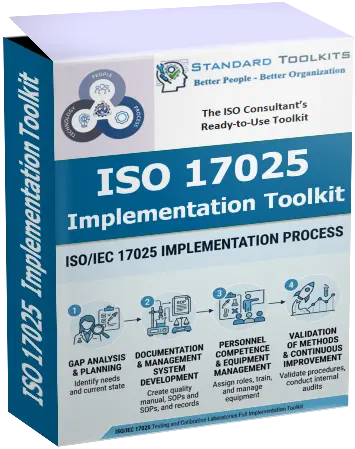
The ISO/IEC 17025 Testing and Calibration Laboratories Toolkit package provides a comprehensive set of easy to use templates, procedures, forms, registers, and practical implementation documents in Word and Excel formats, helping your laboratory standardize documentation, improve operational consistency, support accreditation readiness, and accelerate implementation with greater confidence, efficiency, and professional rigor.

Below is the complete list of documents included in the package. Click the index file button to review the full contents in spreadsheet format.
 Part 1. Laboratory Accreditation Program Initiation & Governance
Objective: To establish the governance architecture, accreditation scope, quality policy direction, implementation roadmap, leadership accountability, and strategic oversight necessary to launch and control the ISO/IEC 17025 laboratory competence program with executive clarity and audit readiness.
 Laboratory Accreditation Program Charter.docx ISO/IEC 17025 Governance Framework.docx Laboratory Scope Definition.docx Quality Policy & Strategic Intent Statement.docx Laboratory Organizational Structure & Authority Matrix.docx Accreditation Readiness Roadmap.docx Laboratory Objectives & Performance Framework.docx Communication & Stakeholder Engagement Plan.docx
 Accreditation Scope Register.xlsx Stakeholder Register.xlsx Program Milestone Tracker.xlsx Laboratory KPI Register.xlsx Governance Meeting Schedule.xlsx
 ISO/IEC 17025 Program Kickoff Slides.pptx Executive Accreditation Awareness Slides.pptx
Part 2. Impartiality, Confidentiality & Organizational Control
Objective: To define and control the organizational safeguards required to protect impartiality, preserve confidentiality, manage conflicts of interest, and ensure that laboratory activities are performed under a structure that supports competent and unbiased results.
Impartiality Policy.docx Confidentiality & Information Protection Policy.docx Conflict of Interest Procedure.docx Laboratory Independence & Escalation Protocol.docx Roles, Responsibilities & Authority Statement.docx Confidentiality Undertaking Template.docx Impartiality Risk Register.xlsx Conflict of Interest Declaration Log.xlsx Confidentiality Agreement Register.xlsx Organizational Authority Matrix.xlsx Impartiality & Ethics Awareness Slides.pptx
Part 3. Personnel Competence, Authorization & Training Control
Objective: To establish the competency framework, qualification requirements, authorization controls, supervision methods, and training records needed to ensure personnel performing laboratory activities are competent, consistently evaluated, and formally approved for assigned duties.
Personnel Competence Policy.docx Competence Framework for Laboratory Roles.docx Personnel Authorization Procedure.docx Training, Mentoring & Supervision Procedure.docx Job Description Template for Laboratory Personnel.docx Competence Assessment Methodology.docx Personnel Authorization Certificate Template.docx Competence Matrix.xlsx Training Attendance Register.xlsx Personnel Authorization Register.xlsx Skills Gap Analysis Tracker.xlsx Witnessing & Observation Log.xlsx Laboratory Competence Awareness Slides.pptx
Part 4. Facilities, Environmental Conditions & Laboratory Infrastructure
Objective: To define the controls, monitoring arrangements, zoning requirements, and environmental safeguards needed to ensure laboratory premises, utilities, and conditions do not adversely affect the validity of testing or calibration results.
Facilities & Environmental Control Policy.docx Environmental Conditions Monitoring Procedure.docx Laboratory Zoning & Access Control Guidelines.docx Housekeeping, Contamination Prevention & Segregation Procedure.docx Out-of-Site Activity Control Procedure.docx Environmental Monitoring Log.xlsx Facility Qualification Checklist.xlsx Laboratory Area Access Register.xlsx Environmental Excursion Log.xlsx Laboratory Environment Control Slides.pptx
Part 5. Equipment, Calibration Control & Maintenance Management
Objective: To control equipment lifecycle activities including selection, installation, identification, calibration status, intermediate checks, maintenance, repair, and out-of-service disposition so that all equipment influencing results remains fit for intended use.
Equipment Management Policy.docx Equipment Control & Identification Procedure.docx Calibration Program Procedure.docx Preventive Maintenance Procedure.docx Intermediate Check Procedure.docx Equipment Failure & Out-of-Service Handling Procedure.docx Equipment Qualification & Commissioning Template.docx Master Equipment Register.xlsx Calibration Schedule.xlsx Preventive Maintenance Log.xlsx Intermediate Check Log.xlsx Equipment Breakdown & Repair Log.xlsx Equipment Status Label Tracker.xlsx Calibration Control Overview Slides.pptx
Part 6. Metrological Traceability, Reference Standards & Reference Materials
Objective: To ensure measurement results are supported by documented metrological traceability, appropriate calibration chains, competent providers, reference standards, and controlled reference materials in alignment with technical and accreditation expectations.
Metrological Traceability Policy.docx Traceability Chain Management Procedure.docx Reference Standard Control Procedure.docx Certified Reference Material Management Procedure.docx Supplier Competence Evaluation for Calibration Services.docx Traceability Matrix.xlsx Reference Standards Register.xlsx Certified Reference Materials Register.xlsx Calibration Certificate Review Log.xlsx Reference Material Usage Log.xlsx Traceability & Reference Material Slides.pptx
Part 7. Review of Requests, Tenders, Contracts & Customer Communication
Objective: To ensure customer requirements are clearly defined, technically reviewed, contractually accepted, and effectively communicated before work begins, including control of deviations, capability confirmation, subcontracting visibility, and customer interaction records.
Contract Review Procedure.docx Customer Communication & Technical Enquiry Procedure.docx Review of Requests & Tenders Checklist.docx Deviation Acceptance Template.docx Subcontracted Activity Notification Template.docx Contract Review Log.xlsx Customer Requirement Capture Form.xlsx Quotations & Tender Tracker.xlsx Customer Communication Log.xlsx Customer Requirement Review Slides.pptx
Part 8. Method Selection, Verification, Validation & Decision Rules
Objective: To define how standard methods are selected and verified, how non-standard or modified methods are validated, and how decision rules, acceptance criteria, and technical justifications are established to support valid laboratory results.
Method Management Policy.docx Method Selection & Verification Procedure.docx Method Validation Procedure.docx Statistical Design for Method Validation.docx Decision Rule & Statement of Conformity Guidance.docx Method Change Control Procedure.docx Method Master Register.xlsx Method Verification Plan.xlsx Method Validation Master Plan.xlsx Validation Results Workbook.xlsx Decision Rule Register.xlsx Method Validation Workshop Slides.pptx
Part 9. Measurement Uncertainty Evaluation & Technical Calculations
Objective: To identify, evaluate, quantify, and maintain the significant contributors to measurement uncertainty, including sampling where relevant, and to ensure technical calculations are documented, reviewed, and consistently applied to laboratory outputs.
Measurement Uncertainty Policy.docx Measurement Uncertainty Evaluation Procedure.docx Uncertainty Budget Development Guide.docx Technical Calculation Review Procedure.docx Guard Banding & Decision Rule Application Note.docx Measurement Uncertainty Budget.xlsx Source Contribution Analysis.xlsx Coverage Factor & Confidence Workbook.xlsx Uncertainty Review Register.xlsx Measurement Uncertainty Training Slides.pptx
Part 10. Sampling, Item Handling, Transport & Chain of Custody
Objective: To control sampling activities, sample identification, receipt, transport, storage, retention, and disposal so that the integrity, traceability, and suitability of test or calibration items are maintained throughout the laboratory workflow.
Sampling Procedure.docx Sample Receipt & Registration Procedure.docx Item Handling, Storage & Retention Procedure.docx Chain of Custody Procedure.docx Sample Disposal & Return Procedure.docx Sampling Plan Template.docx Sample Receipt Log.xlsx Chain of Custody Register.xlsx Sample Storage Monitoring Log.xlsx Sample Retention & Disposal Register.xlsx Sampling Deviation Log.xlsx Sample Integrity Control Slides.pptx
Part 11. Ensuring Validity of Results, Quality Control & Proficiency Testing
Objective: To establish the ongoing monitoring, internal quality control, trend analysis, interlaboratory comparison, proficiency testing, retesting, and result review practices required to demonstrate the continuing validity and reliability of laboratory outputs.
Validity of Results Monitoring Procedure.docx Internal Quality Control Procedure.docx Proficiency Testing & Interlaboratory Comparison Procedure.docx Control Chart Management Guidance.docx Out-of-Control & Trend Escalation Procedure.docx Quality Control Plan.xlsx Control Chart Workbook.xlsx Proficiency Testing Participation Register.xlsx Interlaboratory Comparison Tracker.xlsx Retest / Recalibration Log.xlsx Trend Analysis Dashboard.xlsx Validity of Results Review Slides.pptx
Part 12. Technical Records, Data Integrity, LIMS & Information Management
Objective: To manage technical records, raw data, calculations, system access, data transfer checks, and laboratory information systems in a manner that preserves integrity, traceability, retrievability, and confidence in recorded and reported information.
Technical Records Control Procedure.docx Data Integrity & Electronic Records Policy.docx LIMS Administration & Validation Procedure.docx Data Transfer Verification Procedure.docx Electronic Backup, Recovery & Access Control Procedure.docx Technical Record Register.xlsx Data Integrity Review Log.xlsx LIMS User Access Matrix.xlsx Calculation Check Log.xlsx System Change Log.xlsx Backup Verification Register.xlsx Laboratory Data Integrity Slides.pptx
Part 13. Reporting, Certificates, Statements of Conformity & Result Release
Objective: To standardize the preparation, review, authorization, issue, amendment, and control of test reports, calibration certificates, sampling reports, and statements of conformity so that released results are technically complete, defensible, and professionally presented.
Reporting & Result Authorization Procedure.docx Test Report Template.docx Calibration Certificate Template.docx Sampling Report Template.docx Statement of Conformity Guidance.docx Report Amendment & Reissue Procedure.docx Report Issue Log.xlsx Authorized Signatory Register.xlsx Report Review Checklist.xlsx Amended Report Register.xlsx Technical Reporting Excellence Slides.pptx
Part 14. Externally Provided Products, Services & Subcontracted Activities
Objective: To ensure that externally provided products, consumables, calibration services, reference materials, and subcontracted laboratory activities are selected, approved, monitored, and documented in a manner that protects result validity and accreditation integrity.
Supplier & External Services Control Procedure.docx Purchasing & Acceptance Control Procedure.docx Subcontracted Laboratory Activities Procedure.docx Approved Supplier Qualification Criteria.docx Incoming Verification of Critical Supplies Procedure.docx Approved Supplier Register.xlsx Supplier Evaluation Scorecard.xlsx Critical Consumables Receipt Log.xlsx Subcontracted Activity Register.xlsx Supplier Nonconformity Log.xlsx External Provider Control Slides.pptx
Part 15. Nonconforming Work, Complaints, CAPA & Risk-Based Improvement
Objective: To provide a disciplined framework for identifying nonconforming work, handling complaints, performing root cause analysis, implementing correction and corrective action, and addressing risks and opportunities to strengthen laboratory reliability and customer confidence.
Nonconforming Work Procedure.docx Complaint Handling Procedure.docx Corrective Action Procedure.docx Root Cause Analysis Toolkit.docx Risks & Opportunities Management Procedure.docx Immediate Correction & Containment Template.docx Nonconforming Work Register.xlsx Complaint Log.xlsx CAPA Tracker.xlsx Root Cause Analysis Workbook.xlsx Risk & Opportunity Register.xlsx CAPA & Risk Review Slides.pptx
Part 16. Internal Audits, Management Review, Document Control
Objective: To maintain the laboratory management system through controlled documentation, retention of records, internal audit execution, management review, performance analysis, and structured continual improvement in support of sustained ISO/IEC 17025 conformity.
Management System Manual.docx Document Control Procedure.docx Record Retention & Archiving Procedure.docx Internal Audit Procedure.docx Management Review Procedure.docx Continual Improvement Procedure.docx Master Document Register.xlsx Record Retention Schedule.xlsx Internal Audit Program.xlsx Audit Checklist.xlsx Management Review Input & Output Tracker.xlsx Improvement Action Log.xlsx Document Change Log.xlsx Management Review Slides.pptx Internal Audit Results Slides.pptxUse these quick links to review the full file list and payment instructions.


| Date File Updated | 25/03/2025 |
| File Format | pdf, xls, doc, docx, xlsx, pptx |
| No. of files | 191 Files, 16 Folders |
| File download size | 68.42 MB (.rar) |
| Language |
 English
|
| Purchase code | ISO17025-Toolkits |
The ISO Toolkit has helped us structure our implementation work clearly. It gave our team practical templates, organized procedures, and a reliable starting point for building our management system documentation.
After using the ISO Toolkit, our ISO preparation became much more organized. The documents are professional, easy to adapt, and helpful for aligning internal teams around clear compliance requirements.
Our consultants and internal managers found the toolkit very practical. It saved time, improved documentation consistency, and gave us a better framework for ISO implementation across departments.
The toolkit provides a strong foundation for ISO best practices. It helped us organize policies, procedures, records, and improvement actions in a way that is simple to maintain.
The ISO Toolkit brought structure to our compliance documentation and reduced the workload for our implementation team. It allowed us to focus more on improving processes instead of starting documents from scratch.
The ISO Toolkit is practical, well arranged, and easy to customize. It helped replace scattered files with a more complete document set for managing our ISO implementation activities.
The toolkit is very straightforward to use. It gave our team a clear implementation path, helped define responsibilities, and made ISO documentation easier for non-specialists to understand.
The ISO Toolkit gave us a better understanding of management system requirements and provided a user-friendly way to improve processes, controls, and internal documentation.
The toolkit helped me organize our ISO training, document review, and implementation planning. It made the entire preparation process more focused and easier to communicate with the team.
Excellent ISO Toolkit. It is highly useful for managers, consultants, and implementation teams who need practical documents to support ISO certification readiness.
A very useful toolkit and one of the most practical document sets I have used. It provides clear templates that can be adapted quickly for different ISO implementation needs.
These ISO Toolkits increased my confidence in managing implementation work. They helped us prepare documentation, assign responsibilities, and move toward a more mature management system.