
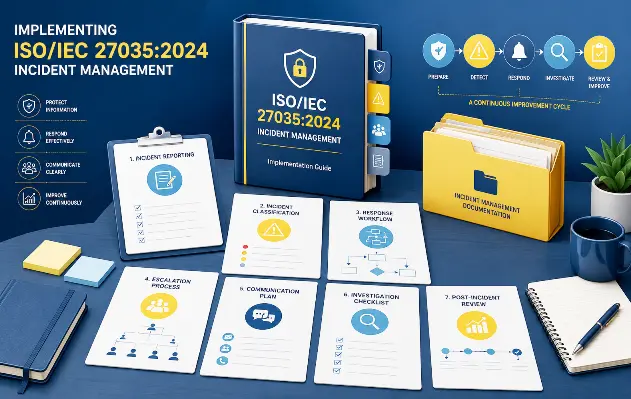
The ISO/IEC 27035:2024 Incident Management Toolkits provide a comprehensive, ready-to-use set of professional templates and practical guidance to help organizations establish, implement, manage, and continually improve an effective information security incident management process.
Aligned with ISO/IEC 27035:2024 requirements and best practices, this toolkit translates incident management expectations into actionable policies, procedures, registers, forms, playbooks, workbooks, slides, and reporting tools. It supports the full incident lifecycle, including planning, detection, reporting, triage, assessment, response, escalation, communication, evidence management, recovery, lessons learned, audit, and continual improvement.
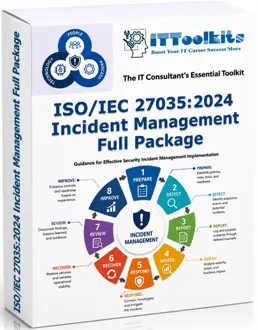
Implementing a structured information security incident management process aligned with ISO/IEC 27035:2024 can be complex and time-consuming, especially for organizations that require coordinated response procedures, clear escalation rules, forensic readiness, stakeholder communication, regulatory notification, and consistent evidence management.
The ISO/IEC 27035:2024 Incident Management Toolkits provide a comprehensive collection of 363 professionally developed files across 18 structured folders, designed to support incident planning, reporting, assessment, response, recovery, communications, evidence handling, legal and privacy coordination, third-party management, reporting, audit, and continual improvement. It helps your organization establish a practical, repeatable, and audit-ready incident management capability with greater confidence.

Below is the structured list of documents included in the package. Use the quick navigation or expand each part to review the files before downloading the index file.
 Part 1. Program Initiation & Governance
 ISO IEC 27035 Implementation Project Charter.docx Incident Management Program Scope Statement.docx Executive Sponsorship Approval.docx Incident Management Governance Model.docx Incident Management Steering Committee Terms of Reference.docx Project Communication Plan.docx Implementation Meeting Minutes.docx
 Stakeholder Register.xlsx Incident Management Program RACI Matrix.xlsx Implementation Roadmap.xlsx Project Risk and Issue Register.xlsx Project Milestone Tracker.xlsx Decision Log.xlsx Action Item Tracker.xlsx
 Program Initiation Executive Briefing.pptx ISO IEC 27035 Implementation Kickoff Presentation.pptx
Part 2. Current-State Assessment & Gap Analysis
Current-State Incident Process Assessment.docx Current Incident Response Capability Assessment.docx Current SOC Capability Assessment.docx Current CSIRT Capability Assessment.docx Forensic Readiness Assessment.docx Third-Party Incident Management Assessment.docx Gap Analysis Report.docx ISO IEC 27035 Gap Assessment Checklist.xlsx Incident Management Maturity Assessment.xlsx Existing Policy and Procedure Review Checklist.xlsx Incident Tooling Assessment.xlsx Logging and Monitoring Capability Assessment.xlsx Legal and Regulatory Requirement Mapping.xlsx Business Unit Incident Readiness Survey.xlsx Gap Remediation Plan.xlsx Current-State Assessment Findings Presentation.pptx Gap Analysis Executive Summary Presentation.pptx
Part 3. Context, Scope & Requirement Definition
Organizational Context Analysis.docx Incident Management Scope Definition.docx Incident Management Requirement Matrix.docx Internal and External Issues Register.xlsx Interested Parties Register.xlsx Business Process Dependency Mapping.xlsx Critical Asset Register.xlsx Crown Jewel Asset Register.xlsx Information Asset Classification Register.xlsx Critical Service Mapping.xlsx Regulatory Obligation Register.xlsx Contractual Incident Obligation Register.xlsx Incident Management Objective Register.xlsx Incident Management KPI and KRI Library.xlsx Incident Management Scope and Context Presentation.pptx Requirement Definition Workshop Presentation.pptx
Part 4. Policy Framework
Information Security Incident Management Policy.docx Incident Reporting Policy.docx Security Event Monitoring Policy.docx Vulnerability Reporting Policy.docx Digital Evidence Handling Policy.docx Crisis Communication Policy.docx Data Breach Notification Policy.docx Third-Party Incident Notification Policy.docx Law Enforcement Engagement Policy.docx Media Communication Policy.docx Whistleblowing and Anonymous Reporting Policy.docx Acceptable Use Incident Reporting Addendum.docx Policy Exception Request.docx Policy Approval Record.xlsx Policy Review Log.xlsx Incident Management Policy Awareness Presentation.pptx Executive Policy Approval Presentation.pptx
Part 5. Incident Management Framework & Process Design
Incident Management Framework Document.docx Incident Management Lifecycle Process.docx Security Event Management Procedure.docx Incident Detection Procedure.docx Incident Reporting Procedure.docx Incident Triage Procedure.docx Incident Classification Procedure.docx Incident Prioritization Procedure.docx Incident Escalation Procedure.docx Incident Response Procedure.docx Incident Containment Procedure.docx Incident Eradication Procedure.docx Incident Recovery Procedure.docx Incident Closure Procedure.docx Lessons Learned Procedure.docx Vulnerability Handling Procedure.docx Major Incident Management Procedure.docx Crisis Management Interface Procedure.docx Business Continuity Interface Procedure.docx Disaster Recovery Interface Procedure.docx Process Control Mapping.xlsx Procedure Ownership Matrix.xlsx Process Interface Matrix.xlsx Incident Management Framework Presentation.pptx Incident Lifecycle Process Flow Presentation.pptx
Part 6. Organization, Roles & Competencies
Incident Management Organization Structure.docx Incident Management Team Charter.docx CSIRT Charter.docx SOC Charter.docx Incident Commander Role Description.docx Incident Manager Role Description.docx Technical Lead Role Description.docx Forensic Analyst Role Description.docx Communications Lead Role Description.docx Legal Liaison Role Description.docx Privacy Liaison Role Description.docx Business Liaison Role Description.docx HR Liaison Role Description.docx Third-Party Coordinator Role Description.docx Executive Crisis Sponsor Role Description.docx Duty Handover Checklist.docx Incident Role Competency Matrix.xlsx Incident Response Skills Matrix.xlsx On-Call Roster.xlsx Escalation Contact Directory.xlsx Incident Management Organization Model Presentation.pptx Roles and Responsibilities Training Presentation.pptx
Part 7. Incident Classification, Taxonomy & Prioritization
Security Event Taxonomy.docx Information Security Incident Taxonomy.docx Incident Classification Decision Tree.docx Major Incident Criteria.docx Incident Category Matrix.xlsx Incident Severity Matrix.xlsx Incident Impact Assessment Matrix.xlsx Incident Urgency Assessment Matrix.xlsx Incident Priority Matrix.xlsx Data Breach Classification Matrix.xlsx Privacy Incident Classification Matrix.xlsx Cyber Attack Type Classification.xlsx Business Impact Scoring.xlsx Incident SLA Matrix.xlsx Escalation Threshold Matrix.xlsx Incident Classification Training Presentation.pptx Severity and Escalation Workshop Presentation.pptx
Part 8. Detection, Reporting & Intake
Security Event Report Form.docx Information Security Incident Report Form.docx Suspected Data Breach Report Form.docx Phishing Report Form.docx Malware Incident Report Form.docx Ransomware Incident Report Form.docx Insider Threat Report Form.docx Lost or Stolen Asset Report Form.docx Unauthorized Access Report Form.docx Third-Party Incident Notification Form.docx Customer Incident Notification Intake Form.docx Incident Hotline Script.docx Incident Email Intake.docx Incident Ticket Intake.docx Initial Incident Screening Checklist.docx Initial Incident Triage Checklist.docx False Positive Review.docx Incident Intake Register.xlsx Detection Source Register.xlsx Initial Triage Tracker.xlsx Incident Reporting Awareness Presentation.pptx Detection and Intake Process Training Presentation.pptx
Part 9. Incident Response Planning
Incident Response Plan.docx Major Incident Response Plan.docx Cyber Crisis Response Plan.docx Data Breach Response Plan.docx Ransomware Response Plan.docx Phishing Response Plan.docx Malware Response Plan.docx DDoS Response Plan.docx Business Email Compromise Response Plan.docx Insider Threat Response Plan.docx Cloud Security Incident Response Plan.docx SaaS Incident Response Plan.docx Endpoint Compromise Response Plan.docx Network Intrusion Response Plan.docx Web Application Attack Response Plan.docx Supply Chain Incident Response Plan.docx Third-Party Incident Response Plan.docx OT ICS Incident Response Plan.docx Executive Incident Response Playbook.docx Incident Response Plan Maintenance Log.docx Incident Response Plan Coverage Matrix.xlsx Incident Response Plan Review Tracker.xlsx Incident Response Planning Workshop Presentation.pptx Executive Incident Response Plan Briefing.pptx
Part 10. Communications & Notification
Incident Communication Plan.docx Internal Incident Notification.docx Executive Incident Briefing.docx Board Incident Briefing.docx Crisis Communication Script.docx Employee Incident Advisory.docx Customer Notification.docx Regulator Notification.docx Law Enforcement Notification.docx Cyber Insurance Notification.docx Third-Party Notification.docx Supplier Notification.docx Media Holding Statement.docx Press Release.docx Public FAQ.docx Call Center Briefing.docx Incident Status Update.docx Incident War Room Agenda.docx Stakeholder Communication Log.xlsx Communication Approval Log.xlsx Notification Timeline Tracker.xlsx Crisis Communication Briefing Presentation.pptx Board Incident Communication Presentation.pptx
Part 11. Evidence, Forensics & Chain of Custody
Digital Evidence Handling Procedure.docx Evidence Collection Form.docx Chain of Custody Form.docx Forensic Imaging Request Form.docx Forensic Acquisition Checklist.docx Endpoint Evidence Collection Checklist.docx Server Evidence Collection Checklist.docx Cloud Evidence Collection Checklist.docx Network Evidence Collection Checklist.docx Email Evidence Collection Checklist.docx Log Preservation Request.docx Legal Hold Request.docx Evidence Transfer Form.docx Forensic Analysis Report.docx Malware Analysis Report.docx Evidence Disposal Approval.docx Evidence Register.xlsx Evidence Storage Log.xlsx Root Cause Evidence Mapping.xlsx Evidence Retention Schedule.xlsx Digital Evidence Handling Training Presentation.pptx Forensic Readiness Briefing Presentation.pptx
Part 12. Legal, Privacy & Regulatory Compliance
Legal Incident Assessment.docx Privacy Incident Assessment.docx Personal Data Breach Assessment.docx Data Subject Impact Assessment.docx Cross-Border Notification Assessment.docx Legal Privilege Protocol.docx Law Enforcement Engagement Record.docx Cyber Insurance Claim Notification.docx Data Protection Officer Briefing.docx Legal Counsel Briefing.docx Litigation Hold Notice.docx Regulatory Notification Decision Matrix.xlsx Contractual Notification Obligation Matrix.xlsx Breach Notification Timeline Tracker.xlsx Regulator Communication Log.xlsx Incident Regulatory Compliance Register.xlsx Legal and Privacy Incident Briefing Presentation.pptx Regulatory Notification Decision Presentation.pptx
Part 13. Third-Party & Multi-Organization Coordination
Third-Party Incident Management Procedure.docx Supplier Incident Notification Requirement.docx Third-Party Incident Reporting Form.docx Joint Incident Response Plan.docx Multi-Organization Coordination Plan.docx Managed Service Provider Incident Interface.docx Cloud Service Provider Incident Interface.docx Outsourced SOC Incident Interface.docx Third-Party Evidence Sharing Agreement.docx Joint Communication Approval.docx Supplier Incident Post-Mortem.docx Third-Party Corrective Action Plan.docx Supplier Incident Performance Review.docx Supplier Incident Escalation Matrix.xlsx Third-Party Contact Directory.xlsx External Stakeholder Coordination Matrix.xlsx Third-Party Incident SLA Tracker.xlsx Multi-Organization Incident Coordination Presentation.pptx Supplier Incident Management Briefing.pptx
Part 14. Technology, Tools & Records
Incident Management Tool Requirement Specification.docx SOAR Automation Requirement.docx Case Management Configuration Checklist.docx Incident Ticketing Workflow.docx Incident Dashboard Requirement.docx SIEM Use Case Register.xlsx Alert Rule Register.xlsx Detection Engineering Backlog.xlsx Log Source Inventory.xlsx Critical Log Source Coverage Matrix.xlsx Log Retention Matrix.xlsx Threat Intelligence Source Register.xlsx IOC Register.xlsx Blocklist Request Form.xlsx Forensic Tool Register.xlsx Evidence Repository Access Register.xlsx Incident Data Retention Register.xlsx Incident Record Register.xlsx Incident Metrics Data Dictionary.xlsx Incident Technology Architecture Presentation.pptx Incident Dashboard Design Presentation.pptx
Part 15. Incident Execution & Operational Control
Incident Case File.docx Incident Action Plan.docx Incident Status Report.docx Situation Report.docx Shift Handover.docx Technical Investigation Log.docx Incident Closure Checklist.docx Incident Timeline.xlsx Incident War Room Log.xlsx Incident Decision Log.xlsx Incident Task Tracker.xlsx Containment Action Log.xlsx Eradication Action Log.xlsx Recovery Action Log.xlsx Business Impact Update.xlsx Affected Asset List.xlsx Affected User List.xlsx Affected Data Set Register.xlsx IOC Tracking.xlsx Remediation Tracker.xlsx Major Incident Situation Briefing.pptx Executive Incident Update Presentation.pptx
Part 16. Recovery, Restoration & Business Resumption
Recovery Plan.docx System Restoration Checklist.docx Service Restoration Checklist.docx Backup Validation Checklist.docx Recovery Readiness Checklist.docx Recovery Approval Form.docx Business Service Resumption Checklist.docx Post-Recovery Monitoring Plan.docx Residual Risk Acceptance Form.docx Temporary Control Approval.docx Recovery Communication.docx Recovery Validation Report.docx Return-to-Normal Approval.docx Post-Incident Stabilization Checklist.docx Compensating Control Register.xlsx Recovery Status Tracker.xlsx Restoration Validation Tracker.xlsx Recovery Status Briefing Presentation.pptx Business Resumption Executive Presentation.pptx
Part 17. Metrics, Reporting & Management Review
Monthly Incident Report.docx Quarterly Incident Management Report.docx Incident Trend Analysis Report.docx Recurring Incident Analysis.docx Regulatory Notification Performance Report.docx Management Review Minutes.docx Incident KPI Dashboard.xlsx Incident KRI Dashboard.xlsx Mean Time to Detect Tracker.xlsx Mean Time to Respond Tracker.xlsx Mean Time to Contain Tracker.xlsx Mean Time to Recover Tracker.xlsx Incident Volume Trend.xlsx Incident Severity Trend.xlsx Incident Category Trend.xlsx SLA Compliance Report.xlsx Training Completion Report.xlsx Exercise Performance Report.xlsx Management Action Tracker.xlsx Executive Incident Management Dashboard.pptx Board Incident Management Report.pptx Management Review Presentation.pptx
Part 18. Audit, Assurance & Compliance
Internal Audit Plan.docx Audit Interview Guide.docx Evidence Request List.docx Nonconformity Report.docx Corrective Action Verification.docx Policy Compliance Review.docx Procedure Compliance Review.docx Incident Record Quality Review.docx Incident Closure Quality Review.docx Third-Party Incident Compliance Review.docx Audit Report.docx Certification Readiness Assessment.docx ISO IEC 27035 Internal Audit Checklist.xlsx Incident Management Control Testing.xlsx Audit Sampling Plan.xlsx Audit Findings Register.xlsx Compliance Obligation Testing.xlsx Audit Follow-Up Tracker.xlsx Audit Opening Meeting Presentation.pptx Audit Closing Meeting Presentation.pptx Certification Readiness Presentation.pptxUse these quick links to review the full file list and payment instructions.


| Date File Updated | 25/03/2025 |
| File Format | pdf, xls, doc, docx, xlsx, pptx |
| No. of files | 363 Files, 18 Folders |
| File download size | 69.72 MB (.rar) |
| Language |  English English |
| Purchase code | ISO27035-Toolkits |
The ISO Toolkit has helped us structure our implementation work clearly. It gave our team practical templates, organized procedures, and a reliable starting point for building our management system documentation.
After using the ISO Toolkit, our ISO preparation became much more organized. The documents are professional, easy to adapt, and helpful for aligning internal teams around clear compliance requirements.
Our consultants and internal managers found the toolkit very practical. It saved time, improved documentation consistency, and gave us a better framework for ISO implementation across departments.
The toolkit provides a strong foundation for ISO best practices. It helped us organize policies, procedures, records, and improvement actions in a way that is simple to maintain.
The ISO Toolkit brought structure to our compliance documentation and reduced the workload for our implementation team. It allowed us to focus more on improving processes instead of starting documents from scratch.
The ISO Toolkit is practical, well arranged, and easy to customize. It helped replace scattered files with a more complete document set for managing our ISO implementation activities.