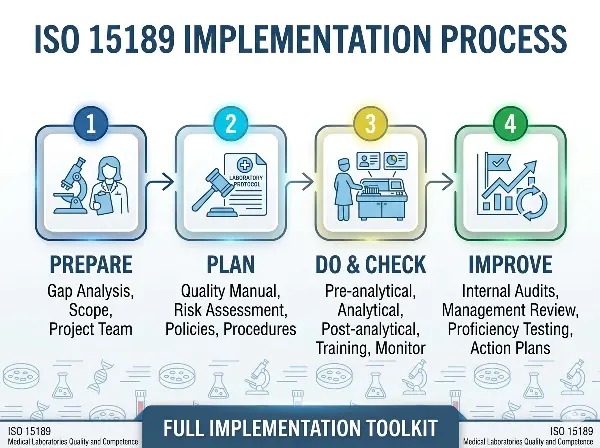
The ISO 15189 Medical Laboratories Quality and Competence Implementation Toolkits provide a comprehensive, Ready to use suite of premium templates and practical resources to help medical laboratories establish, implement, maintain, and continually improve management system and technical competence requirements with consistency, accuracy, and operational confidence.
Aligned with ISO 15189 requirements,this toolkit translates laboratory quality and competence expectations into actionable policies, procedures, records, forms, and monitoring tools enabling organizations to strengthen laboratory governance, support reliable examination processes, improve patient safety, enhance audit and accreditation readiness, and drive sustained performance across clinical laboratory operations.
Implementing requirements aligned with ISO 15189 can be complex and time-consuming, particularly for medical laboratories seeking to strengthen quality, technical competence, and consistent documentation across testing processes and laboratory operations.
The ISO 15189 Medical Laboratories Toolkit package provides a comprehensive set of easy to use templates, procedures, forms, registers, and practical implementation documents in Word and Excel formats, helping your laboratory standardize documentation, improve operational consistency, and accelerate implementation with greater confidence, efficiency, and professional rigor.

Below is the complete list of documents included in the package. Click the index file button to review the full contents in spreadsheet format.
 Part 1. Laboratory Governance, Quality Strategy & Implementation Launch
Objective: To establish the leadership framework, quality policy direction, implementation scope, organizational accountability, and deployment roadmap required to launch and govern an ISO 15189 medical laboratory management system with executive oversight and operational clarity.
 Medical Laboratory Quality Program Charter.docx Laboratory Governance Framework.docx ISO 15189 Scope Definition Statement.docx Quality Policy (Master).docx Laboratory Quality Objectives Framework.docx Organizational Roles & Responsibilities for Laboratory Quality.docx Implementation Communication Plan.docx Accreditation Readiness Roadmap.docx
 Stakeholder Register.xlsx Laboratory RACI Matrix.xlsx Quality Objectives & KPI Register.xlsx Governance Meeting Schedule.xlsx ISO 15189 Implementation Budget Tracker.xlsx
 ISO 15189 Program Kickoff Slides.pptx Executive Leadership Awareness Slides.pptx
Part 2. Impartiality, Confidentiality & Ethics Control
Objective: To ensure laboratory activities are performed impartially, confidentially, and ethically, with documented safeguards over patient information, conflicts of interest, professional conduct, and integrity of examination services.
Impartiality Policy.docx Confidentiality & Patient Information Protection Policy.docx Ethics & Professional Conduct Policy.docx Conflict of Interest Declaration Procedure.docx Confidentiality Breach Response Procedure.docx Conflict of Interest Register.xlsx Confidentiality Acknowledgement Log.xlsx Information Access Authorization Register.xlsx Confidentiality Incident Log.xlsx Confidentiality & Ethics Awareness Slides.pptx
Part 3. Personnel Competence, Authorization & Training Management
Objective: To define how laboratory personnel are recruited, qualified, trained, supervised, authorized, and periodically evaluated to ensure competence across pre-examination, examination, post-examination, and supporting laboratory activities.
Personnel Competence Management Procedure.docx Training, Supervision & Authorization Policy.docx Competency Assessment Procedure.docx Continuing Education & Professional Development Procedure.docx Job Descriptions & Competence Criteria.docx Personnel Competence Matrix.xlsx Training Attendance Register.xlsx Authorization & Sign-off Register.xlsx Annual Competency Review Log.xlsx Continuing Education Tracker.xlsx Personnel Competence Awareness Slides.pptx
Part 4. Facilities, Equipment & Environmental Conditions Control
Objective: To control laboratory accommodation, environmental conditions, utilities, equipment lifecycle, maintenance, calibration coordination, and operational suitability so that examination activities are performed under defined and reliable conditions.
Facilities & Environmental Conditions Policy.docx Laboratory Equipment Management Procedure.docx Equipment Calibration & Maintenance Procedure.docx Environmental Monitoring Procedure.docx Equipment Decommissioning & Disposal Procedure.docx Equipment Inventory Register.xlsx Calibration Schedule.xlsx Preventive Maintenance Log.xlsx Environmental Monitoring Log.xlsx Equipment Downtime & Breakdown Log.xlsx Equipment & Environment Control Slides.pptx
Part 5. Reagents, Consumables, External Services & Supplier Control
Objective: To ensure externally provided products and services, including reagents, calibrators, reference materials, consumables, maintenance services, and referral laboratory services, are selected, approved, monitored, and controlled on a risk-based basis.
Supplier & External Services Control Policy.docx Reagent & Consumable Management Procedure.docx Referral Laboratory Control Procedure.docx Purchasing & Receiving Inspection Procedure.docx Supplier Evaluation & Re-evaluation Criteria.docx Approved Supplier Register.xlsx Reagent Lot Traceability Log.xlsx Consumables Stock Control Register.xlsx Referral Laboratory Register.xlsx Supplier Performance Review.xlsx Supplier Quality Oversight Slides.pptx
Part 6. Metrological Traceability, Measurement Assurance & Reference Systems
Objective: To establish traceability, measurement assurance, calibration hierarchy, reference interval governance, and uncertainty-related control mechanisms necessary to support technically valid and clinically reliable examination results.
Metrological Traceability Policy.docx Measurement Assurance Procedure.docx Reference Materials & Calibrators Control Procedure.docx Reference Interval Verification Procedure.docx Measurement Uncertainty Evaluation Guidance.docx Traceability Register.xlsx Calibrator & Reference Material Log.xlsx Reference Interval Review Register.xlsx Measurement Uncertainty Worksheet.xlsx Metrological Traceability Overview Slides.pptx
Part 7. Examination Request, Patient Preparation & Pre-Examination Control
Objective: To define and standardize pre-examination processes, including service requests, patient instructions, sample collection requirements, specimen acceptance criteria, transportation conditions, receipt, identification, and handling before examination.
Pre-Examination Process Control Procedure.docx Patient Preparation Instructions Framework.docx Sample Collection & Identification Procedure.docx Specimen Acceptance & Rejection Criteria.docx Sample Transport & Stability Requirements.docx Chain of Custody Procedure.docx Test Request Review Log.xlsx Sample Receipt & Accession Register.xlsx Specimen Rejection Log.xlsx Sample Transport Temperature Log.xlsx Pre-Examination Incident Log.xlsx Pre-Examination Quality Slides.pptx
Part 8. Examination Methods, Method Validation & Verification
Objective: To ensure examination methods are selected, validated, verified, authorized, and periodically reviewed using defined technical criteria so that laboratory examinations remain fit for intended clinical use.
Examination Method Selection Policy.docx Method Validation Procedure.docx Method Verification Procedure.docx Method Change Control Procedure.docx Analytical Performance Acceptance Criteria.docx Reference Interval Establishment & Review Procedure.docx Method Validation Master Plan.xlsx Method Validation Protocol.xlsx Method Verification Summary Report.xlsx Analytical Performance Study Register.xlsx Method Change Log.xlsx Method Validation Workshop Slides.pptx Method Verification Summary Slides.pptx
Part 9. Internal Quality Control, EQA/PT & Result Assurance
Objective: To provide the policies, rules, control plans, and records required to monitor examination performance, manage internal quality control, participate in external quality assessment or proficiency testing, and ensure the validity of reported results.
Quality Control Policy.docx Internal Quality Control Procedure.docx EQA / Proficiency Testing Participation Procedure.docx Quality Control Review & Escalation Procedure.docx Result Validity Decision Rules.docx IQC Daily Control Log.xlsx Levey-Jennings / Westgard Worksheet.xlsx EQA / PT Participation Register.xlsx EQA Performance Review Log.xlsx QC Failure & Corrective Action Log.xlsx QC & EQA Assurance Slides.pptx
Part 10. Post-Examination Activities, Reporting & Critical Results Communication
Objective: To define how examination results are reviewed, authorized, released, corrected, communicated, archived, and interpreted where applicable, including urgent notification and critical result escalation protocols.
Result Reporting & Authorization Policy.docx Critical Results Notification Procedure.docx Amended Report Control Procedure.docx Turnaround Time Monitoring Procedure.docx Report Retention & Release Procedure.docx Clinical Consultation & Interpretive Comment Guidance.docx Critical Results Communication Log.xlsx Amended Report Register.xlsx Turnaround Time Dashboard.xlsx Report Release Authorization Matrix.xlsx Result Communication Incident Log.xlsx Result Reporting Excellence Slides.pptx
Part 11. Laboratory Information Management, Data Integrity & Digital Records
Objective: To control laboratory information systems, digital records, interfaces, result data integrity, user authorization, backup, recovery, cybersecurity coordination, and confidentiality safeguards across the laboratory information lifecycle.
Laboratory Information Management Policy.docx LIS / Middleware Change Control Procedure.docx Data Integrity & Electronic Records Procedure.docx User Access & Authorization Procedure.docx Backup, Recovery & Archive Procedure.docx Interface Validation Guidance.docx LIS User Access Register.xlsx System Change Log.xlsx Backup Verification Log.xlsx Interface Validation Register.xlsx Data Integrity Incident Log.xlsx Laboratory Information Governance Slides.pptx
Part 12. Risk Management, Opportunities & Change Control
Objective: To identify, assess, prioritize, and control risks and opportunities affecting patient care, examination quality, laboratory operations, and system effectiveness, while ensuring planned changes are evaluated and implemented under controlled conditions.
Risk & Opportunity Management Policy.docx Laboratory Risk Assessment Methodology.docx Change Control Procedure.docx Patient Safety Risk Escalation Procedure.docx Opportunity Improvement Planning Guide.docx Risk Register.xlsx Opportunity Register.xlsx Change Impact Assessment.xlsx Change Control Log.xlsx Patient Safety Risk Log.xlsx Risk-Based Thinking Slides.pptx
Part 13. Nonconformities, Complaints, Occurrence Management & CAPA
Objective: To provide a disciplined framework for recording, investigating, correcting, and preventing laboratory nonconformities, service complaints, process failures, and quality occurrences in a manner that protects patient care and drives systemic improvement.
Nonconformity & Corrective Action Procedure.docx Complaint Handling Procedure.docx Occurrence Management Procedure.docx Root Cause Analysis Guidance.docx Corrective Action Effectiveness Review Procedure.docx Nonconformity Register.xlsx Complaint Log.xlsx Corrective Action Tracker.xlsx Root Cause Analysis Worksheet.xlsx CAPA Effectiveness Review Log.xlsx CAPA & Quality Events Slides.pptx
Part 14. Internal Audit, Quality Indicators & Management Review
Objective: To support systematic evaluation of laboratory performance through internal audits, quality indicators, trend analysis, management review, and evidence-based oversight of quality system effectiveness and service conformity.
Internal Audit Policy.docx Audit Planning & Execution Procedure.docx Quality Indicators Monitoring Procedure.docx Management Review Procedure.docx Quality Performance Reporting Standard.docx Internal Audit Program.xlsx Audit Checklist.xlsx Audit Findings Register.xlsx Quality Indicators Dashboard.xlsx Management Review Action Log.xlsx Audit & Management Review Slides.pptx Laboratory Performance Review Slides.pptx
Part 15. Point-of-Care Testing (POCT) Oversight & Network Control
Objective: To provide governance, technical oversight, training, quality control, connectivity, and compliance records for point-of-care testing services operating under the medical laboratory quality framework.
POCT Governance Policy.docx POCT Operator Training & Authorization Procedure.docx POCT Quality Control Procedure.docx POCT Device Management Procedure.docx POCT Result Review & Escalation Procedure.docx POCT Device Inventory.xlsx POCT Operator Competency Register.xlsx POCT QC Log.xlsx POCT Site Review Checklist.xlsx POCT Incident & Escalation Log.xlsx POCT Governance Slides.pptx
Part 16. Document Control, Records Retention & Continuous Improvement
Objective: To govern the creation, approval, review, distribution, retention, version control, archival, and continuous improvement of laboratory documents and records while sustaining long-term ISO 15189 conformity and accreditation readiness.
Document Control Procedure.docx Record Retention & Archival Policy.docx Controlled Template Management Procedure.docx Continuous Improvement Procedure.docx Annual Quality System Review Plan.docx Master Document Register.xlsx Record Retention Schedule.xlsx Document Revision History Log.xlsx Obsolete Document Withdrawal Log.xlsx Continuous Improvement Register.xlsx Accreditation Evidence Index.xlsx Continuous Improvement Roadmap Slides.pptxUse these quick links to review the full file list and payment instructions.


| Date File Updated | 25/03/2025 |
| File Format | pdf, xls, doc, docx, xlsx, pptx |
| No. of files | 185 Files, 16 Folders |
| File download size | 91.90 MB (.rar) |
| Language |
 English
|
| Purchase code | ISO15189-Toolkits |
The ISO Toolkit has helped us structure our implementation work clearly. It gave our team practical templates, organized procedures, and a reliable starting point for building our management system documentation.
After using the ISO Toolkit, our ISO preparation became much more organized. The documents are professional, easy to adapt, and helpful for aligning internal teams around clear compliance requirements.
Our consultants and internal managers found the toolkit very practical. It saved time, improved documentation consistency, and gave us a better framework for ISO implementation across departments.
The toolkit provides a strong foundation for ISO best practices. It helped us organize policies, procedures, records, and improvement actions in a way that is simple to maintain.
The ISO Toolkit brought structure to our compliance documentation and reduced the workload for our implementation team. It allowed us to focus more on improving processes instead of starting documents from scratch.
The ISO Toolkit is practical, well arranged, and easy to customize. It helped replace scattered files with a more complete document set for managing our ISO implementation activities.
The toolkit is very straightforward to use. It gave our team a clear implementation path, helped define responsibilities, and made ISO documentation easier for non-specialists to understand.
The ISO Toolkit gave us a better understanding of management system requirements and provided a user-friendly way to improve processes, controls, and internal documentation.
The toolkit helped me organize our ISO training, document review, and implementation planning. It made the entire preparation process more focused and easier to communicate with the team.
Excellent ISO Toolkit. It is highly useful for managers, consultants, and implementation teams who need practical documents to support ISO certification readiness.
A very useful toolkit and one of the most practical document sets I have used. It provides clear templates that can be adapted quickly for different ISO implementation needs.
These ISO Toolkits increased my confidence in managing implementation work. They helped us prepare documentation, assign responsibilities, and move toward a more mature management system.