
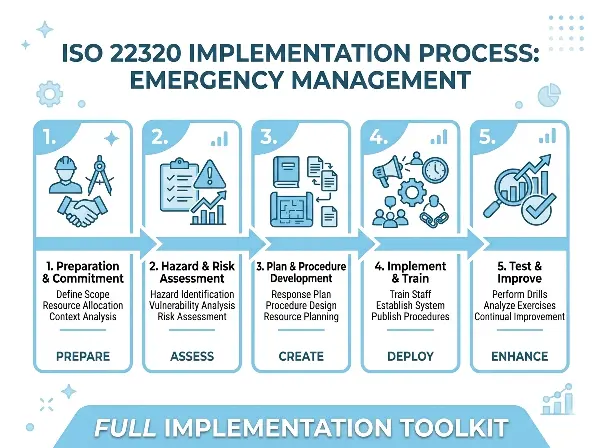
The ISO 22320 Emergency Management Implementation Toolkit provides a comprehensive, easy to use package of professional templates and practical guidance to help organizations establish, implement, maintain, and improve effective emergency management and incident response arrangements.
Aligned with ISO 22320 guidelines for incident management, this toolkit converts emergency management requirements into structured policies, procedures, forms, registers, workbooks, slides, and tracking tools. It supports command, coordination, communication, resource control, situation reporting, operational readiness, recovery coordination, and continual improvement across complex incident environments.
Implementing emergency management arrangements aligned with ISO 22320 can be complex and demanding, especially for organizations that require clear command structures, coordinated communication, incident documentation, resource visibility, situation reporting, and rapid operational response.
The ISO 22320 Emergency Management Implementation Toolkit provides a comprehensive set of easy to use templates, procedures, forms, registers, and implementation documents in Word, Excel, and PowerPoint formats. It helps your organization strengthen incident management capability, standardize emergency documentation, improve operational coordination, and build emergency readiness with greater speed, control, and confidence.

Below is the structured list of documents included in the package. Use the quick navigation or expand each part to review the files before downloading the index file.
 Part 1. Emergency Management Program Initiation & Governance
Objective: To establish the governance structure, implementation scope, leadership responsibilities, policy direction, stakeholder alignment, and executive oversight required to launch and govern the emergency management program effectively.
 Emergency Management Program Charter.docx Emergency Management Governance Framework.docx Emergency Management Policy (Master).docx ISO 22320 Scope Definition.docx Emergency Management Objectives & Principles.docx Leadership Roles & Responsibilities for Incident Management.docx Stakeholder Communication & Escalation Framework.docx Emergency Management Implementation Roadmap.docx
 Stakeholder Register.xlsx Governance RACI Matrix.xlsx Program Milestone Tracker.xlsx Executive Review Schedule.xlsx Emergency Management Budget Tracker.xlsx
 Program Kickoff Slides.pptx Executive Awareness Slides.pptx
Part 2. Incident Management Framework & Command Structure
Objective: To define the incident management structure, command model, authority levels, coordination principles, and operational roles needed to manage incidents consistently across different types and scales of emergencies.
Incident Management Framework.docx Incident Command Policy.docx Incident Command Structure Guidelines.docx Incident Escalation Procedure.docx Command Authority & Delegation Procedure.docx Incident Level Classification Standard.docx Incident Leadership Role Cards.docx Incident Severity Matrix.xlsx Command Role Assignment Register.xlsx Incident Activation Log.xlsx Escalation Decision Log.xlsx Incident Command Overview Slides.pptx Leadership Briefing Slides.pptx
Part 3. Emergency Coordination & Multi-Agency Cooperation
Objective: To establish the structures, procedures, and coordination mechanisms required for joint direction, interdepartmental cooperation, external agency alignment, and unified operational decision making during emergencies.
Emergency Coordination Framework.docx Joint Operations Coordination Procedure.docx Multi-Agency Cooperation Protocol.docx Emergency Operations Centre (EOC) Operating Procedure.docx Coordination Meeting Guidelines.docx External Authority Liaison Procedure.docx Coordination Contact Register.xlsx Agency Interface Matrix.xlsx Coordination Meeting Action Log.xlsx EOC Staffing Roster.xlsx Emergency Coordination Slides.pptx Joint Operations Briefing Slides.pptx
Part 4. Incident Assessment, Situation Awareness & Reporting
Objective: To support timely incident assessment, development of a common operating picture, structured situation reporting, intelligence consolidation, and informed decision making throughout the emergency lifecycle.
Incident Assessment Procedure.docx Situation Reporting Standard.docx Common Operating Picture Guidelines.docx Operational Intelligence Collection Procedure.docx Rapid Impact Assessment Template.docx Decision Support Briefing Template.docx Initial Incident Assessment Form.xlsx Situation Report Log.xlsx Incident Status Dashboard.xlsx Key Decision Register.xlsx Operational Assumption Log.xlsx Situation Report Briefing Slides.pptx
Part 5. Emergency Communication, Notification & Information Sharing
Objective: To define the communication channels, internal and external notification procedures, message control methods, and information-sharing arrangements required to support coordinated and credible emergency response.
Emergency Communication Plan.docx Incident Notification Procedure.docx Stakeholder Information-Sharing Protocol.docx Media & Public Communication Guidelines.docx Message Approval & Release Procedure.docx Crisis Communication Holding Statements.docx Emergency Contact Directory.xlsx Notification Cascade Tracker.xlsx Communication Log.xlsx Stakeholder Message Register.xlsx Emergency Communication Slides.pptx Spokesperson Briefing Slides.pptx
Part 6. Resource Management & Operational Support
Objective: To define how people, equipment, facilities, services, and critical support resources are identified, mobilized, tracked, allocated, sustained, and demobilized during incident operations.
Emergency Resource Management Policy.docx Resource Mobilization Procedure.docx Logistics Support Procedure.docx Personnel Deployment Guidelines.docx Mutual Aid & External Support Procedure.docx Resource Demobilization Checklist.docx Emergency Resource Register.xlsx Resource Allocation Tracker.xlsx Logistics Request Log.xlsx Personnel Deployment Roster.xlsx Equipment Status Register.xlsx Resource Management Overview Slides.pptx
Part 7. Operational Response Procedures & Incident Action Planning
Objective: To provide the procedures, response checklists, tactical planning tools, and operational records needed to execute coordinated actions and maintain control throughout active incident response.
Incident Response Procedure.docx Incident Action Planning Procedure.docx Response Checklist Toolkit.docx Operational Period Planning Template.docx Tactical Briefing Template.docx Shift Handover Procedure.docx Incident Action Plan Tracker.xlsx Response Task Assignment Log.xlsx Operational Briefing Register.xlsx Shift Handover Log.xlsx Response Timeline Tracker.xlsx Response Operations Slides.pptx
Part 8. Business Continuity Interface, Recovery & Return to Normal Operations
Objective: To coordinate the transition from incident response to service stabilization, continuity arrangements, recovery execution, and orderly return to normal operations with documented responsibilities and priorities.
Response-to-Recovery Transition Procedure.docx Service Recovery Coordination Guidelines.docx Critical Service Restoration Plan.docx Recovery Prioritization Framework.docx Return to Normal Operations Checklist.docx Critical Activities Recovery Register.xlsx Service Restoration Tracker.xlsx Recovery Dependency Matrix.xlsx Return-to-Normal Approval Log.xlsx Recovery Management Slides.pptx
Part 9. Training, Exercises & Capability Development
Objective: To strengthen emergency management capability through structured awareness, role-based training, drills, simulation exercises, exercise evaluation, and corrective action follow-up.
Emergency Management Training Policy.docx Competence & Capability Development Plan.docx Exercise Management Procedure.docx Tabletop Exercise Scenario Pack.docx Drill Evaluation Form.docx Exercise After-Action Review Template.docx Training Attendance Register.xlsx Exercise Schedule.xlsx Capability Assessment Matrix.xlsx Corrective Action Tracker.xlsx Emergency Response Training Slides.pptx Tabletop Exercise Facilitation Slides.pptx
Part 10. Monitoring, Performance Evaluation & Continual Improvement
Objective: To measure performance, monitor operational effectiveness, capture lessons learned, review incident outcomes, and drive continual improvement of the emergency management framework over time.
Emergency Management Performance Monitoring Procedure.docx Post-Incident Review Procedure.docx Lessons Learned Framework.docx Management Review Guidelines.docx Continual Improvement Plan.docx Emergency KPI Dashboard.xlsx Incident Performance Scorecard.xlsx Lessons Learned Register.xlsx Improvement Action Tracker.xlsx Management Review Action Log.xlsx Post-Incident Review Slides.pptx Management Review Slides.pptx
Part 11. Documentation Control & Emergency Records Management
Objective: To ensure emergency management documents, incident records, logs, forms, approvals, and evidence are controlled, versioned, retained, and retrievable in a manner suitable for governance, learning, and assurance purposes.
Document Control Procedure.docx Emergency Records Management Policy.docx Document Approval Workflow.docx Record Retention & Archiving Guidelines.docx Confidential Incident Information Handling Procedure.docx Emergency Document Register.xlsx Incident Record Index.xlsx Document Change Log.xlsx Record Retention Schedule.xlsx Controlled Copy Distribution Register.xlsx Document Control Awareness Slides.pptxUse these quick links to review the full file list and payment instructions.


| Date File Updated | 25/03/2025 |
| File Format | pdf, xls, doc, docx, xlsx, pptx |
| No. of files | 133 Files, 11 Folders |
| File download size | 50.44 MB (.rar) |
| Language |
 English
|
| Purchase code | ISO22320-Toolkits |
The ISO Toolkit has helped us structure our implementation work clearly. It gave our team practical templates, organized procedures, and a reliable starting point for building our management system documentation.
After using the ISO Toolkit, our ISO preparation became much more organized. The documents are professional, easy to adapt, and helpful for aligning internal teams around clear compliance requirements.
Our consultants and internal managers found the toolkit very practical. It saved time, improved documentation consistency, and gave us a better framework for ISO implementation across departments.
The toolkit provides a strong foundation for ISO best practices. It helped us organize policies, procedures, records, and improvement actions in a way that is simple to maintain.
The ISO Toolkit brought structure to our compliance documentation and reduced the workload for our implementation team. It allowed us to focus more on improving processes instead of starting documents from scratch.
The ISO Toolkit is practical, well arranged, and easy to customize. It helped replace scattered files with a more complete document set for managing our ISO implementation activities.
The toolkit is very straightforward to use. It gave our team a clear implementation path, helped define responsibilities, and made ISO documentation easier for non-specialists to understand.
The ISO Toolkit gave us a better understanding of management system requirements and provided a user-friendly way to improve processes, controls, and internal documentation.