
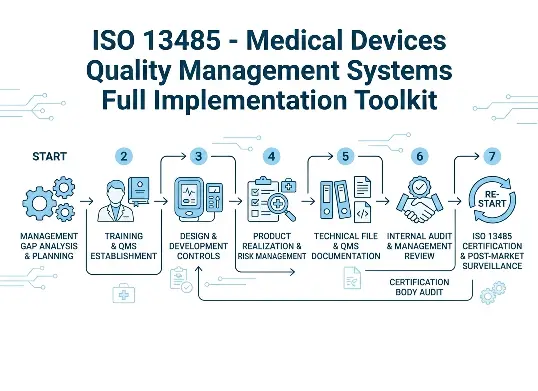
The ISO 13485 Medical Devices Quality Management Systems Implementation Toolkit provides a comprehensive, easy to use set of professional templates and practical guidance to help organizations establish, implement, maintain, and continually improve an effective quality management system for medical devices with greater structure, control, and regulatory discipline.
Aligned with ISO 13485 requirements, this toolkit translates complex quality and regulatory expectations into actionable policies, procedures, registers, workbooks, slides, and tracking tools. It helps teams standardize quality operations, strengthen process control, improve documentation consistency, support compliance readiness, and build a disciplined, reliable, and ready for implementation medical device organization.
Implementing a Medical Devices Quality Management System aligned with ISO 13485 can be complex and time-consuming, especially for organizations that require rigorous documentation, controlled processes, regulatory discipline, traceable records, and consistent compliance across product lifecycle and quality operations.
The ISO 13485 Medical Devices Quality Management Systems Implementation Toolkit provides a comprehensive collection of easy to use templates and structured implementation documents in Word, Excel, and PowerPoint formats. It helps your organization accelerate QMS implementation, standardize documentation, strengthen quality and regulatory control, improve lifecycle evidence management, and support certification readiness with greater confidence.

Below is the structured list of documents included in the package. Use the quick navigation or expand each part to review the files before downloading the index file.
 Part 1. QMS Program Initiation & Governance
Objective: To establish the quality management system governance structure, implementation scope, quality policy, regulatory oversight, organizational responsibilities, and executive direction required to launch and control the ISO 13485 implementation program effectively.
 ISO 13485 Implementation Charter.docx Medical Device QMS Governance Framework.docx QMS Scope Definition.docx Quality Policy (Master).docx Quality Objectives & Compliance Commitments.docx Regulatory Responsibility Assignment.docx Organization Roles & Responsibilities.docx QMS Implementation Roadmap.docx
 Stakeholder Register.xlsx QMS RACI Matrix.xlsx Quality Objectives & KPI Register.xlsx Regulatory Requirement Register.xlsx Governance Meeting Schedule.xlsx
 ISO 13485 Program Kickoff Slides.pptx Executive Quality Awareness Slides.pptx
Part 2. Document Control & Record Management
Objective: To define how quality documents and records are created, reviewed, approved, issued, revised, retained, archived, and protected to ensure controlled evidence across the medical device lifecycle.
Document Control Procedure.docx Record Retention & Archiving Policy.docx Controlled Form Management Procedure.docx Document Change Control Procedure.docx Electronic Record Administration Guideline.docx Master Document Register.xlsx Record Retention Schedule.xlsx Document Revision History Log.xlsx Document Approval Log.xlsx Obsolete Document Withdrawal Log.xlsx Document Control Awareness Slides.pptx
Part 3. Regulatory Strategy & Product Compliance Planning
Objective: To define the regulatory pathway, product compliance obligations, intended use statements, product classification assumptions, and market-specific planning requirements needed to align the QMS with applicable regulatory purposes.
Regulatory Strategy Procedure.docx Applicable Regulatory Requirements Mapping.docx Intended Use & Indications Definition Template.docx Product Classification Rationale.docx Market Authorization Planning Guide.docx Regulatory Submission Tracker.xlsx Product Classification Register.xlsx Standards & Guidance Mapping Register.xlsx Country Market Access Matrix.xlsx Regulatory Strategy Overview Slides.pptx
Part 4. Design & Development Control Toolkit
Objective: To establish the planning, design input, design output, review, verification, validation, transfer, and design change controls required to manage medical device development in a disciplined and auditable manner.
Design & Development Procedure.docx Design Control Plan.docx Design Input Specification Template.docx Design Output Specification Template.docx Design Review Procedure.docx Design Verification Protocol Template.docx Design Validation Protocol Template.docx Design Transfer Procedure.docx Design Change Control Procedure.docx Design & Development Plan Tracker.xlsx Design Review Log.xlsx Verification & Validation Matrix.xlsx Design Change Log.xlsx Design Traceability Matrix.xlsx Design Control Overview Slides.pptx Design Review Workshop Slides.pptx
Part 5. Risk Management & Usability Engineering
Objective: To define the methodologies, criteria, and records required to identify hazards, estimate and evaluate risks, implement risk controls, assess residual risk, and maintain risk files throughout the product lifecycle.
Medical Device Risk Management Procedure.docx Risk Acceptability Criteria.docx Hazard Identification Guideline.docx Risk Control Measure Planning Template.docx Residual Risk Evaluation Template.docx Risk Management Report Template.docx Usability Engineering Plan Template.docx Hazard Analysis Register.xlsx Risk Analysis Worksheet.xlsx Risk Control Effectiveness Tracker.xlsx Benefit-Risk Assessment Log.xlsx Usability Issue Register.xlsx Risk Management Workshop Slides.pptx Risk File Review Slides.pptx
Part 6. Supplier & External Provider Control
Objective: To define supplier selection, qualification, monitoring, purchasing controls, quality agreements, and outsourced process oversight needed to ensure externally provided products and services meet specified requirements.
Supplier Control Procedure.docx Purchasing Control Procedure.docx Supplier Qualification Criteria.docx Supplier Quality Agreement Template.docx Outsourced Process Oversight Guideline.docx Approved Supplier Maintenance Procedure.docx Approved Supplier List.xlsx Supplier Evaluation Scorecard.xlsx Supplier Audit Plan.xlsx Incoming Supplier Performance Register.xlsx Supplier Change Notification Log.xlsx Supplier Quality Control Slides.pptx
Part 7. Production & Process Control
Objective: To establish the procedures, specifications, validation activities, work instructions, and operational controls needed to manufacture and service medical devices consistently in accordance with approved requirements.
Production Control Procedure.docx Process Validation Procedure.docx Work Instruction Template.docx Manufacturing Batch Release Procedure.docx Rework & Reprocessing Procedure.docx Process Change Control Procedure.docx Process Validation Master Plan.xlsx Manufacturing Process Register.xlsx Batch Record Review Log.xlsx Process Deviation Log.xlsx Rework Authorization Log.xlsx Production Control Awareness Slides.pptx
Part 8. Equipment, Calibration & Maintenance Control
Objective: To ensure inspection, measuring, monitoring, and production equipment are appropriately identified, calibrated, maintained, qualified, and controlled to support reliable product realization and quality evidence.
Equipment Control Procedure.docx Calibration Management Procedure.docx Preventive Maintenance Procedure.docx Equipment Qualification Protocol Template.docx Out-of-Calibration Response Procedure.docx Equipment Register.xlsx Calibration Schedule.xlsx Preventive Maintenance Log.xlsx Equipment Qualification Tracker.xlsx Equipment Breakdown Log.xlsx Calibration & Maintenance Slides.pptx
Part 9. Identification, Traceability & Device Status Control
Objective: To define how product status, lot or serial traceability, inspection release condition, and special traceability requirements are controlled to support product conformity, field action readiness, and regulatory accountability.
Product Identification & Traceability Procedure.docx Status Identification Control Procedure.docx Product Release & Acceptance Procedure.docx Implantable Device Traceability Guideline.docx Unique Device Identification Data Guide.docx Lot & Serial Number Register.xlsx Device Traceability Matrix.xlsx Product Release Log.xlsx Label Reconciliation Log.xlsx Returned Device Traceability Log.xlsx Traceability Control Slides.pptx
Part 10. Inspection, Testing & Nonconforming Product Control
Objective: To define incoming, in-process, and final inspection controls, acceptance criteria, test evidence, segregation practices, and nonconforming product disposition to ensure only conforming product is released.
Inspection & Testing Procedure.docx Acceptance Criteria Definition Template.docx Final Release Verification Procedure.docx Nonconforming Product Control Procedure.docx Material Review Board Guideline.docx Incoming Inspection Log.xlsx In-Process Inspection Record.xlsx Final Inspection & Release Log.xlsx Nonconforming Product Register.xlsx Scrap, Rework & Concession Log.xlsx Inspection & Release Control Slides.pptx
Part 11. Technical Documentation & Device File Management
Objective: To establish the structure, ownership, compilation, maintenance, and review controls for device technical documentation, product files, specifications, labeling records, and supporting compliance evidence.
Technical Documentation Compilation Procedure.docx Medical Device File Structure Guide.docx Device Description & Specification Template.docx Labeling & IFU Control Procedure.docx Product Specification Sheet Template.docx Essential Documentation Review Checklist.docx Device Master Documentation Index.xlsx Technical File Completeness Checklist.xlsx Labeling Version Register.xlsx Product Specification Register.xlsx IFU Approval Tracker.xlsx Technical Documentation Overview Slides.pptx
Part 12. Complaint Handling, Vigilance & CAPA
Objective: To define the processes for complaint intake, evaluation, investigation, trend review, adverse event escalation, corrective action, preventive action, and effectiveness verification across the post-market lifecycle.
Complaint Handling Procedure.docx Vigilance & Escalation Procedure.docx CAPA Procedure.docx Root Cause Analysis Template.docx Field Action Assessment Guideline.docx Complaint Investigation Report Template.docx Complaint Register.xlsx Complaint Triage & Classification Log.xlsx CAPA Tracker.xlsx Effectiveness Verification Log.xlsx Adverse Event Assessment Register.xlsx Complaint Trend Analysis Dashboard.xlsx Complaint & CAPA Awareness Slides.pptx CAPA Review Meeting Slides.pptx
Part 13. Internal Audit, Management Review & Continuous Improvement
Objective: To support systematic internal audit, management review, quality performance evaluation, issue escalation, and structured improvement planning across the medical device QMS.
Internal Audit Procedure.docx Management Review Procedure.docx Audit Report Template.docx Continuous Improvement Procedure.docx Management Review Agenda & Minutes Template.docx Annual Internal Audit Program.xlsx Process Audit Checklist.xlsx Audit Findings Register.xlsx Improvement Action Tracker.xlsx Management Review KPI Dashboard.xlsx Audit Results Presentation Slides.pptx Management Review Slides.pptx
Part 14. Training, Competence & Personnel Awareness
Objective: To establish competence requirements, training plans, qualification evidence, awareness activities, and role-based capability controls for personnel performing work affecting product quality and regulatory compliance.
Training & Competence Procedure.docx Competency Framework by Function.docx Training Needs Analysis Template.docx Employee Competence Assessment Form.docx QMS Awareness Communication Plan.docx Training Matrix.xlsx Training Attendance Register.xlsx Competency Evaluation Log.xlsx Retraining & Recertification Tracker.xlsx ISO 13485 Staff Awareness Slides.pptx Role-Based Quality Training Slides.pptx
Part 15. Monitoring, Measurement & Quality Reporting
Objective: To define quality monitoring methods, process metrics, complaint and CAPA trends, supplier performance measures, and management reporting structures needed to assess QMS effectiveness on an ongoing basis.
Monitoring & Measurement Procedure.docx Quality Reporting Procedure.docx KPI & Trend Review Guideline.docx Quality KPI Dashboard.xlsx Supplier Performance Dashboard.xlsx CAPA Trend Analysis.xlsx Complaint Trending Dashboard.xlsx Process Performance Scorecard.xlsx Monthly Quality Report Slides.pptx Quality Review Dashboard Slides.pptx
Part 16. Software, Data Integrity & Digital QMS Controls
Objective: To define software validation, spreadsheet control, electronic data integrity, system access, and digital quality record controls where computerized systems are used within the medical device quality management system.
Computerized System Validation Procedure.docx Spreadsheet Validation Guideline.docx Electronic Data Integrity Policy.docx eQMS Access Administration Procedure.docx Software Change Assessment Template.docx Validated Systems Register.xlsx System Access Register.xlsx Validation Test Evidence Log.xlsx Audit Trail Review Log.xlsx Digital QMS Control Slides.pptxUse these quick links to review the full file list and payment instructions.


| Date File Updated | 25/03/2025 |
| File Format | pdf, xls, doc, docx, xlsx, pptx |
| No. of files | 192 Files, 16 Folders |
| File download size | 35.93 MB (.rar) |
| Language |
 English
|
| Purchase code | ISO13485-Toolkits |
The ISO Toolkit has helped us structure our implementation work clearly. It gave our team practical templates, organized procedures, and a reliable starting point for building our management system documentation.
After using the ISO Toolkit, our ISO preparation became much more organized. The documents are professional, easy to adapt, and helpful for aligning internal teams around clear compliance requirements.
Our consultants and internal managers found the toolkit very practical. It saved time, improved documentation consistency, and gave us a better framework for ISO implementation across departments.
The toolkit provides a strong foundation for ISO best practices. It helped us organize policies, procedures, records, and improvement actions in a way that is simple to maintain.
The ISO Toolkit brought structure to our compliance documentation and reduced the workload for our implementation team. It allowed us to focus more on improving processes instead of starting documents from scratch.
The ISO Toolkit is practical, well arranged, and easy to customize. It helped replace scattered files with a more complete document set for managing our ISO implementation activities.
The toolkit is very straightforward to use. It gave our team a clear implementation path, helped define responsibilities, and made ISO documentation easier for non-specialists to understand.
The ISO Toolkit gave us a better understanding of management system requirements and provided a user-friendly way to improve processes, controls, and internal documentation.
The toolkit helped me organize our ISO training, document review, and implementation planning. It made the entire preparation process more focused and easier to communicate with the team.
Excellent ISO Toolkit. It is highly useful for managers, consultants, and implementation teams who need practical documents to support ISO certification readiness.
A very useful toolkit and one of the most practical document sets I have used. It provides clear templates that can be adapted quickly for different ISO implementation needs.
These ISO Toolkits increased my confidence in managing implementation work. They helped us prepare documentation, assign responsibilities, and move toward a more mature management system.