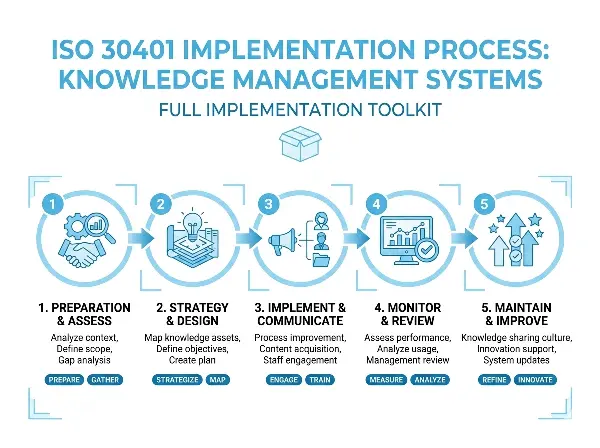
The ISO 30401 Knowledge Management Systems Implementation Toolkits provide a comprehensive, easy to use set of professional templates and practical guidance to help organizations establish, implement, maintain, and continually improve an effective knowledge management system with greater structure, consistency, and organizational value.
Aligned with ISO 30401 requirements, this toolkit translates complex knowledge management expectations into actionable documents, procedures, registers, and tracking tools enabling teams to strengthen knowledge governance, standardize knowledge capture and sharing practices, improve organizational learning, support better decision making, and build a more connected, resilient, and ready for implementation organization with confidence.
Implementing a Knowledge Management System aligned with ISO 30401 can be complex and time-consuming, especially for organizations that require structured documentation, consistent governance, and effective control over knowledge creation, sharing, retention, and continual improvement across the enterprise.
The ISO 30401 Knowledge Management Systems Implementation Toolkits package provides a comprehensive collection of easy to use templates and structured implementation documents in Word, Excel, and PowerPoint formats. It helps your organization accelerate KMS implementation, standardize documentation, strengthen knowledge governance, improve organizational learning, and support certification readiness with greater confidence and long-term business value.

Below is the structured list of documents included in the package. Use the quick navigation or expand each part to review the files before downloading the index file.
 Part 1. KM Program Initiation & Governance Framework
Objective: To establish the strategic mandate, governance model, scope, policy structure, leadership accountability, stakeholder alignment, and implementation direction required to launch and govern the Knowledge Management System (KMS) effectively across the enterprise.
 KMS Program Charter.docx Knowledge Management Governance Framework.docx KMS Scope Definition.docx Knowledge Management Policy (Master).docx Knowledge Management Objectives & Strategic Alignment.docx Knowledge Governance Roles & Responsibilities.docx KMS Communication & Change Plan.docx Knowledge Management Implementation Roadmap.docx
 Stakeholder Register.xlsx KMS RACI Matrix.xlsx KM Objectives & KPI Register.xlsx Governance Meeting Schedule.xlsx KMS Budget Tracker.xlsx
 KM Program Kickoff Slides.pptx Executive Knowledge Leadership Slides.pptx
Part 2. Organizational Context & Knowledge Needs Analysis
Objective: To identify the internal and external issues, stakeholder expectations, business priorities, and knowledge needs that shape the design, relevance, and business value of the Knowledge Management System.
Organizational Context Analysis Methodology.docx Interested Parties & Knowledge Expectations Analysis.docx Business Knowledge Needs Assessment Procedure.docx Strategic Knowledge Domains Definition.docx Knowledge Value Criteria.docx Organizational Context Register.xlsx Interested Parties Register.xlsx Knowledge Needs Assessment Register.xlsx Strategic Knowledge Domains Matrix.xlsx KM Context Analysis Slides.pptx
Part 3. Knowledge Asset Identification & Critical Knowledge Mapping
Objective: To define how organizational knowledge assets are identified, categorized, evaluated, and mapped so that critical knowledge can be protected, leveraged, transferred, and sustained.
Knowledge Asset Management Policy.docx Knowledge Classification Framework.docx Critical Knowledge Identification Procedure.docx Tacit and Explicit Knowledge Mapping Guidelines.docx Knowledge Ownership & Stewardship Standard.docx Knowledge Asset Register.xlsx Critical Knowledge Register.xlsx Knowledge Domain Ownership Matrix.xlsx Knowledge Classification Register.xlsx Knowledge Flow Mapping Sheet.xlsx Critical Knowledge Mapping Slides.pptx
Part 4. Knowledge Capture, Creation & Validation
Objective: To establish structured methods for capturing tacit and explicit knowledge, generating new knowledge, validating content quality, and ensuring business-critical know-how is retained in usable form.
Knowledge Capture Procedure.docx Expert Interview & Knowledge Elicitation Guide.docx Lessons Capture Methodology.docx Knowledge Validation & Approval Procedure.docx Knowledge Authoring Template.docx Knowledge Retention for Key Experts Procedure.docx Knowledge Capture Log.xlsx Expert Knowledge Interview Tracker.xlsx Knowledge Validation Register.xlsx Knowledge Retention Plan.xlsx Knowledge Capture Workshop Slides.pptx
Part 5. Knowledge Repository & Content Lifecycle Management
Objective: To define the structure, standards, controls, and lifecycle rules required to organize, store, curate, retrieve, review, archive, and retire knowledge content within enterprise repositories.
Knowledge Repository Governance Standard.docx Metadata & Taxonomy Design Guidelines.docx Knowledge Content Lifecycle Procedure.docx Repository Access & Publishing Rules.docx Content Review & Obsolescence Control Procedure.docx Repository Content Register.xlsx Metadata Schema Register.xlsx Taxonomy Structure Matrix.xlsx Content Review Schedule.xlsx Archived Knowledge Index.xlsx Repository Governance Overview Slides.pptx
Part 6. Knowledge Sharing, Transfer & Reuse
Objective: To establish the policies, practices, and operational tools needed to promote knowledge exchange, cross-functional transfer, practical reuse, and faster application of trusted knowledge across teams and business units.
Knowledge Sharing Policy.docx Knowledge Transfer Procedure.docx Cross-Functional Knowledge Exchange Guidelines.docx Knowledge Reuse & Replication Framework.docx Exit Knowledge Transfer Checklist.docx Onboarding Knowledge Assimilation Plan.docx Knowledge Transfer Register.xlsx Reusable Knowledge Assets Log.xlsx Exit Knowledge Handover Tracker.xlsx Onboarding Knowledge Checklist.xlsx Knowledge Sharing Enablement Slides.pptx
Part 7. Lessons Learned & Organizational Learning
Objective: To institutionalize post-activity learning, lessons identification, root-cause reflection, and continuous learning loops so that experience is systematically converted into improved practices and decisions.
Lessons Learned Policy.docx Post-Project Review Procedure.docx After Action Review Methodology.docx Organizational Learning Framework.docx Learning Dissemination Procedure.docx Lessons Learned Register.xlsx After Action Review Tracker.xlsx Improvement Insights Log.xlsx Learning Adoption Tracker.xlsx Lessons Learned Workshop Slides.pptx
Part 8. Communities of Practice & Collaboration Enablement
Objective: To enable collaborative knowledge creation and exchange through communities of practice, peer networks, expert forums, facilitation structures, and participation mechanisms that strengthen organizational capability.
Communities of Practice Framework.docx Collaboration & Knowledge Networking Guidelines.docx Community Facilitator Role Description.docx Knowledge Forum Operating Procedure.docx Expert Directory Management Procedure.docx Community of Practice Register.xlsx Expert Directory.xlsx Collaboration Session Log.xlsx Community Participation Tracker.xlsx Collaboration & CoP Launch Slides.pptx
Part 9. Knowledge Culture, Competence & Awareness
Objective: To strengthen the cultural, behavioral, and competency foundations required for sustainable knowledge management by defining awareness expectations, learning pathways, incentives, and role-based capability development.
Knowledge Culture Development Plan.docx KM Competency Framework.docx KM Awareness & Training Procedure.docx Knowledge Leadership Expectations.docx Knowledge Contribution Recognition Guidelines.docx KM Competency Assessment.xlsx Training Attendance Register.xlsx Awareness Campaign Calendar.xlsx Knowledge Participation Scorecard.xlsx KM Awareness Training Slides.pptx Knowledge Culture Leadership Slides.pptx
Part 10. Critical Knowledge Risk & Continuity Protection
Objective: To identify, assess, and treat risks associated with loss, inaccessibility, concentration, obsolescence, or misuse of critical knowledge, and to ensure continuity of essential know-how during organizational change or disruption.
Critical Knowledge Risk Management Policy.docx Knowledge Risk Assessment Methodology.docx Knowledge Continuity Planning Procedure.docx Single-Point-of-Knowledge Dependency Guidelines.docx Knowledge Loss Prevention Plan.docx Critical Knowledge Risk Register.xlsx Knowledge Dependency Matrix.xlsx Knowledge Continuity Plan Tracker.xlsx Knowledge Retention Priority List.xlsx Critical Knowledge Risk Slides.pptx
Part 11. Operational Control, Support Tools & KM Processes
Objective: To define the operational procedures, enabling technologies, service support controls, and process discipline required to run the Knowledge Management System consistently and at scale.
KMS Operational Control Procedure.docx KM Process Architecture.docx Knowledge Request & Fulfilment Procedure.docx KM Platform Administration Guidelines.docx Search, Retrieval & Access Rules.docx Knowledge Service Support SOP.docx KM Process Control Matrix.xlsx Knowledge Request Log.xlsx Search Effectiveness Tracker.xlsx Platform Administration Checklist.xlsx KMS Operations Overview Slides.pptx
Part 12. Performance Evaluation, Metrics & Management Review
Objective: To establish the measures, review mechanisms, dashboards, and management reporting practices needed to evaluate knowledge management performance, business contribution, system maturity, and strategic effectiveness.
KM Measurement & Reporting Procedure.docx Knowledge Value Measurement Framework.docx Management Review Procedure.docx KM Maturity Assessment Methodology.docx KM KPI & KVI Register.xlsx Knowledge Usage Dashboard.xlsx Knowledge Reuse Metrics.xlsx KM Maturity Assessment.xlsx Management Review Minutes Log.xlsx KM Performance Report Slides.pptx Management Review Slides.pptx
Part 13. Audit, Compliance & System Assurance
Objective: To support internal audit, conformity assessment, control verification, nonconformity management, and evidence-based assurance across the lifecycle of the Knowledge Management System.
KMS Internal Audit Procedure.docx Audit Checklist for ISO 30401.docx Nonconformity & Corrective Action Procedure.docx KMS Evidence Collection Guidelines.docx Control Effectiveness Review Template.docx Internal Audit Plan.xlsx Audit Findings Register.xlsx Nonconformity Register.xlsx Corrective Action Tracker.xlsx Evidence Register.xlsx KMS Audit Readiness Slides.pptx
Part 14. Continuous Improvement & KMS Documentation Control
Objective: To support the sustained improvement, controlled evolution, and reliable documentation of the Knowledge Management System through version control, change management, structured improvement actions, and periodic policy review.
Continuous Improvement Policy.docx KMS Change Management Procedure.docx Documented Information Control Procedure.docx Policy Review & Update Procedure.docx KMS Improvement Roadmap.docx Continuous Improvement Register.xlsx Improvement Action Tracker.xlsx KMS Document Register.xlsx Document Version Control Log.xlsx Policy Review Schedule.xlsx KMS Improvement Roadmap Slides.pptxUse these quick links to review the full file list and payment instructions.


| Date File Updated | 25/03/2025 |
| File Format | pdf, xls, doc, docx, xlsx, pptx |
| No. of files | 154 Files, 14 Folders |
| File download size | 51.84 MB (.rar) |
| Language |  English English |
| Purchase code | ISO30401-Toolkits |
The ISO Toolkit has helped us structure our implementation work clearly. It gave our team practical templates, organized procedures, and a reliable starting point for building our management system documentation.
After using these ISO templates, our documentation became much more consistent. The toolkit saved preparation time and helped us understand what records and evidence should be maintained.
The structure is practical and easy to follow. We adapted the templates quickly to our internal processes and used the checklists to prepare for review meetings and internal audits.
The toolkit provides a professional starting point for ISO implementation. It helped reduce confusion around responsibilities, procedures, registers, and evidence collection.
Very useful for teams that need editable ISO documents. The Word and Excel files are clear, organized, and practical for implementation planning and audit preparation.
These templates helped our organization standardize management system documentation. The package is detailed enough for implementation but still flexible for customization.
I found the toolkit very practical for consulting work. It provides a complete documentation structure that can be adjusted for different business contexts and maturity levels.
The package gave us a clear roadmap and reduced the amount of time needed to create documents from scratch. The templates are easy to edit and well organized.
Good value for implementation teams. The document index, procedures, and tracking tools made it easier to coordinate responsibilities across departments.
The toolkit improved our confidence before internal review. It helped us organize evidence, update templates, and identify gaps in our existing documentation.
This is one of the most practical document sets I have used. It provides clear templates that can be adapted quickly for different ISO implementation needs.
These ISO Toolkits increased my confidence in managing implementation work. They helped us prepare documentation, assign responsibilities, and move toward a more mature management system.