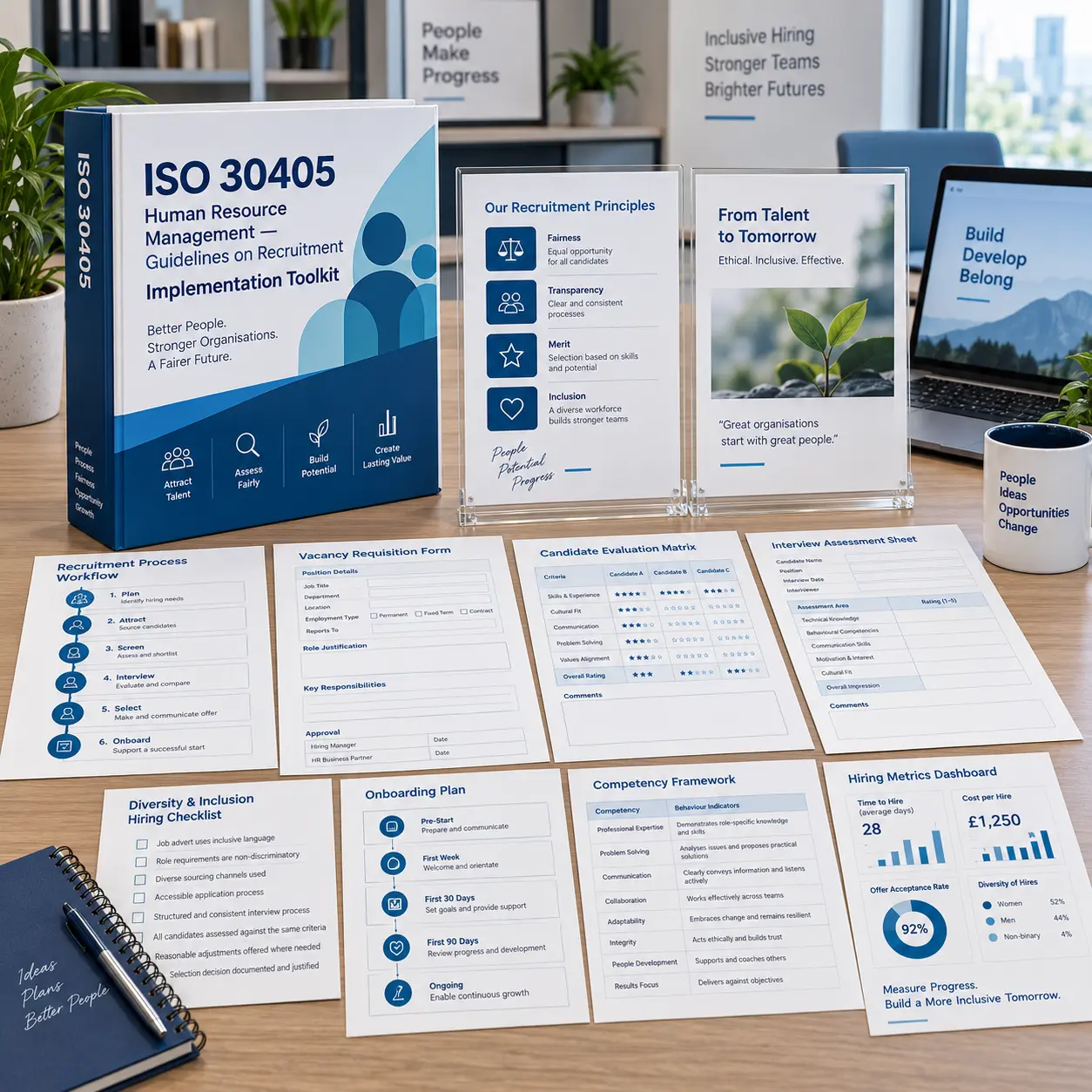
The ISO 30405:2023 Recruitment Implementation Toolkit provides a structured collection of editable templates, workbooks, checklists, forms, and practical implementation resources to help organizations improve the quality, fairness, consistency, and governance of their recruitment activities.
Aligned with the recruitment lifecycle reflected in the supplied ISO 30405 document index, the toolkit supports workforce demand planning, vacancy approval, sourcing, candidate attraction, screening, assessment, interviews, selection, pre-employment verification, offer management, candidate experience, recruitment service providers, recruitment metrics, review, and continual improvement.
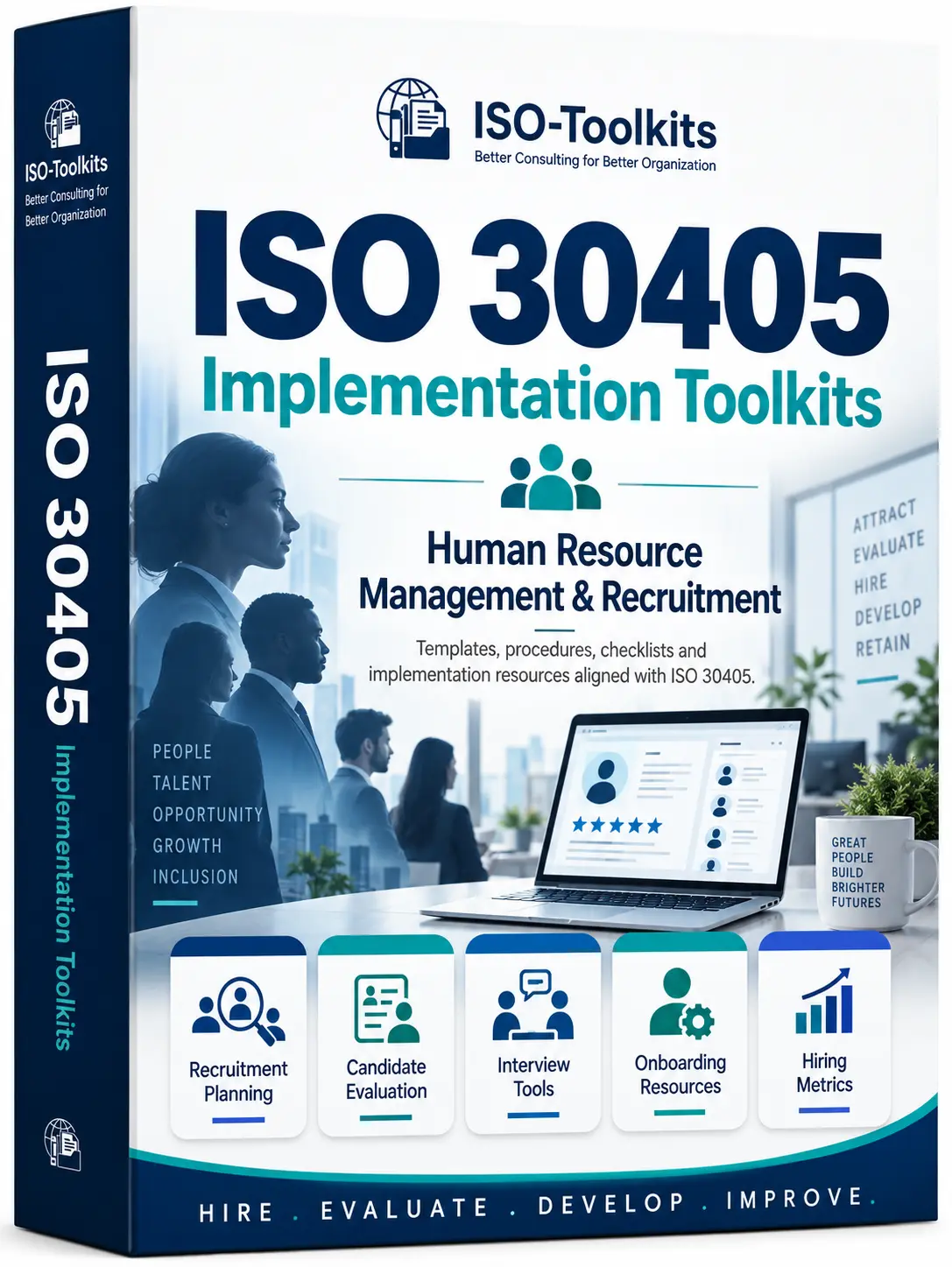
Building a consistent recruitment process requires more than isolated forms or interview notes. Organizations need clear governance, defined approval authorities, objective screening criteria, structured assessments, documented selection decisions, appropriate verification controls, candidate communication, provider oversight, and recruitment performance measures.
The ISO 30405:2023 Recruitment Implementation Toolkit provides a practical collection of editable recruitment templates and structured implementation documents in Word, Excel, and PowerPoint formats. It helps organizations accelerate recruitment process design, standardize hiring practices, improve transparency, strengthen candidate experience, manage recruitment service providers, and monitor recruitment effectiveness with greater consistency.

Below is the structured list of documents included in the package. Use the quick navigation or expand each part to review the files before downloading the index file.
 Part 1. Program Initiation & Recruitment Readiness Assessment
 ISO 30405 Implementation Charter.docx
 Recruitment Scope & Applicability Assessment.xlsx Current Recruitment Practice Assessment.xlsx Existing Recruitment Documentation Review.xlsx Recruitment Maturity Assessment.xlsx Recruitment Gap & Improvement Action Plan.xlsx Implementation Roadmap.xlsx Recruitment Roles & RACI Matrix.xlsx
 Project Kick-off Slide.pptx
Part 2. Recruitment Policy, Governance, Ethics & Fairness
Recruitment Policy.docx Recruitment Governance Framework.docx Recruitment Roles Responsibilities & Authorities Matrix.xlsx Recruitment Decision & Approval Authority Matrix.xlsx Recruitment Ethics & Fairness Principles.docx Equal Opportunity & Inclusive Recruitment Checklist.xlsx Conflict of Interest Declaration.docx Candidate Data Privacy & Confidentiality Checklist.xlsx Recruitment Governance Calendar.xlsx Recruitment Policy Awareness Slide.pptx
Part 3. Workforce Demand, Vacancy & Role Planning
Recruitment Demand Plan.xlsx Vacancy & Position Requisition Form.docx Recruitment Requisition Register.xlsx Job Analysis Worksheet.xlsx Job Description Template.docx Person Specification Template.docx Role Competency Profile.xlsx Essential & Desirable Criteria Matrix.xlsx Recruitment Priority Matrix.xlsx Vacancy Approval Tracker.xlsx
Part 4. Recruitment Strategy & Sourcing Planning
Recruitment Strategy Template.docx Recruitment Campaign Plan.xlsx Sourcing Channel Selection Matrix.xlsx Target Candidate Profile.xlsx Talent Pool & Pipeline Plan.xlsx Internal Recruitment & Mobility Plan.xlsx Employee Referral Sourcing Plan.xlsx External Recruitment Agency Plan.xlsx Diversity & Inclusive Sourcing Plan.xlsx Recruitment Campaign Budget Tracker.xlsx Sourcing Activity Tracker.xlsx
Part 5. Candidate Attraction & Recruitment Communication
Job Advertisement Template.docx Inclusive Job Advertisement Review Checklist.xlsx Employer Value Proposition Recruitment Brief.docx Career Site Recruitment Content Checklist.xlsx Candidate Application Instructions Template.docx Candidate Communication Plan.xlsx Candidate FAQ Template.docx Recruitment Event & Campaign Tracker.xlsx Candidate Enquiry Log.xlsx Talent Community Register.xlsx
Part 6. Application, Screening & Shortlisting
Candidate Application Form.docx Applicant Tracking Register.xlsx Minimum Eligibility Screening Checklist.xlsx Application Screening Criteria Matrix.xlsx CV / Resume Screening Scorecard.xlsx Candidate Screening Record.xlsx Candidate Conflict & Relationship Declaration.docx Longlist Evaluation Matrix.xlsx Shortlist Decision Matrix.xlsx Shortlist Approval Record.docx Candidate Status Communication Templates.docx
Part 7. Candidate Assessment & Interview
Candidate Assessment Plan.docx Assessment Criteria & Weighting Matrix.xlsx Structured Interview Guide.docx Interview Question Bank.docx Interview Evaluation Scorecard.xlsx Competency-Based Interview Scorecard.xlsx Technical Assessment Template.xlsx Work Sample Assessment Rubric.xlsx Assessment Centre Evaluation Workbook.xlsx Interview Panel Roles & Guidance.docx Interviewer Conflict of Interest Declaration.docx Candidate Assessment Accommodation Record.docx Assessment Evidence Register.xlsx
Part 8. Selection, Decision & Pre-Employment Verification
Candidate Comparison & Selection Matrix.xlsx Final Selection Recommendation.docx Selection Decision Record.docx Reference Check Form.docx Qualification Verification Checklist.xlsx Employment History Verification Checklist.xlsx Background Screening Checklist.xlsx Right-to-Work / Employment Eligibility Checklist.xlsx Pre-Employment Requirements Tracker.xlsx Selection Exception & Risk Approval Form.docx Final Hiring Approval Form.docx Candidate Feedback Record.docx
Part 9. Offer, Employment, Candidate Experience & Handover
Offer Approval Form.docx Employment Offer Letter Template.docx Compensation & Offer Alignment Worksheet.xlsx Offer Negotiation Tracker.xlsx Offer Acceptance & Decline Register.xlsx Candidate Experience Survey.docx Candidate Experience Results Workbook.xlsx Unsuccessful Candidate Communication Template.docx Pre-Boarding Handover Checklist.xlsx New Hire Information Transfer Form.docx Recruitment Case Closure Checklist.xlsx
Part 10. External Recruiters & Recruitment Service Providers
Recruitment Service Provider Requirements.docx Recruitment Agency Qualification Checklist.xlsx Approved Recruitment Provider Register.xlsx Recruitment Agency Service Level Agreement Template.docx Agency Candidate Submission Register.xlsx External Recruiter Compliance Checklist.xlsx Third-Party Candidate Data Protection Checklist.xlsx Recruitment Provider Performance Scorecard.xlsx Agency Issue & Escalation Register.xlsx Recruitment Provider Review Record.docx
Part 11. Recruitment Metrics, Evaluation & Candidate Experience
Recruitment KPI Register.xlsx Recruitment Funnel Dashboard.xlsx Time-to-Fill & Time-to-Hire Tracker.xlsx Cost-per-Hire Tracker.xlsx Source Effectiveness Analysis.xlsx Shortlist-to-Hire Conversion Tracker.xlsx Offer Acceptance Rate Tracker.xlsx Candidate Experience Dashboard.xlsx Recruitment Diversity Metrics Workbook.xlsx Hiring Manager Satisfaction Survey.docx New Hire Quality Feedback Form.docx Recruitment Effectiveness Review.xlsx Monthly Recruitment Performance Report.docx Recruitment Performance Review Slide.pptx
Part 12. Review, Learning, Improvement & Operational Handover
Recruitment Process Review Checklist.xlsx Recruitment Policy & Procedure Review Schedule.xlsx Hiring Manager Feedback Register.xlsx New Hire Recruitment Feedback Register.xlsx Recruitment Issue & Improvement Register.xlsx Recruitment Lessons Learned Register.xlsx Recruitment Improvement Action Plan.xlsx Recruitment Practice Maturity Reassessment.xlsx Annual Recruitment Review Plan.xlsx Annual Recruitment Effectiveness Report.docx Operational Handover Checklist.xlsx Consultant Handover Checklist.xlsx Final Implementation Report.docx Final Executive Handover Slide.pptxUse these quick links to review the full file list and payment instructions.


| Date File Updated | 25/03/2025 |
| File Format | pdf, xls, doc, docx, xlsx, pptx |
| No. of files | 135 File; 12 Folders |
| File download size | 11.03 MB (rar). |
| Language |
 English
|
| Purchase code | ISO30405-Toolkits |
The recruitment readiness assessment helped us identify gaps before changing any procedures. It was a practical way to prioritize what needed attention first.
The vacancy requisition and job analysis templates are straightforward and useful. Our hiring managers now provide much better information before recruitment starts.
We adapted the sourcing channel matrix and campaign tracker for several hard-to-fill roles. It made our sourcing discussions much more evidence based.
The structured interview guide and scorecards improved consistency between interview panels. We also have a clearer record of why candidates were selected.
The candidate communication templates saved time and helped us standardize updates throughout the recruitment process without making the messages feel mechanical.
The external recruiter section was useful for us because we work with several agencies. The qualification checklist and provider scorecard are now part of our review process.
The selection and verification documents are well organized. We customized the approval records and pre-employment tracker to fit our local HR process.
I liked the recruitment KPI section. Time-to-fill, source effectiveness and offer acceptance are now reported in one consistent format instead of separate spreadsheets.
The inclusive recruitment checklists and objective criteria matrices gave our team a useful baseline for reviewing fairness in advertisements, screening and interviews.
The toolkit is detailed but still easy to navigate because each recruitment stage has its own group of documents. That made implementation easier for our HR team.
We used the candidate experience survey and dashboard after our first recruitment cycle. It gave us useful feedback that we could connect directly to improvement actions.
The final review, lessons learned and handover documents helped us close the project properly and transfer the recruitment controls into day-to-day HR operations.