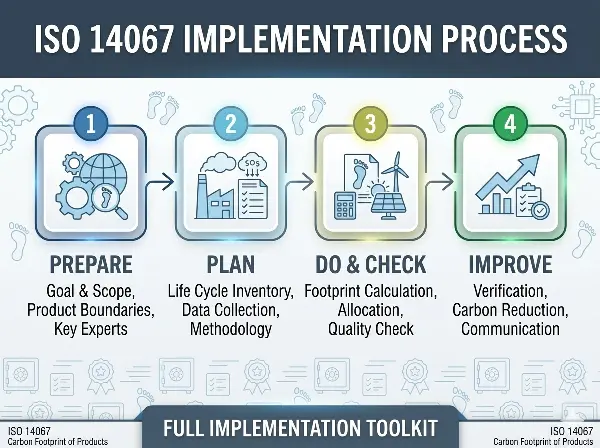
The ISO 14067 Carbon Footprint of Products Implementation Toolkits provide a comprehensive, easy to use suite of premium templates and practical resources to help organizations quantify, document, manage, and communicate product carbon footprints with greater consistency, transparency, and technical confidence.
Aligned with ISO 14067 requirements and guidance, this toolkit translates product carbon footprint principles into actionable methodologies, procedures, data collection templates, calculation workbooks, reporting formats, and verification support tools enabling organizations to strengthen emissions data quality, improve product-level carbon accounting, support credible environmental claims, and enhance readiness for customer, regulatory, and assurance expectations.
Implementing product carbon footprint requirements aligned with ISO 14067 can be complex and time-consuming, especially for organizations seeking to establish credible quantification methods, improve emissions transparency, and maintain consistent documentation across product life cycle stages.
The ISO 14067 Carbon Footprint of Products Toolkits package provides a comprehensive set of easy to use templates, procedures, registers, calculation support documents, and practical implementation files in Word and Excel formats, helping your organization standardize carbon footprint documentation, improve reporting consistency, and accelerate implementation with greater confidence, efficiency, and professional rigor.

Below is the complete list of documents included in the package. Click the index file button to review the full contents in spreadsheet format.
 Part 1. Program Initiation & CFP Governance Setup
Objective: To establish the governance structure, implementation scope, methodological direction, leadership sponsorship, roles, stakeholder alignment, and program controls required to launch and govern the ISO 14067 carbon footprint of products initiative effectively.
 CFP Program Charter.docx Carbon Footprint Governance Framework.docx ISO 14067 Implementation Scope Definition.docx CFP Policy & Methodology Framework.docx Roles & Responsibilities for CFP Study.docx CFP Objectives & Success Criteria.docx Stakeholder Communication Plan.docx Project Implementation Roadmap.docx
 Stakeholder Register.xlsx CFP Governance RACI Matrix.xlsx Program Milestone Tracker.xlsx Project Budget Tracker.xlsx
 CFP Program Kickoff Slides.pptx Executive Briefing on ISO 14067.pptx
Part 2. Goal, Scope & Product System Definition
Objective: To define the product under study, intended application, functional or declared unit, system boundaries, life cycle stages, cut-off rules, assumptions, and study scope needed to build a credible and decision-useful CFP model.
Goal & Scope Definition Procedure.docx Product System Boundary Definition.docx Functional Unit & Declared Unit Guideline.docx Life Cycle Stage Mapping Procedure.docx Assumptions & Limitations Register Guidance.docx Partial CFP Boundary Definition.docx Product Portfolio Scoping Register.xlsx Goal & Scope Approval Form.xlsx System Boundary Mapping Matrix.xlsx Assumptions & Exclusions Log.xlsx Goal & Scope Workshop Slides.pptx
Part 3. Life Cycle Inventory Data Collection Toolkit
Objective: To establish the structured templates, requests, source controls, and collection protocols required to gather primary and secondary activity data across raw materials, energy use, transport, packaging, manufacturing, distribution, use phase, and end-of-life stages.
Data Collection Procedure.docx Primary Data Collection Guideline.docx Secondary Data Selection Guideline.docx Supplier Data Request Template.docx Manufacturing Data Capture Instruction.docx Logistics & Transport Data Collection Guide.docx Use Phase Data Collection Guide.docx End-of-Life Scenario Data Guideline.docx LCI Data Collection Workbook.xlsx Supplier Data Register.xlsx Material Input Register.xlsx Energy Consumption Log.xlsx Transport Activity Log.xlsx Packaging Data Register.xlsx Data Collection Training Slides.pptx
Part 4. Data Quality, Representativeness & Emission Factor Management
Objective: To define how activity data and emission factors are selected, validated, documented, and controlled to ensure technological, temporal, and geographical representativeness, transparency, consistency, and auditability of the CFP study.
Data Quality Management Procedure.docx Emission Factor Selection Guideline.docx Representativeness Assessment Method.docx Data Validation & Reconciliation Procedure.docx Missing Data Estimation Guideline.docx Data Source Traceability Standard.docx Data Quality Assessment Matrix.xlsx Emission Factor Library.xlsx Source Evidence Register.xlsx Data Gap & Estimation Log.xlsx Data Validation Checklist.xlsx Data Quality Review Slides.pptx
Part 5. Carbon Footprint Calculation Workbook Toolkit
Objective: To provide the structured models, formulas, conversion logic, aggregation sheets, and calculation controls needed to quantify greenhouse gas emissions and removals across the product life cycle and consolidate them into a defensible CFP result.
CFP Calculation Methodology.docx Calculation Rules & Formula Logic.docx Unit Conversion & Normalization Guideline.docx Calculation Review Procedure.docx Product Carbon Footprint Calculator.xlsx Material Emissions Workbook.xlsx Energy & Fuel Emissions Workbook.xlsx Transport Emissions Workbook.xlsx Packaging Emissions Workbook.xlsx Use Phase Emissions Workbook.xlsx End-of-Life Emissions Workbook.xlsx Consolidated CFP Summary Dashboard.xlsx CFP Calculation Walkthrough Slides.pptx
Part 6. Allocation, Recycling & Biogenic Carbon Treatment
Objective: To define the methodological rules and documentation needed to treat co-products, shared processes, recycled content, recycling at end of life, land-use related considerations where relevant, and biogenic carbon accounting in a transparent and consistent manner.
Allocation Methodology Guideline.docx Recycled Content & End-of-Life Treatment Guide.docx Biogenic Carbon Accounting Guideline.docx Co-Product Allocation Decision Tree.docx Methodological Assumptions Paper.docx Allocation Decision Register.xlsx Recycling Scenario Model.xlsx Biogenic Carbon Tracking Sheet.xlsx Scenario Comparison Table.xlsx Methodology Decision Review Slides.pptx
Part 7. Interpretation, Hotspot Analysis & Sensitivity Assessment
Objective: To interpret calculation outputs, identify carbon hotspots, test assumptions, perform sensitivity and scenario analysis, evaluate completeness and consistency, and derive management insights for improvement and decision making.
CFP Interpretation Procedure.docx Hotspot Analysis Guideline.docx Sensitivity Analysis Procedure.docx Scenario Modelling Guidance.docx Completeness & Consistency Review Checklist.docx Hotspot Analysis Dashboard.xlsx Sensitivity Analysis Model.xlsx Scenario Comparison Register.xlsx Improvement Opportunity Register.xlsx Carbon Hotspot Review Slides.pptx
Part 8. Internal Review, Verification Readiness & Assurance Support
Objective: To organize the review structure, evidence pack, traceability records, cross-check protocols, and assurance support files required to prepare the CFP study for internal review, customer scrutiny, or independent verification where needed.
CFP Internal Review Procedure.docx Verification Readiness Guideline.docx Evidence File Structure Guide.docx Review Findings & Resolution Procedure.docx Audit Trail & Traceability Standard.docx Verification Readiness Checklist.xlsx Evidence Register.xlsx Review Comment Log.xlsx Data Traceability Matrix.xlsx Corrective Action Tracker.xlsx Verification Preparation Slides.pptx
Part 9. CFP Study Report & Technical Documentation Toolkit
Objective: To prepare the formal technical report, methodological disclosures, data source references, assumptions, limitations, results summaries, and supporting annexes required to document the CFP study in a transparent, consistent, and reviewable manner.
CFP Study Report Template.docx Technical Methodology Report.docx Assumptions, Limitations & Exclusions Report.docx Data Source Reference Appendix.docx Management Summary Report.docx Report Input Index.xlsx Results Summary Table.xlsx Annex Evidence Index.xlsx CFP Results Presentation Slides.pptx Management Review Slides.pptx
Part 10. External Communication & Claims Governance
Objective: To control how CFP-related results are translated into external communication materials, customer responses, marketing claims governance, disclosure statements, and approval workflows so that published information remains accurate, traceable, and appropriately managed.
CFP Communication Governance Procedure.docx External Disclosure Approval Workflow.docx Customer CFP Response Template.docx Sustainability Claims Review Checklist.docx Product CFP Summary Sheet Template.docx Communication Approval Log.xlsx External Request Tracker.xlsx Published CFP Statement Register.xlsx Sales & Marketing Guidance Slides.pptx Customer Communication Slides.pptx
Part 11. Reduction Planning & Decarbonization Opportunity Toolkit
Objective: To convert CFP findings into practical emission reduction initiatives by prioritizing hotspot interventions, redesign options, material substitution opportunities, process improvements, logistics optimization, and supplier engagement actions across the product life cycle.
Product Decarbonization Strategy.docx Carbon Reduction Opportunity Assessment.docx Supplier Engagement for Emissions Reduction.docx Low-Carbon Design Improvement Plan.docx Reduction Roadmap Governance Procedure.docx Reduction Opportunity Register.xlsx Marginal Abatement Screening Tool.xlsx Product Improvement Roadmap.xlsx Supplier Action Tracker.xlsx Emissions Reduction KPI Dashboard.xlsx Decarbonization Roadmap Slides.pptx
Part 12. Document Control, Record Retention & Continuous Update
Objective: To maintain version control, evidence retention, periodic data refresh, methodological update management, and record integrity for the ongoing maintenance of product carbon footprint files and future study revisions.
Document Control Procedure.docx CFP Record Retention Policy.docx Periodic Review & Update Procedure.docx Methodology Change Control Procedure.docx Evidence Archiving Standard.docx Document Register.xlsx Version Control Log.xlsx Data Refresh Schedule.xlsx Record Retention Schedule.xlsx Change History Register.xlsx CFP Maintenance & Governance Slides.pptxUse these quick links to review the full file list and payment instructions.


| Date File Updated | 25/03/2025 |
| File Format | pdf, xls, doc, docx, xlsx, pptx |
| No. of files | 138 Files, 12 Folders |
| File download size | 45.70 MB (.rar) |
| Language |
 English
|
| Purchase code | ISO14067-Toolkits |
The ISO Toolkit has helped us structure our implementation work clearly. It gave our team practical templates, organized procedures, and a reliable starting point for building our management system documentation.
After using the ISO Toolkit, our ISO preparation became much more organized. The documents are professional, easy to adapt, and helpful for aligning internal teams around clear compliance requirements.
Our consultants and internal managers found the toolkit very practical. It saved time, improved documentation consistency, and gave us a better framework for ISO implementation across departments.
The toolkit provides a strong foundation for ISO best practices. It helped us organize policies, procedures, records, and improvement actions in a way that is simple to maintain.
The ISO Toolkit brought structure to our compliance documentation and reduced the workload for our implementation team. It allowed us to focus more on improving processes instead of starting documents from scratch.
The ISO Toolkit is practical, well arranged, and easy to customize. It helped replace scattered files with a more complete document set for managing our ISO implementation activities.
The toolkit is very straightforward to use. It gave our team a clear implementation path, helped define responsibilities, and made ISO documentation easier for non-specialists to understand.
The ISO Toolkit gave us a better understanding of management system requirements and provided a user-friendly way to improve processes, controls, and internal documentation.
The toolkit helped me organize our ISO training, document review, and implementation planning. It made the entire preparation process more focused and easier to communicate with the team.
Excellent ISO Toolkit. It is highly useful for managers, consultants, and implementation teams who need practical documents to support ISO certification readiness.
A very useful toolkit and one of the most practical document sets I have used. It provides clear templates that can be adapted quickly for different ISO implementation needs.
These ISO Toolkits increased my confidence in managing implementation work. They helped us prepare documentation, assign responsibilities, and move toward a more mature management system.