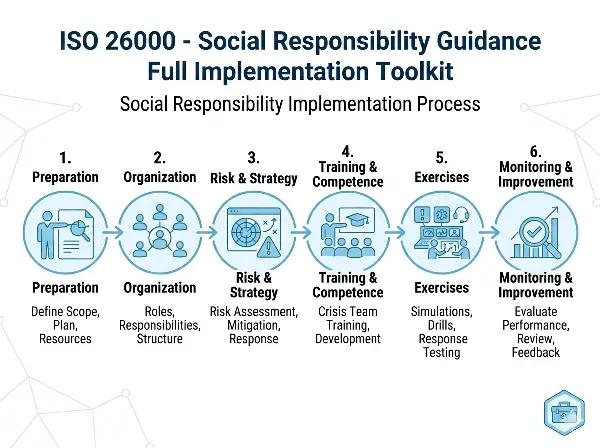
The ISO 26000 Social Responsibility Guidance Implementation Toolkits provide a comprehensive, easy to use suite of premium templates and practical resources to help organizations integrate social responsibility principles into governance, decision making, and day-to-day operations with clarity, consistency, and strategic direction.
Aligned with ISO 26000 guidance, this toolkit translates broad social responsibility principles into actionable policies, frameworks, procedures, assessment tools, and reporting documents enabling organizations to strengthen ethical conduct, enhance stakeholder trust, improve sustainability performance, and advance responsible business practices with greater confidence and organizational maturity.
Implementing guidance aligned with ISO 26000 can be a complex and time-intensive undertaking, especially for organizations aiming to strengthen governance, stakeholder engagement, ethical practices, and sustainability-related documentation across multiple functions.
The ISO 26000 Social Responsibility Guidance Toolkits package provides a comprehensive set of easy to use templates, policies, procedures, registers, and practical implementation documents in Word, Excel, and PowerPoint formats. It helps your organization translate social responsibility principles into structured practice, improve consistency, and accelerate deployment with greater confidence and professional rigor.

Below is the structured list of documents included in the package. Use the quick navigation or expand each part to review the files before downloading the index file.
 Part 1. Social Responsibility Governance & Strategic Framework
Objective: To establish the governance architecture, strategic intent, leadership accountability, social responsibility principles, policy framework, stakeholder oversight, and implementation roadmap required to embed ISO 26000 across the organization at enterprise level.
 Social Responsibility Program Charter.docx Social Responsibility Governance Framework.docx ISO 26000 Implementation Scope Definition.docx Social Responsibility Policy Framework Structure.docx Corporate Social Responsibility Policy (Master).docx Social Responsibility Principles & Commitments Statement.docx Social Responsibility Objectives & Targets Definition.docx Social Responsibility Roles & Responsibilities.docx Governance Escalation & Decision Rights Matrix.docx ISO 26000 Enterprise Implementation Roadmap.docx
 Social Responsibility Stakeholder Register.xlsx CSR Governance RACI Matrix.xlsx Social Responsibility Objectives & KPI Register.xlsx Governance Meeting Schedule.xlsx Social Responsibility Budget Tracker.xlsx
 ISO 26000 Program Kickoff Slides.pptx Executive Leadership Awareness Slides.pptx
Part 2. Stakeholder Engagement & Materiality Management
Objective: To define how stakeholders are identified, prioritized, engaged, consulted, responded to, and incorporated into decision making through structured dialogue, materiality analysis, issue tracking, and relationship management.
Stakeholder Engagement Policy.docx Stakeholder Identification & Mapping Methodology.docx Stakeholder Communication & Consultation Procedure.docx Materiality Assessment Methodology.docx Grievance & Feedback Handling Procedure.docx Stakeholder Dialogue Facilitation Guide.docx Stakeholder Mapping Register.xlsx Material Issues Register.xlsx Engagement Action Tracker.xlsx Stakeholder Feedback Log.xlsx Complaints & Resolution Register.xlsx Stakeholder Engagement Workshop Slides.pptx Materiality Review Presentation.pptx
Part 3. Human Rights Due Diligence & Remedy
Objective: To establish the policy framework, due diligence methodology, risk identification process, escalation pathways, and remedy mechanisms needed to respect human rights across operations, relationships, and spheres of influence.
Human Rights Policy.docx Human Rights Due Diligence Procedure.docx Human Rights Risk Assessment Methodology.docx Non-Discrimination & Equal Opportunity Standard.docx Vulnerable Groups Protection Guidelines.docx Grievance Mechanism & Remedy Procedure.docx Modern Slavery & Forced Labour Prevention Statement.docx Human Rights Risk Register.xlsx Grievance Case Log.xlsx Corrective Action Tracker.xlsx Vulnerable Groups Impact Assessment.xlsx Human Rights Awareness Slides.pptx
Part 4. Labour Practices, Wellbeing & Workforce Development
Objective: To define the standards, procedures, and management tools required to support responsible employment practices, fair working conditions, social dialogue, occupational wellbeing, capability development, and workforce engagement.
Labour Practices Policy.docx Employment Conditions & Fair Work Standard.docx Diversity, Equity & Inclusion Policy.docx Employee Wellbeing & Support Framework.docx Social Dialogue & Worker Consultation Procedure.docx Learning, Development & Skills Advancement Procedure.docx Occupational Health, Safety & Welfare Guidelines.docx Workforce Profile Dashboard.xlsx Training & Development Register.xlsx Employee Consultation Log.xlsx Workplace Incident & Wellbeing Tracker.xlsx Responsible Workplace Awareness Slides.pptx
Part 5. Environmental Responsibility & Resource Stewardship
Objective: To define environmental commitments, pollution prevention controls, climate response actions, resource efficiency measures, biodiversity considerations, and environmental performance monitoring needed to support responsible operations.
Environmental Responsibility Policy.docx Pollution Prevention & Waste Management Procedure.docx Sustainable Resource Use Standard.docx Climate Change Mitigation & Adaptation Framework.docx Energy, Water & Materials Efficiency Guideline.docx Biodiversity & Habitat Protection Guidance.docx Environmental Aspects & Impacts Register.xlsx Waste & Emissions Tracker.xlsx Resource Consumption Dashboard.xlsx Climate Action Plan Tracker.xlsx Environmental Compliance Obligations Register.xlsx Environmental Stewardship Slides.pptx
Part 6. Fair Operating Practices & Ethical Conduct
Objective: To provide the governance documents, controls, and monitoring tools required to promote ethical conduct, anti-corruption, fair competition, responsible public engagement, and integrity throughout business relationships and decision making.
Code of Ethics & Business Conduct.docx Anti-Bribery & Anti-Corruption Policy.docx Conflict of Interest Standard.docx Whistleblowing & Speak-Up Procedure.docx Fair Competition & Market Conduct Guidelines.docx Gifts, Hospitality & Sponsorship Procedure.docx Responsible Political Involvement Guidelines.docx Ethics Declarations Register.xlsx Gifts & Hospitality Log.xlsx Conflict of Interest Register.xlsx Ethics Incident & Investigation Log.xlsx Ethics & Integrity Awareness Slides.pptx
Part 7. Responsible Supply Chain & Social Procurement
Objective: To ensure suppliers, contractors, and business partners are governed through social responsibility requirements, due diligence criteria, onboarding controls, performance reviews, and corrective action mechanisms across the value chain.
Responsible Sourcing Policy.docx Supplier Social Responsibility Standard.docx Supplier Due Diligence Procedure.docx Supplier Code of Conduct.docx Social Procurement Evaluation Criteria.docx Supplier Improvement & Remediation Procedure.docx Approved Supplier Register.xlsx Supplier Social Risk Assessment.xlsx Supplier Audit & Review Tracker.xlsx Supplier Corrective Action Log.xlsx Social Procurement Scorecard.xlsx Responsible Supply Chain Slides.pptx
Part 8. Consumer Responsibility, Product Stewardship & Trust
Objective: To define the controls, communication standards, product responsibility measures, customer care processes, and dispute resolution arrangements needed to address consumer interests fairly, transparently, and responsibly.
Consumer Responsibility Policy.docx Fair Marketing & Transparent Communication Standard.docx Product & Service Safety Assurance Procedure.docx Customer Complaint & Dispute Resolution Procedure.docx Consumer Data Protection & Privacy Guidelines.docx Sustainable Consumption Communication Guide.docx Customer Complaints Register.xlsx Product Responsibility Tracker.xlsx Marketing Claims Review Log.xlsx Consumer Issue Resolution Dashboard.xlsx Consumer Trust & Responsibility Slides.pptx
Part 9. Community Involvement, Social Investment & Local Impact
Objective: To provide the strategic framework, evaluation tools, and implementation records needed to manage community engagement, social investment, local development initiatives, volunteering, and measurable socio-economic impact.
Community Involvement Policy.docx Social Investment Strategy.docx Community Partnership & Sponsorship Procedure.docx Local Impact Assessment Methodology.docx Employee Volunteering Program Framework.docx Community Grievance & Response Procedure.docx Community Projects Register.xlsx Social Investment Tracker.xlsx Community Impact Measurement Dashboard.xlsx Volunteering Hours Log.xlsx Community Feedback Register.xlsx Community Impact Review Slides.pptx
Part 10. Performance Measurement, ESG Reporting & Disclosure Support
Objective: To establish the metrics, evidence structures, dashboards, review cycles, and reporting templates required to measure social responsibility performance, support ESG disclosure, and strengthen management transparency and accountability.
Social Responsibility Measurement Framework.docx ESG Reporting Support Methodology.docx KPI, KRI & Material Metrics Definition.docx Sustainability Disclosure Review Procedure.docx Management Review & Assurance Procedure.docx Social Responsibility KPI Dashboard.xlsx ESG Data Collection Register.xlsx Material Topic Performance Scorecard.xlsx Social Responsibility Evidence Register.xlsx Management Review Action Tracker.xlsx ESG Reporting Overview Slides.pptx Social Responsibility Performance Review Slides.pptx
Part 11. Awareness, Culture & Internal Communication
Objective: To establish a structured social responsibility awareness program that aligns leadership messaging, employee understanding, behavioural expectations, campaign planning, and internal engagement with ISO 26000 principles and organizational values.
Social Responsibility Awareness Policy.docx Internal Communication & Engagement Plan.docx Awareness Campaign Procedure.docx Employee Social Responsibility Commitment Form.docx Leadership Messaging Guide.docx Awareness Campaign Calendar.xlsx Training Attendance Register.xlsx Awareness Effectiveness Survey.xlsx Internal Communication Tracker.xlsx ISO 26000 Awareness Training Slides.pptx Values, Ethics & Culture Slides.pptx
Part 12. Continuous Improvement, Assurance & Document Control
Objective: To support the ongoing maintenance, review, assurance, corrective action management, maturity improvement, and controlled documentation of the social responsibility management framework and related implementation records.
Continuous Improvement Policy.docx Social Responsibility Internal Review Procedure.docx Corrective Action & Preventive Action Procedure.docx Document Control Procedure.docx Record Retention & Evidence Management Policy.docx Social Responsibility Maturity Assessment Methodology.docx Continuous Improvement Register.xlsx Corrective Action Tracker.xlsx Document Register.xlsx Version Control Log.xlsx Record Retention Schedule.xlsx Social Responsibility Maturity Scorecard.xlsx Continuous Improvement Roadmap Slides.pptx Management Assurance Review Slides.pptxUse these quick links to review the full file list and payment instructions.


| Date File Updated | 25/03/2025 |
| File Format | pdf, xls, doc, docx, xlsx, pptx |
| No. of files | 150 Files, 12 Folders |
| File download size | 54.34 MB (.rar) |
| Language |
 English
|
| Purchase code | ISO26000-Toolkits |
The ISO Toolkit has helped us structure our implementation work clearly. It gave our team practical templates, organized procedures, and a reliable starting point for building our management system documentation.
After using the ISO Toolkit, our ISO preparation became much more organized. The documents are professional, easy to adapt, and helpful for aligning internal teams around clear compliance requirements.
Our consultants and internal managers found the toolkit very practical. It saved time, improved documentation consistency, and gave us a better framework for ISO implementation across departments.
The toolkit provides a strong foundation for ISO best practices. It helped us organize policies, procedures, records, and improvement actions in a way that is simple to maintain.
The ISO Toolkit brought structure to our compliance documentation and reduced the workload for our implementation team. It allowed us to focus more on improving processes instead of starting documents from scratch.
The ISO Toolkit is practical, well arranged, and easy to customize. It helped replace scattered files with a more complete document set for managing our ISO implementation activities.
The toolkit is very straightforward to use. It gave our team a clear implementation path, helped define responsibilities, and made ISO documentation easier for non-specialists to understand.
The ISO Toolkit gave us a better understanding of management system requirements and provided a user-friendly way to improve processes, controls, and internal documentation.
The toolkit helped me organize our ISO training, document review, and implementation planning. It made the entire preparation process more focused and easier to communicate with the team.
Excellent ISO Toolkit. It is highly useful for managers, consultants, and implementation teams who need practical documents to support ISO certification readiness.
A very useful toolkit and one of the most practical document sets I have used. It provides clear templates that can be adapted quickly for different ISO implementation needs.
These ISO Toolkits increased my confidence in managing implementation work. They helped us prepare documentation, assign responsibilities, and move toward a more mature management system.