
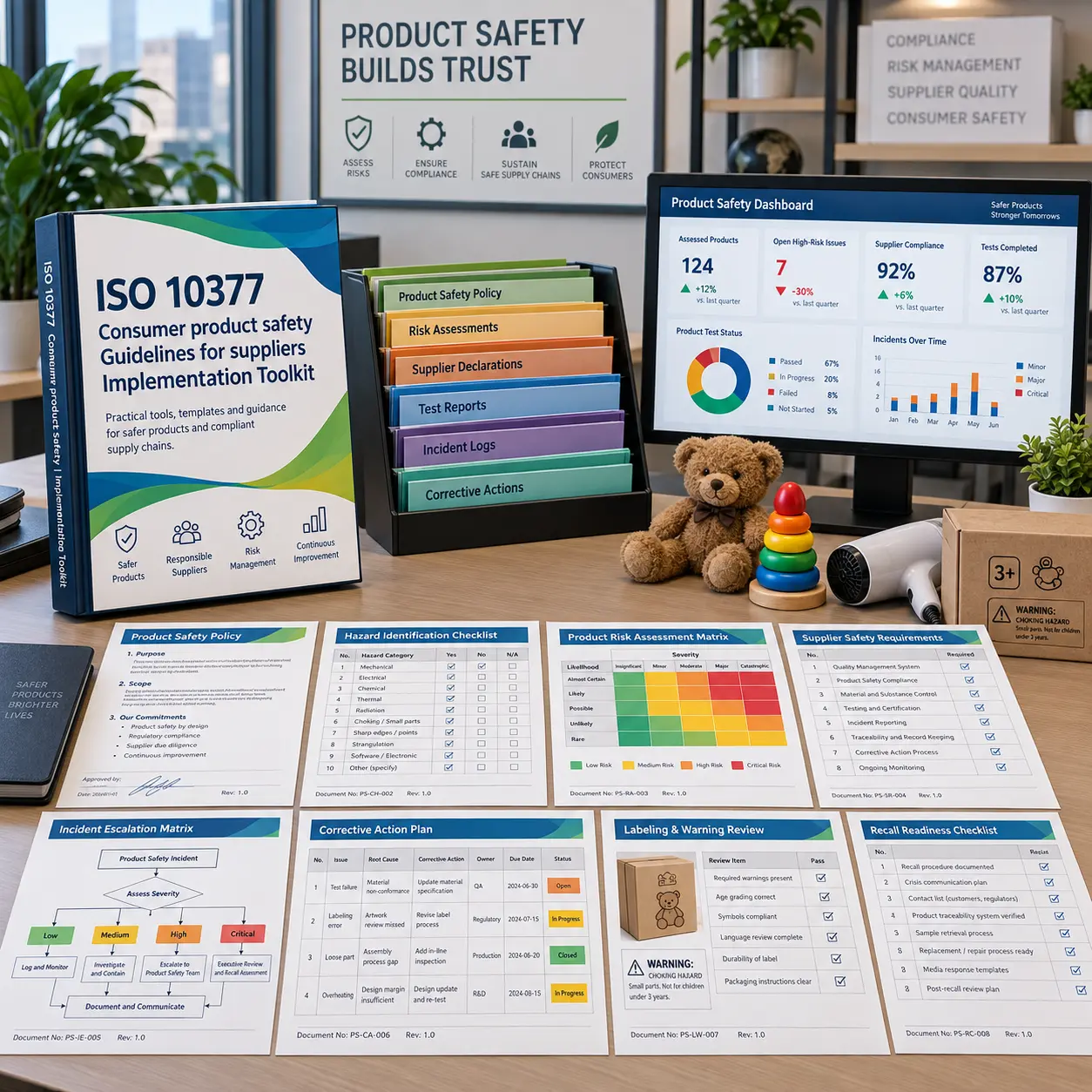
The ISO 10377:2013 Consumer Product Safety Implementation Toolkit provides a comprehensive, easy to use set of premium templates and professionally structured implementation resources to help suppliers establish, document, operate, review, and improve a systematic approach to consumer product safety.
Aligned with ISO 10377:2013, the toolkit translates consumer product safety guidance into practical policies, procedures, registers, risk assessment workbooks, checklists, plans, dashboards, and training resources. It supports product safety governance, consumer and product requirements, hazard identification, risk reduction, safe design, supplier controls, production controls, testing and release, warnings and instructions, traceability, market monitoring, incident management, corrective action, and continual improvement across the product lifecycle.
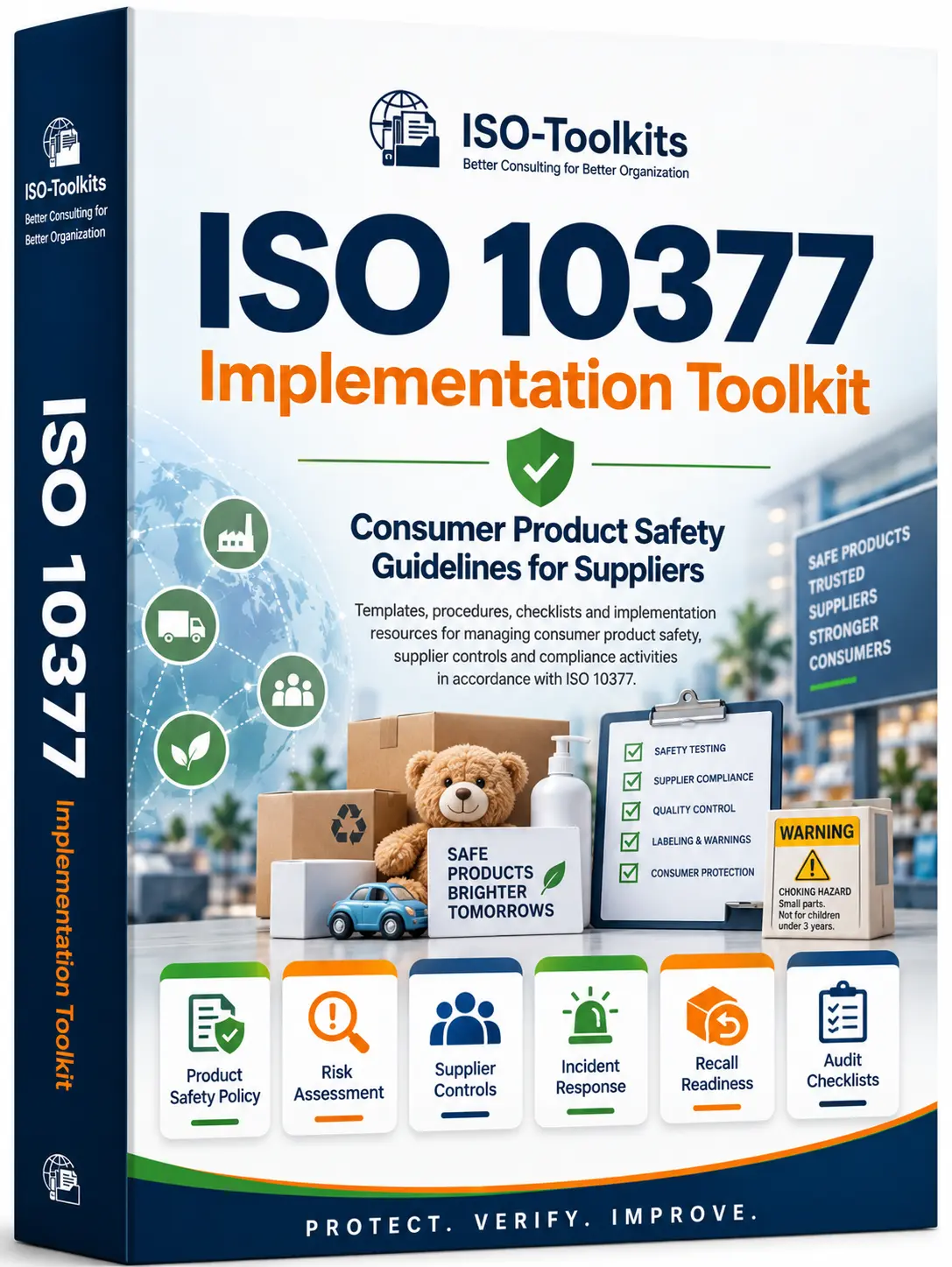
Building a consistent consumer product safety program can require significant time and cross-functional coordination, particularly when an organization must manage product requirements, foreseeable use and misuse, hazards, risk reduction, supplier controls, production safety, testing, safety information, traceability, market monitoring, and incident response across different products and markets.
The ISO 10377:2013 Consumer Product Safety Implementation Toolkit provides a comprehensive collection of easy to use templates and structured implementation documents in Word, Excel, and PowerPoint formats. It helps your organization establish a practical product safety framework, improve risk-based decision making, strengthen supplier and operational controls, organize product safety evidence, and support more consistent monitoring and improvement throughout the consumer product lifecycle.

Below is the structured list of documents included in the package. Use the quick navigation or expand each part to review the files before downloading the index file.
 Part 1. Program Initiation & Product Safety Applicability
 ISO 10377 Implementation Charter.docx
 Consumer Product Safety Applicability Assessment.xlsx Product Portfolio & Scope Register.xlsx Current Product Safety Practice Assessment.xlsx Existing Product Safety Documentation Review.xlsx Product Safety Gap & Improvement Action Plan.xlsx Implementation Roadmap.xlsx Product Safety Roles & RACI Matrix.xlsx
 Project Kick-off Slide.pptx
Part 2. Product Safety Governance, Culture & Competence
Consumer Product Safety Policy.docx Product Safety Governance Framework.docx Product Safety Roles & Responsibilities Matrix.xlsx Product Safety Decision & Escalation Matrix.xlsx Product Safety Committee Terms of Reference.docx Product Safety Competence Matrix.xlsx Product Safety Training Needs Analysis.xlsx Annual Product Safety Training Plan.xlsx Product Safety Awareness Slide.pptx Product Safety Specialist Training Slide.pptx
Part 3. Product Requirements, Consumer Profile & Foreseeable Use
Applicable Product Safety Requirements Register.xlsx Legal Regulatory & Standards Requirements Register.xlsx Customer & Market Safety Requirements Register.xlsx Target Consumer Profile Worksheet.xlsx Vulnerable Consumer Group Assessment.xlsx Intended Use Definition Template.docx Reasonably Foreseeable Misuse Assessment.xlsx Product Environment & Use Conditions Assessment.xlsx Product Safety Requirements Traceability Matrix.xlsx Product Safety Requirements Review Checklist.xlsx
Part 4. Hazard Identification, Risk Assessment & Risk Reduction
Product Safety Risk Assessment Procedure.docx Product Safety Risk Assessment Methodology.docx Hazard Identification Checklist.xlsx Consumer Product Hazard Register.xlsx Product Safety Risk Assessment Workbook.xlsx Risk Severity & Probability Criteria.xlsx Risk Evaluation & Acceptability Matrix.xlsx Foreseeable Misuse Risk Assessment.xlsx Vulnerable Consumer Risk Assessment.xlsx Risk Reduction Measures Selection Matrix.xlsx Residual Product Safety Risk Register.xlsx Product Safety Risk Assessment Approval Form.docx
Part 5. Safe Product Design & Development
Safe Product Design Procedure.docx Product Safety Design Input Checklist.xlsx Design Safety Requirements Matrix.xlsx Inherently Safe Design Assessment.xlsx Design Hazard Elimination Checklist.xlsx Safety Feature & Protective Measure Register.xlsx Design Risk Review Checklist.xlsx Design Review Record.docx Design Verification & Validation Plan.xlsx Design Change Product Safety Impact Assessment.xlsx Design Change Approval Form.docx Product Safety Design Release Checklist.xlsx
Part 6. Supplier & Supply Chain Product Safety Controls
Supplier Product Safety Requirements.docx Supplier Product Safety Qualification Checklist.xlsx Supplier Product Safety Questionnaire.docx Supplier Product Safety Risk Assessment.xlsx Critical Safety Component & Material Register.xlsx Supplier Safety Requirements Matrix.xlsx Supplier Safety Evidence Checklist.xlsx Supplier Product Safety Agreement.docx Supplier Change Notification Form.docx Supplier Product Safety Performance Scorecard.xlsx Supplier Safety Issue & Corrective Action Tracker.xlsx Approved Safety-Critical Supplier Register.xlsx
Part 7. Production, Assembly & Process Safety Controls
Product Safety Production Control Plan.xlsx Safety-Critical Process Register.xlsx Safety-Critical Characteristic Control Plan.xlsx Production Process Safety Checklist.xlsx Manufacturing Workmanship Safety Criteria.docx Safety-Critical Equipment & Tooling Register.xlsx Process Validation Plan.xlsx Production Change Safety Impact Assessment.xlsx Nonconforming Safety-Critical Output Report.docx Production Product Safety Deviation Request.docx Production Safety Issue Register.xlsx
Part 8. Verification, Testing, Conformity & Product Release
Product Safety Verification & Validation Plan.xlsx Product Safety Test Plan.xlsx Safety Test Requirements Matrix.xlsx Product Safety Test Results Register.xlsx Product Safety Inspection Checklist.xlsx Safety-Critical Component Verification Checklist.xlsx Product Conformity Review Checklist.xlsx Product Safety Evidence Dossier Index.xlsx Product Safety Release Checklist.xlsx Product Safety Release Approval Form.docx Independent Safety Review Record.docx
Part 9. Safety Information, Warnings, Instructions & Packaging
Product Safety Information Development Procedure.docx Safety Warning Development Checklist.xlsx Safety Label & Marking Review Checklist.xlsx Instructions for Safe Use Template.docx Installation Safety Instructions Template.docx Maintenance & Service Safety Instructions Template.docx Safe Disposal Instructions Template.docx Warning Comprehension Review.xlsx Consumer Safety Information Review Checklist.xlsx Packaging Safety Assessment.xlsx Product Safety Communication Approval Form.docx
Part 10. Traceability, Market Monitoring & Consumer Feedback
Product Safety Traceability Procedure.docx Product Traceability Register.xlsx Batch Lot Serial Number Traceability Matrix.xlsx Distribution & Market Destination Register.xlsx Consumer Safety Complaint Form.docx Consumer Safety Complaint Register.xlsx Product Safety Incident Intake Form.docx Market Safety Monitoring Plan.xlsx Product Safety Signal & Trend Tracker.xlsx Safety-Related Return & Warranty Analysis.xlsx Market Surveillance Findings Register.xlsx Product Safety Monitoring Dashboard.xlsx
Part 11. Product Safety Incidents, Corrective Action & Recall Escalation
Product Safety Incident Management Procedure.docx Product Safety Incident Investigation Form.docx Product Safety Incident Risk Reassessment.xlsx Product Safety Incident Investigation Report.docx Immediate Consumer Risk Control Checklist.xlsx Product Safety Corrective Action Request.docx Root Cause Analysis Template.docx Corrective Action & Effectiveness Tracker.xlsx Market Corrective Action Decision Matrix.xlsx Product Recall Escalation Assessment.xlsx Recall Decision & Handover Record.docx Regulatory Notification Requirements Matrix.xlsx Product Safety Lessons Learned Register.xlsx
Part 12. Performance Review, Records, Improvement & Handover
Product Safety Records & Evidence Index.xlsx Product Safety Document Retention Schedule.xlsx Product Safety KPI & KRI Register.xlsx Product Safety Performance Dashboard.xlsx Product Safety Review Checklist.xlsx Annual Product Safety Review Plan.xlsx Product Safety Improvement Opportunities Register.xlsx Product Safety Maturity Reassessment.xlsx Annual Product Safety Improvement Plan.xlsx Operational Handover Checklist.xlsx Consultant Handover Checklist.xlsx Final Implementation Report.docx Final Executive Handover Slide.pptxUse these quick links to review the full file list and payment instructions.


| Date File Updated | 25/03/2025 |
| File Format | pdf, xls, doc, docx, xlsx, pptx |
| No. of files | 136 File; 12 Folders |
| File download size | 15.44 MB (rar). |
| Language |
 English
|
| Purchase code | ISO10377-Toolkits |
The product safety toolkit gave us a practical starting point for documenting risk reviews and safety responsibilities. The hazard and foreseeable-use templates were much easier to adapt than building our own forms from the beginning.
We mainly needed stronger supplier product safety controls. The qualification, evidence, and change-notification documents helped us formalize what had previously been handled through emails and separate spreadsheets.
The structure is very logical. We moved from product requirements into risk assessment, design controls, testing, release, and market monitoring without having to invent a document architecture ourselves.
The warning and instructions section was useful for our household products. It helped our regulatory and design teams review labels, safe-use instructions, and packaging information in one consistent process.
I found the governance and escalation templates particularly useful. They helped clarify who can accept product safety risks, when issues must be escalated, and how decisions should be recorded.
The traceability and market monitoring tools fit well with our existing quality system. We were able to connect complaints, returns, incident signals, and corrective actions much more clearly.
A comprehensive set of product safety documents. The design review, verification, and product release checklists helped us make safety evidence more consistent between engineering projects.
We used several templates during a supplier product safety improvement project. The safety-critical material register and supplier performance scorecard were practical and straightforward to customize.
The toolkit made our internal training easier because the documents use consistent terminology across governance, risk assessment, design, production, and post-market activities.
The incident investigation and corrective action templates are detailed without being overly complicated. They helped our team document field issues and feed the results back into product risk assessment.
We purchased the toolkit to strengthen our consumer product safety program before expanding into additional markets. The requirements registers and market monitoring documents were particularly helpful for planning.
The ISO 10377 toolkit is well arranged and practical for day-to-day product safety management. It provided a useful framework for bringing design, quality, regulatory, procurement, and operations teams into the same process.