
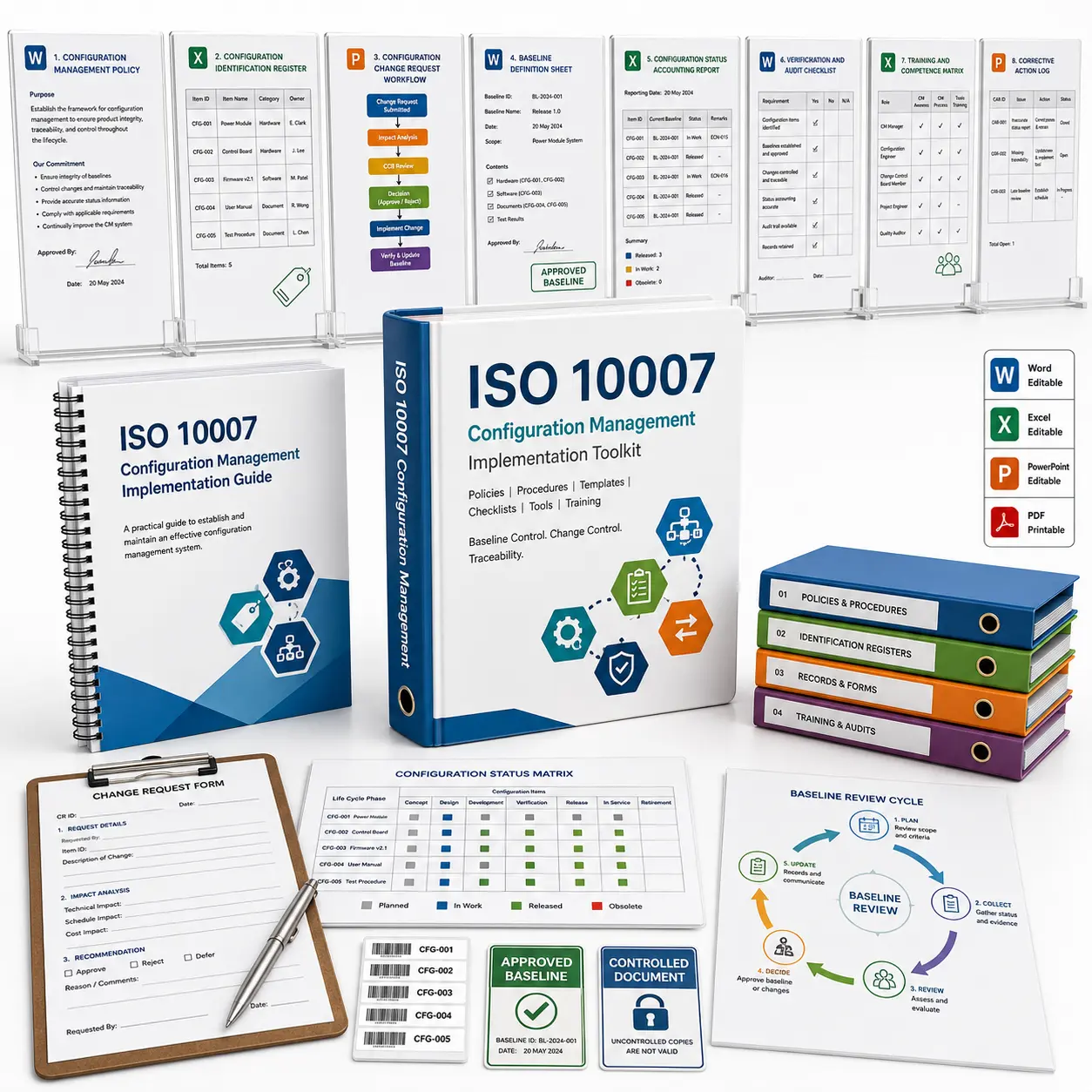
The ISO 10007:2017 Configuration Management Implementation Toolkit provides a comprehensive, easy to use set of editable templates and professionally structured implementation resources to help organizations plan, establish, operate, review, and improve configuration management across products, services, projects, and controlled lifecycle information.
Aligned with the ISO 10007:2017 guidance for configuration management, this toolkit converts configuration management activities into practical plans, procedures, registers, workbooks, checklists, dashboards, forms, and training resources. It supports configuration identification, baseline management, change control, configuration status accounting, supplier and interface control, verification and audit, performance monitoring, release, transition, handover, and lifecycle closeout.
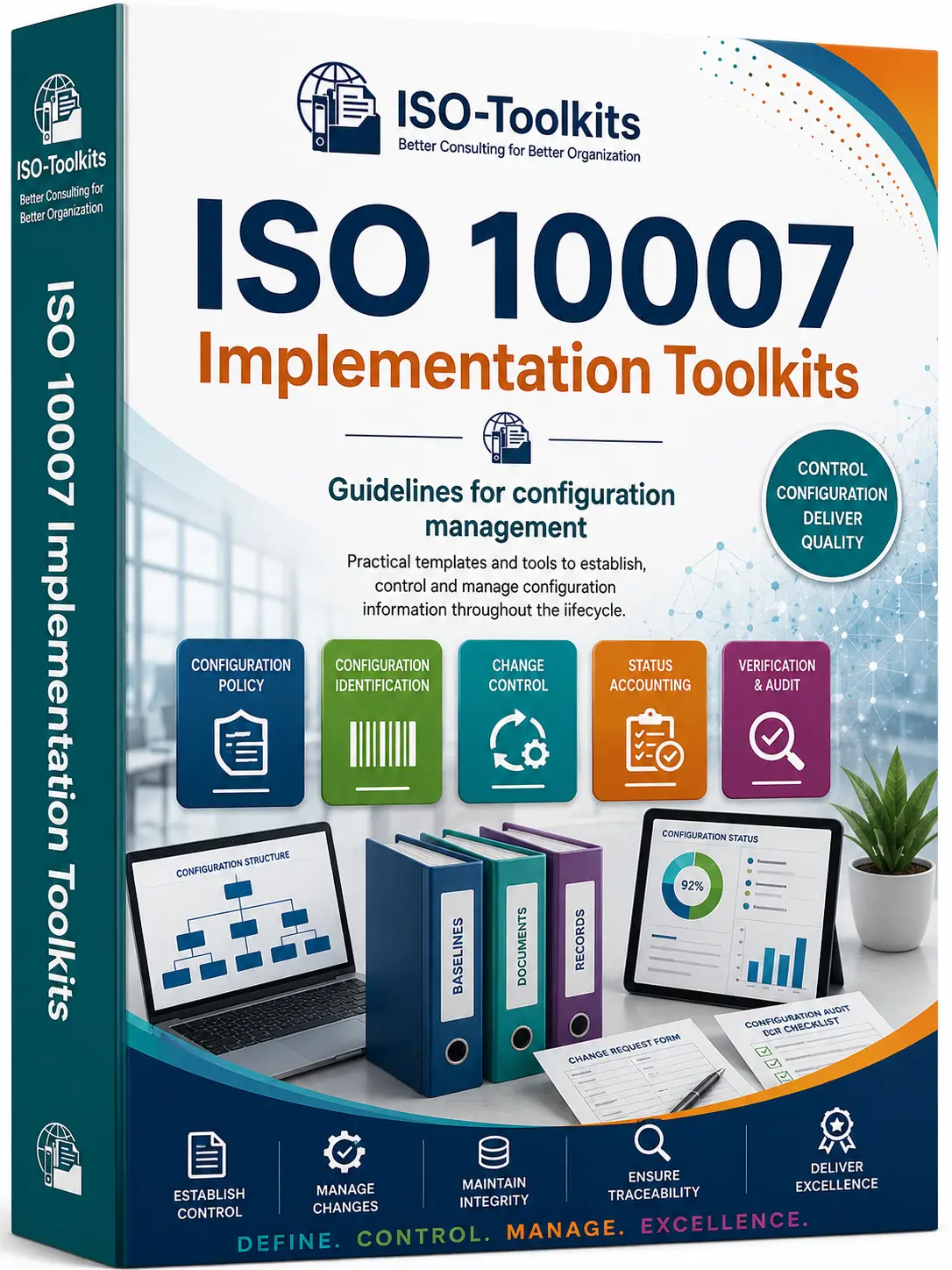
Establishing effective configuration management requires coordinated planning, configuration identification, baseline definition, disciplined change control, accurate status accounting, supplier and interface control, verification, audit, and lifecycle records. Developing these documents from scratch can require substantial time across quality, engineering, project, supplier, and document-control functions.
The ISO 10007:2017 Configuration Management Implementation Toolkit provides a comprehensive collection of easy to use templates and structured implementation documents in Word, Excel, and PowerPoint formats. It helps organizations establish configuration governance, define configuration items and baselines, control changes, maintain status information, verify configuration integrity, manage external interfaces, monitor performance, and support release, transition, handover, and closeout activities with greater consistency and traceability.

Below is the structured list of documents included in the package. Use the quick navigation or expand each part to review the files before downloading the index file.
 Part 1. Program Initiation & Configuration Management Applicability
 ISO 10007 Implementation Charter.docx
 Configuration Management Applicability Assessment.xlsx Current Configuration Management Practice Assessment.xlsx Existing Configuration Documentation Review.xlsx Configuration Management Scope & Boundaries Worksheet.xlsx Implementation Gap & Action Plan.xlsx Integrated Implementation Plan.xlsx Configuration Management RACI Matrix.xlsx
 Project Kick-off Deck.pptx
Part 2. Governance, Roles, Responsibilities & Competence
Configuration Management Governance Framework.docx Configuration Management Roles & Responsibilities Matrix.xlsx Configuration Control Board Terms of Reference.docx Configuration Control Board Membership Register.xlsx Configuration Decision & Approval Authority Matrix.xlsx Configuration Management Competence Matrix.xlsx Configuration Management Training Plan.xlsx Configuration Management Awareness Deck.pptx Configuration Manager & Configuration Owner Training Deck.pptx
Part 3. Configuration Management Planning
Configuration Management Plan Template.docx Product Configuration Management Plan.docx Service Configuration Management Plan.docx Project Configuration Management Plan.docx Configuration Management Planning Checklist.xlsx Configuration Management Lifecycle Matrix.xlsx Configuration Management Interface Matrix.xlsx Configuration Management Deliverables Register.xlsx Configuration Management Milestone & Review Schedule.xlsx Configuration Management Tool & Repository Requirements.xlsx Configuration Management Plan Approval Form.docx
Part 4. Configuration Identification & Baseline Management
Configuration Identification Procedure.docx Configuration Item Selection Criteria.xlsx Configuration Item Register.xlsx Configuration Item Identification & Coding Standard.docx Configuration Item Attribute Register.xlsx Configuration Structure & Hierarchy Workbook.xlsx Product Breakdown Structure.xlsx Configuration Documentation Index.xlsx Configuration Baseline Definition Worksheet.xlsx Configuration Baseline Register.xlsx Functional Baseline Record.docx Allocated Baseline Record.docx Product Baseline Record.docx Baseline Approval & Release Form.docx Configuration Identification Review Checklist.xlsx
Part 5. Configuration Change Control
Configuration Change Control Procedure.docx Configuration Change Request Form.docx Engineering / Technical Change Request Form.docx Change Impact Assessment.xlsx Configuration Change Classification Matrix.xlsx Change Evaluation & Decision Matrix.xlsx Configuration Control Board Agenda & Minutes.docx Configuration Change Decision Log.xlsx Approved Change Implementation Plan.xlsx Configuration Change Implementation Tracker.xlsx Configuration Change Verification Checklist.xlsx Emergency Configuration Change Form.docx Configuration Deviation / Waiver Request.docx Configuration Change Closure Record.docx
Part 6. Configuration Status Accounting & Records
Configuration Status Accounting Procedure.docx Configuration Status Accounting Register.xlsx Configuration Item Status Report.xlsx Configuration Baseline Status Report.xlsx Configuration Change Status Register.xlsx Configuration Release Status Register.xlsx Configuration Version & Revision Register.xlsx Configuration History Record.xlsx Configuration Documentation Status Index.xlsx Configuration Record Retention Matrix.xlsx Configuration Status Dashboard.xlsx
Part 7. External Provider & Interface Configuration Control
Supplier Configuration Management Requirements.docx Supplier Configuration Management Plan Review Checklist.xlsx Supplier Configuration Item Register.xlsx Supplier Configuration Baseline Register.xlsx Supplier Configuration Change Notification Form.docx Supplier Change Impact Assessment.xlsx Supplier Configuration Status Report.xlsx External Interface Configuration Register.xlsx Interface Control Document Template.docx Supplier Configuration Compliance Review.xlsx
Part 8. Configuration Verification & Audit
Configuration Audit Procedure.docx Configuration Audit Program.xlsx Configuration Audit Plan.docx Functional Configuration Audit Checklist.xlsx Physical Configuration Audit Checklist.xlsx Configuration Baseline Verification Checklist.xlsx Configuration Item Verification Checklist.xlsx Configuration Documentation Consistency Checklist.xlsx Configuration Audit Evidence Log.xlsx Configuration Audit Findings Register.xlsx Configuration Audit Report.docx Configuration Audit Corrective Action Tracker.xlsx
Part 9. Performance Monitoring, Issues & Continual Improvement
Configuration Management KPI Register.xlsx Configuration Management Performance Dashboard.xlsx Configuration Change Cycle-Time Tracker.xlsx Configuration Data Accuracy Review.xlsx Configuration Management Issue Register.xlsx Configuration Nonconformity Report.docx Configuration Corrective Action Tracker.xlsx Root Cause Analysis Template.docx Configuration Management Lessons Learned Register.xlsx Configuration Management Improvement Plan.xlsx Configuration Management Review Deck.pptx
Part 10. Release, Transition, Handover & Lifecycle Closeout
Configuration Release & Readiness Checklist.xlsx Configuration Release Approval Form.docx As-Built / As-Delivered Configuration Record.xlsx Configuration Handover Checklist.xlsx Configuration Data Handover Register.xlsx Operational Configuration Acceptance Form.docx Configuration Transfer & Transition Plan.docx Configuration Archive & Retention Checklist.xlsx Configuration Disposal / Retirement Record.docx Final Configuration Status Report.docx Configuration Management Closeout Checklist.xlsx Lessons Learned & Final Improvement Register.xlsx Final Implementation Report.docx Final Executive Handover Deck.pptxUse these quick links to review the full file list and payment instructions.


| Date File Updated | 25/03/2025 |
| File Format | pdf, xls, doc, docx, xlsx, pptx |
| No. of files | 116 File; 10 Folders |
| File download size | 10.84 MB (rar). |
| Language |
 English
|
| Purchase code | ISO10007-Toolkits |
The configuration item selection criteria helped us avoid putting every document under formal configuration control.
The baseline approval form is simple, clear, and useful for documenting exactly what was released at each milestone.
The supplier change notification form improved communication whenever vendors proposed changes to controlled equipment.
The configuration documentation index reduced confusion about current drawings, specifications, software versions, and records.
The change impact assessment is well designed and forces the team to consider technical, schedule, cost, safety, and documentation effects.
The configuration control board agenda and minutes template gave our review meetings a much more consistent structure.
The status dashboard is useful for management because it summarizes open changes, releases, baselines, and configuration item status.
The audit checklists are detailed enough for formal reviews without becoming difficult for project engineers to use.
The external interface register helped us control responsibilities and technical boundaries between several contractors.
The lifecycle matrix makes it clear when configuration activities should happen from planning through release and retirement.
The handover checklist helped us verify that configuration records were complete before transferring the system to operations.
The toolkit is well structured and can be scaled from a single project to a more formal organization-wide configuration process.