
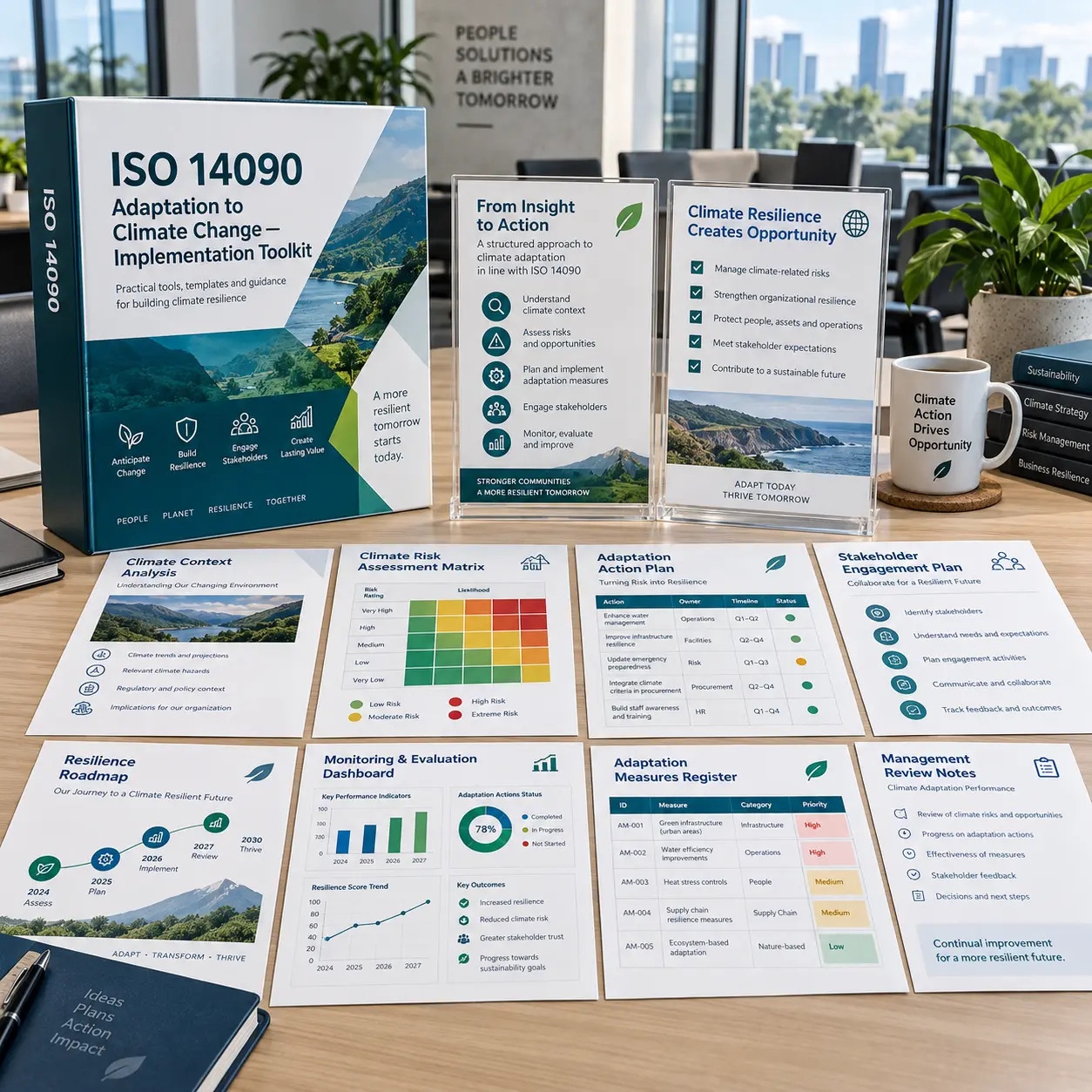
The ISO 14090:2019 Climate Change Adaptation Implementation Toolkit provides a structured collection of editable templates, assessment tools, plans, registers, workbooks, dashboards, and reporting resources to help organizations establish a practical approach to climate change adaptation.
Aligned with the implementation areas identified in the supplied ISO 14090 index, the toolkit supports climate information and scenario management, vulnerability and risk assessment, adaptation priorities, option appraisal, adaptation planning, integration into strategy and investment decisions, stakeholder engagement, monitoring and evaluation, reporting, continual improvement, and operational handover.
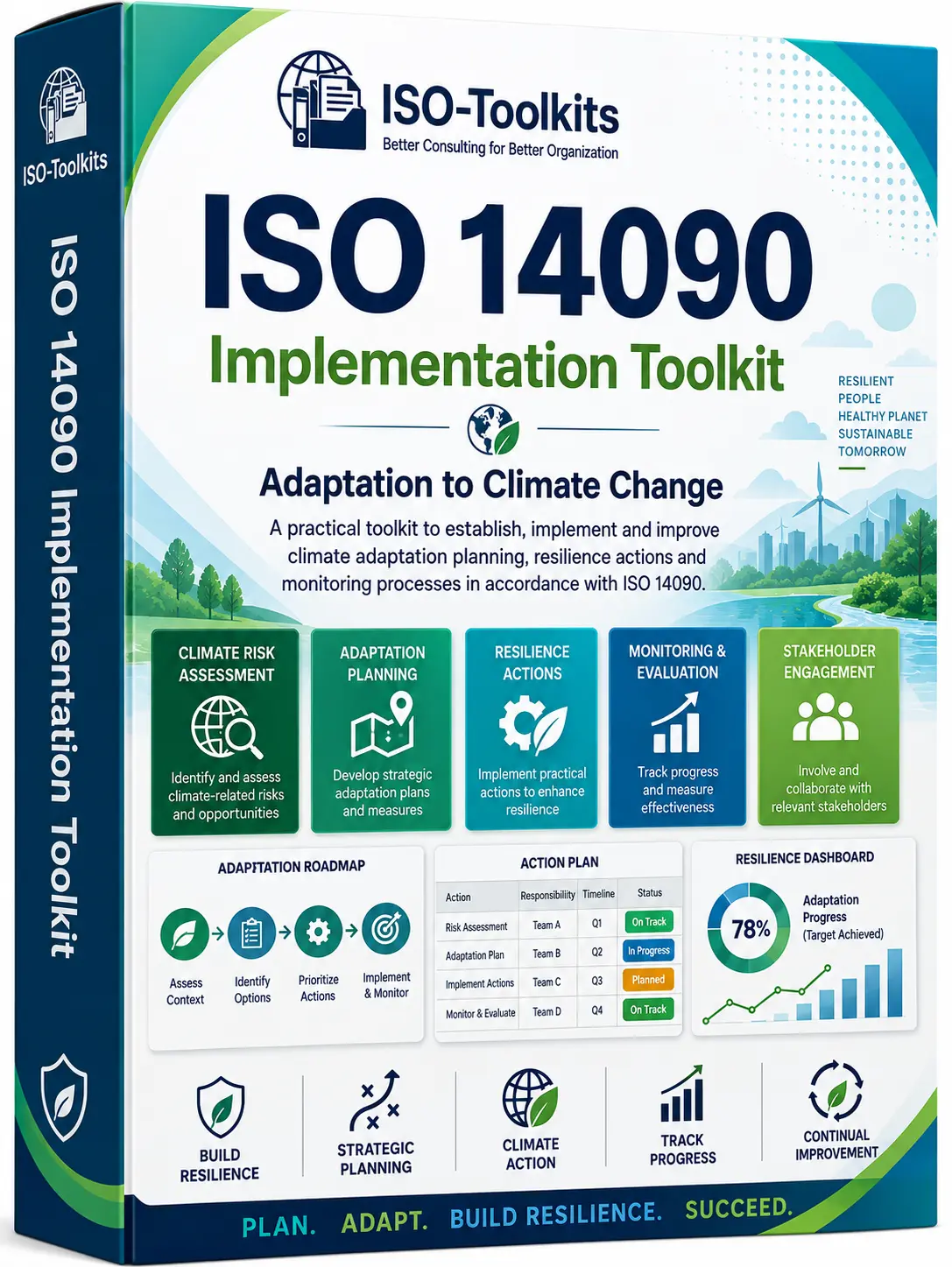
Building a credible climate change adaptation program requires more than identifying climate hazards. Organizations need consistent methods for climate information, vulnerability and risk assessment, adaptation option appraisal, decision making, action planning, integration into strategy and investment, stakeholder engagement, performance monitoring, and periodic review.
The ISO 14090:2019 Climate Change Adaptation Implementation Toolkit provides a comprehensive collection of editable templates and structured implementation resources in Word, Excel, and PowerPoint formats. It helps teams organize climate adaptation governance, document risk and opportunity assessments, compare adaptation measures, develop actionable plans, monitor resilience outcomes, and maintain an auditable evidence trail.

Below is the structured list of documents included in the package. Use the quick navigation or expand each part to review the files before downloading the index file.
 Part 1. Program Initiation & Adaptation Readiness Assessment
 ISO 14090 Implementation Charter.docx
 Climate Change Adaptation Applicability Assessment.xlsx Organizational Adaptation Scope Worksheet.xlsx Current Adaptation Readiness Assessment.xlsx Existing Climate Risk & Adaptation Documentation Review.xlsx Adaptation Maturity Assessment.xlsx Adaptation Gap & Improvement Action Plan.xlsx Implementation Roadmap.xlsx Adaptation Roles & RACI Matrix.xlsx
 Project Kick-off Slide.pptx
Part 2. Organizational Context, Governance & Adaptation Principles
Climate Adaptation Governance Framework.docx Climate Adaptation Policy / Commitment Statement.docx Organizational Context & Climate Relevance Assessment.xlsx Internal & External Issues Register.xlsx Interested Parties & Adaptation Requirements Register.xlsx Legal Regulatory & Policy Requirements Register.xlsx Climate Adaptation Roles & Responsibilities Matrix.xlsx Adaptation Decision & Escalation Matrix.xlsx Climate Adaptation Steering Committee Terms of Reference.docx Adaptation Governance Calendar.xlsx Leadership Climate Adaptation Awareness Slide.pptx
Part 3. Climate Information, Baselines, Scenarios & Uncertainty
Climate Information Management Framework.docx Climate Data Source Register.xlsx Historical Climate Baseline Workbook.xlsx Climate Variable & Indicator Register.xlsx Climate Hazard Profile Workbook.xlsx Climate Scenario Selection Matrix.xlsx Climate Scenario Assumptions Register.xlsx Time Horizon Selection Worksheet.xlsx Geographic Climate Exposure Mapping.xlsx Climate Data Quality Assessment.xlsx Climate Projection & Scenario Workbook.xlsx Climate Uncertainty Register.xlsx Climate Information Review Checklist.xlsx
Part 4. Climate Impacts, Vulnerability, Risks & Opportunities
Climate Impact & Vulnerability Assessment Methodology.docx Climate Hazard Register.xlsx Exposure Assessment Workbook.xlsx Sensitivity Assessment Workbook.xlsx Adaptive Capacity Assessment.xlsx Climate Impact Assessment Workbook.xlsx Physical Climate Risk Assessment.xlsx Chronic Climate Risk Assessment.xlsx Acute Climate Risk Assessment.xlsx Climate Risk & Opportunity Register.xlsx Climate Risk Evaluation Criteria.xlsx Climate Risk Heat Map.xlsx Critical Assets Sites & Operations Exposure Register.xlsx Supply Chain Climate Vulnerability Assessment.xlsx Workforce & Community Climate Vulnerability Assessment.xlsx Climate Risk Assessment Review & Approval Form.docx
Part 5. Adaptation Priorities, Objectives & Decision Criteria
Climate Adaptation Prioritization Framework.docx Adaptation Priority Criteria.xlsx Climate Risk Prioritization Matrix.xlsx Critical Climate Risk Register.xlsx Adaptation Objectives & Targets Register.xlsx Adaptation Objective-to-Risk Traceability Matrix.xlsx Adaptation Decision Criteria.xlsx Adaptation Planning Assumptions & Constraints Register.xlsx Adaptation Priority Portfolio.xlsx Adaptation Objectives Approval Record.docx
Part 6. Adaptation Options Identification & Appraisal
Adaptation Options Development Guide.docx Adaptation Options Register.xlsx No-Regret Low-Regret & Flexible Options Assessment.xlsx Structural & Non-Structural Adaptation Options Matrix.xlsx Nature-Based Adaptation Options Assessment.xlsx Technology & Engineering Adaptation Options Assessment.xlsx Operational Adaptation Options Assessment.xlsx Supply Chain Adaptation Options Assessment.xlsx Adaptation Options Multi-Criteria Analysis.xlsx Adaptation Cost-Benefit Assessment.xlsx Adaptation Feasibility Assessment.xlsx Maladaptation Risk Assessment.xlsx Residual Climate Risk Assessment.xlsx Adaptation Option Selection & Decision Record.docx
Part 7. Climate Change Adaptation Planning
Climate Change Adaptation Plan Template.docx Enterprise Climate Adaptation Plan.docx Business Unit Adaptation Plan Template.docx Site & Facility Adaptation Plan Template.docx Critical Asset Adaptation Plan Template.docx Adaptation Action Register.xlsx Adaptation Action Prioritization Matrix.xlsx Adaptation Implementation Schedule.xlsx Adaptation Milestone Tracker.xlsx Adaptation Dependencies Register.xlsx Adaptation Resource & Budget Plan.xlsx Adaptation Responsibility Matrix.xlsx Adaptation Risk & Issue Register.xlsx Adaptation Plan Review & Approval Checklist.xlsx Adaptation Plan Executive Slide.pptx
Part 8. Integration into Strategy, Operations & Investment Decisions
Climate Adaptation Integration Framework.docx Strategic Planning Climate Adaptation Checklist.xlsx Enterprise Risk Management Adaptation Integration Matrix.xlsx Business Continuity Climate Adaptation Integration Matrix.xlsx Capital Investment Climate Risk Screening.xlsx Project Climate Resilience Assessment.xlsx Asset Management Climate Adaptation Checklist.xlsx Procurement & Supplier Climate Adaptation Checklist.xlsx Supply Chain Resilience Integration Worksheet.xlsx Facility & Infrastructure Adaptation Checklist.xlsx Product & Service Climate Adaptation Assessment.xlsx Organizational Change Climate Adaptation Impact Assessment.xlsx Investment Decision Climate Resilience Record.docx
Part 9. Implementation, Resources & Stakeholder Engagement
Adaptation Implementation Management Procedure.docx Adaptation Action Implementation Tracker.xlsx Adaptation Resource Requirements Register.xlsx Adaptation Budget & Expenditure Tracker.xlsx Adaptation Competence Matrix.xlsx Climate Adaptation Training Plan.xlsx Climate Adaptation Practitioner Training Slide.pptx Stakeholder Engagement Plan.xlsx Community & External Stakeholder Engagement Register.xlsx Supplier Adaptation Engagement Plan.xlsx Adaptation Partnership & Collaboration Register.xlsx Adaptation Implementation Issue Log.xlsx Adaptation Change Request Form.docx
Part 10. Monitoring, Measurement & Evaluation
Climate Adaptation Monitoring & Evaluation Framework.docx Adaptation KPI & KRI Register.xlsx Adaptation Indicator Definition Sheet.docx Adaptation Baseline & Target Register.xlsx Adaptation Action Progress Tracker.xlsx Climate Risk Trend Tracker.xlsx Residual Risk Monitoring Register.xlsx Adaptation Effectiveness Evaluation.xlsx Adaptation Outcome & Benefit Tracker.xlsx Maladaptation Monitoring Checklist.xlsx Adaptation Performance Dashboard.xlsx Periodic Adaptation Review Checklist.xlsx Annual Climate Adaptation Performance Report.docx Adaptation Performance Review Slide.pptx
Part 11. Reporting, Communication & Disclosure
Climate Adaptation Reporting Framework.docx Climate Adaptation Report Template.docx Executive Climate Adaptation Summary Template.docx Internal Adaptation Communication Plan.xlsx External Stakeholder Communication Matrix.xlsx Climate Risk & Adaptation Disclosure Register.xlsx Adaptation Assumptions Limitations & Uncertainty Disclosure.xlsx Climate Adaptation Evidence Index.xlsx Adaptation Decision & Rationale Register.xlsx Stakeholder Feedback Register.xlsx Climate Adaptation Results Presentation Slide.pptx Adaptation Report Review & Approval Record.docx
Part 12. Review, Learning, Continual Improvement & Handover
Climate Adaptation Management Review Checklist.xlsx Climate Adaptation Maturity Reassessment.xlsx Climate Risk Reassessment Schedule.xlsx Climate Scenario Update Trigger Register.xlsx Adaptation Plan Review Calendar.xlsx Adaptation Lessons Learned Register.xlsx Adaptation Improvement Opportunities Register.xlsx Adaptation Improvement Action Plan.xlsx Adaptation Methodology Change Log.xlsx Adaptation Records & Evidence Retention Register.xlsx Operational Handover Checklist.xlsx Consultant Handover Checklist.xlsx Final Implementation Report.docx Final Executive Handover Slide.pptxUse these quick links to review the full file list and payment instructions.


| Date File Updated | 25/03/2025 |
| File Format | pdf, xls, doc, docx, xlsx, pptx |
| No. of files | 155 File; 12 Folders |
| File download size | 17.23 MB (rar). |
| Language |
 English
|
| Purchase code | ISO14090-Toolkits |
The ISO 14090 toolkit gave our team a practical structure for organizing climate hazards, scenarios, vulnerability assessments, and adaptation actions in one consistent implementation framework.
The climate risk and opportunity registers are very useful. We were able to connect physical climate exposures to responsible owners, priorities, actions, and review dates much more efficiently.
I found the adaptation option appraisal section particularly practical. It helped our project team compare engineering, operational, nature-based, and supply chain responses using common decision criteria.
The site and critical asset adaptation plan templates saved us considerable preparation time. They are easy to customize and work well for facility and infrastructure resilience planning.
The scenario and uncertainty templates made our climate assumptions much easier to document. This improved the transparency of our internal risk reviews and management discussions.
A strong toolkit for linking climate adaptation with enterprise risk and business continuity. The integration matrices helped us avoid running adaptation as a separate standalone program.
The implementation trackers, budget tools, stakeholder engagement plan, and issue log are practical for managing adaptation actions after the assessment stage.
The monitoring framework helped us define adaptation indicators, residual risk measures, and review triggers. It provides a much better structure for demonstrating progress over time.
The reporting templates are clear and professional. They helped us prepare an executive summary, document assumptions and limitations, and maintain an evidence trail for decisions.
For consulting work, the toolkit is a useful starting point because the documents follow a logical sequence from readiness assessment through risk analysis, planning, implementation, monitoring, and handover.
The procurement and supply chain adaptation checklists were especially relevant for our organization. They helped bring climate resilience considerations into supplier and sourcing decisions.
The continual improvement and handover section is very useful. It helps ensure adaptation plans are reviewed, lessons are captured, scenario changes are tracked, and responsibilities remain clear after implementation.