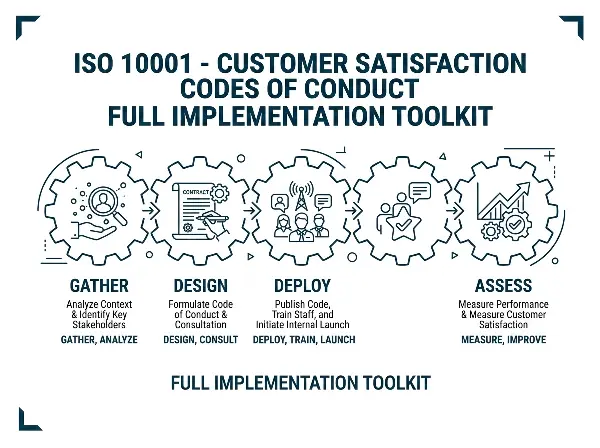
The ISO 10001 Customer Satisfaction Codes of Conduct Implementation Toolkit provides a comprehensive, easy to use suite of professional templates and practical resources to help organizations establish, implement, maintain, and continually improve effective customer-focused codes of conduct.
Aligned with ISO 10001 guidance, this toolkit translates customer satisfaction principles into actionable policies, commitment statements, procedures, governance documents, communication templates, registers, monitoring tools, and improvement records. It helps organizations define clear service promises, strengthen customer trust, improve accountability, support complaint prevention, and enhance customer experience performance across products, services, and communication channels.
Implementing customer satisfaction codes of conduct aligned with ISO 10001 can be complex and time-consuming, especially for organizations seeking to formalize service commitments, strengthen customer trust, prevent complaints, and maintain structured documentation across customer-facing activities.
The ISO 10001 Customer Satisfaction Codes of Conduct Implementation Toolkit provides a comprehensive collection of easy to use templates and structured implementation documents in Word, Excel, and PowerPoint formats. It helps your organization standardize customer promises, improve service consistency, strengthen transparency, monitor commitment fulfilment, and support continual improvement with greater confidence and professional discipline.

Below is the structured list of documents included in the package. Use the quick navigation or expand each part to review the files before downloading the index file.
 Part 1. Customer Promise Strategy & Governance
Objective: To establish the governance, scope, leadership commitment, customer promise principles, accountability structure, and implementation direction required to design and control an effective customer satisfaction code of conduct program across the organization.
 ISO 10001 Program Charter.docx Customer Satisfaction Governance Framework.docx Code of Conduct Scope Definition.docx Customer Promise Policy Framework.docx Customer Satisfaction Objectives Statement.docx Leadership Commitment Statement.docx Cross-Functional Roles & Responsibilities.docx ISO 10001 Implementation Roadmap.docx
 Stakeholder Register.xlsx Governance RACI Matrix.xlsx Customer Promise Objectives & KPI Register.xlsx Governance Meeting Schedule.xlsx Program Budget & Resource Tracker.xlsx
 ISO 10001 Program Kickoff Slides.pptx Executive Awareness Deck for Customer Promises.pptx
Part 2. Customer Insight, Needs & Expectation Analysis
Objective: To identify customer expectations, service commitments, pain points, contractual obligations, and market-facing requirements so that the code of conduct is realistic, relevant, and capable of enhancing customer satisfaction.
Customer Needs & Expectations Assessment Methodology.docx Voice of Customer Collection Procedure.docx Service Promise Design Criteria.docx Customer Journey Mapping Guidelines.docx Customer-Facing Commitment Requirements.docx Exclusions, Conditions & Limitation Rules.docx Customer Segment Analysis.xlsx Customer Needs Register.xlsx Promise Feasibility Assessment.xlsx Customer Pain Point Register.xlsx Customer Journey Map.xlsx Customer Insight Review Slides.pptx
Part 3. Customer Promise Toolkit
Objective: To define clear, credible, customer-facing promises concerning organizational behaviour, service quality, responsiveness, fairness, transparency, privacy, and issue resolution in a form that can be communicated and consistently delivered.
Customer Promise Policy.docx Customer Code of Conduct (Master).docx Customer Promise Writing Guidelines.docx Transparency & Fair Dealing Commitment.docx Privacy & Confidentiality Commitment.docx Customer Communication Standards.docx Code Publication & Accessibility Procedure.docx Customer Promise Register.xlsx Promise Ownership Matrix.xlsx Customer Promise Approval Log.xlsx Customer Communication Channel Register.xlsx Customer Promise Launch Slides.pptx Frontline Communication Slides.pptx
Part 4. Service Commitment Toolkit
Objective: To convert customer promises into measurable service commitments, response standards, service levels, fulfilment rules, and operational controls that enable consistent service delivery and protect promise credibility.
Service Commitment Framework.docx Service Standard Definition Procedure.docx Response Time & Resolution Time Standard.docx Service Escalation Rules.docx Customer Request Handling Procedure.docx Service Failure Recovery Guidelines.docx Service Commitment Exception Handling Procedure.docx Service Commitment Register.xlsx Service Level Matrix.xlsx Escalation Contact Matrix.xlsx Service Failure Log.xlsx Recovery Action Tracker.xlsx Service Commitment Alignment Slides.pptx
Part 5. Complaint Prevention Toolkit
Objective: To prevent avoidable dissatisfaction and complaints by identifying recurring failure points, strengthening preventive controls, improving clarity of commitments, and ensuring customer-facing teams act before service issues escalate.
Complaint Prevention Policy.docx Proactive Service Recovery Procedure.docx Customer Dissatisfaction Early Warning Procedure.docx Root Cause Analysis for Customer Issues.docx Recurring Issue Elimination Procedure.docx Complaint Prevention Control Library.docx Customer Complaint Trend Register.xlsx Early Warning Indicator Dashboard.xlsx Root Cause Analysis Tracker.xlsx Preventive Action Plan.xlsx Repeat Issue Log.xlsx Complaint Prevention Workshop Slides.pptx Service Recovery Awareness Slides.pptx
Part 6. Complaint Handling Interface & Escalation Control
Objective: To define how issues arising from breaches of customer promises are received, acknowledged, assessed, escalated, and coordinated with complaint-handling processes so that customer commitments remain credible and actionable.
Customer Promise Breach Handling Procedure.docx Complaint Intake & Routing Standard.docx Service Apology & Remedial Action Guidelines.docx Escalated Customer Case Management Procedure.docx Promise Breach Communication Template.docx Promise Breach Log.xlsx Customer Complaint Escalation Matrix.xlsx Remedial Action Tracker.xlsx Customer Case Resolution Register.xlsx Complaint Escalation Control Slides.pptx
Part 7. Monitoring Toolkit
Objective: To establish measurement methods, indicators, dashboards, review criteria, and reporting mechanisms for monitoring fulfilment of customer promises, service commitments, complaint prevention effectiveness, and overall customer satisfaction performance.
Customer Satisfaction Monitoring Strategy.docx Monitoring & Measurement Procedure.docx KPI / KCI Definition Standard.docx Customer Feedback Analysis Procedure.docx Management Review Procedure for Customer Promises.docx Customer Satisfaction Dashboard.xlsx Promise Performance Scorecard.xlsx Customer Feedback Register.xlsx Service Commitment Performance Tracker.xlsx Complaint Prevention KPI Dashboard.xlsx Trend Analysis Workbook.xlsx Monthly Customer Satisfaction Report Slides.pptx Management Review Slides.pptx
Part 8. Training, Communication & Competence
Objective: To ensure employees, managers, frontline teams, and service partners understand the code of conduct, customer promises, escalation expectations, and their role in protecting customer trust through competent and consistent delivery.
Customer Promise Awareness Policy.docx Training & Competence Procedure.docx Frontline Communication Guide.docx Customer Promise Acknowledgement Form.docx Partner / Supplier Communication Notice.docx Training Attendance Register.xlsx Role-Based Competency Matrix.xlsx Communication Campaign Calendar.xlsx Employee Acknowledgement Tracker.xlsx Competency Assessment Log.xlsx Customer Promise Training Slides.pptx Frontline Service Excellence Slides.pptx
Part 9. Internal Audit, Review & Continual Improvement
Objective: To support periodic review, internal audit, nonconformity control, corrective action, and continual improvement of the customer satisfaction code of conduct so that promises remain effective, relevant, and aligned with organizational capability.
Internal Audit Procedure for Customer Satisfaction Code.docx Code Review & Revision Procedure.docx Corrective Action Procedure.docx Continual Improvement Framework.docx Lessons Learned Review Template.docx Internal Audit Plan.xlsx Audit Checklist.xlsx Nonconformity Register.xlsx Corrective Action Tracker.xlsx Improvement Opportunity Register.xlsx Code Revision History.xlsx Continual Improvement Review Slides.pptx
Part 10. Documentation & Record Control
Objective: To maintain controlled documentation, evidence, approval records, publication history, retention arrangements, and traceable records supporting the planning, communication, operation, monitoring, and improvement of the ISO 10001 program.
Document Control Procedure.docx Record Retention & Archiving Policy.docx Controlled Publication Procedure for Customer Codes.docx Document Register.xlsx Record Retention Schedule.xlsx Document Approval Log.xlsx Version Control Register.xlsx Publication & Distribution Log.xlsx Evidence Index.xlsx Documentation Control Awareness Slides.pptxUse these quick links to review the full file list and payment instructions.


| Date File Updated | 25/03/2025 |
| File Format | pdf, xls, doc, docx, xlsx, pptx |
| No. of files | 123 Files, 10 Folders |
| File download size | 11.22 MB (.rar) |
| Language |
 English
|
| Purchase code | ISO10001-Toolkits |
The ISO Toolkit has helped us structure our implementation work clearly. It gave our team practical templates, organized procedures, and a reliable starting point for building our management system documentation.
After using the ISO Toolkit, our ISO preparation became much more organized. The documents are professional, easy to adapt, and helpful for aligning internal teams around clear compliance requirements.
Our consultants and internal managers found the toolkit very practical. It saved time, improved documentation consistency, and gave us a better framework for ISO implementation across departments.
The toolkit provides a strong foundation for ISO best practices. It helped us organize policies, procedures, records, and improvement actions in a way that is simple to maintain.
The ISO Toolkit brought structure to our compliance documentation and reduced the workload for our implementation team. It allowed us to focus more on improving processes instead of starting documents from scratch.
The ISO Toolkit is practical, well arranged, and easy to customize. It helped replace scattered files with a more complete document set for managing our ISO implementation activities.
The toolkit is very straightforward to use. It gave our team a clear implementation path, helped define responsibilities, and made ISO documentation easier for non-specialists to understand.
The ISO Toolkit gave us a better understanding of management system requirements and provided a user-friendly way to improve processes, controls, and internal documentation.
The toolkit helped me organize our ISO training, document review, and implementation planning. It made the entire preparation process more focused and easier to communicate with the team.
Excellent ISO Toolkit. It is highly useful for managers, consultants, and implementation teams who need practical documents to support ISO certification readiness.
A very useful toolkit and one of the most practical document sets I have used. It provides clear templates that can be adapted quickly for different ISO implementation needs.
These ISO Toolkits increased my confidence in managing implementation work. They helped us prepare documentation, assign responsibilities, and move toward a more mature management system.