
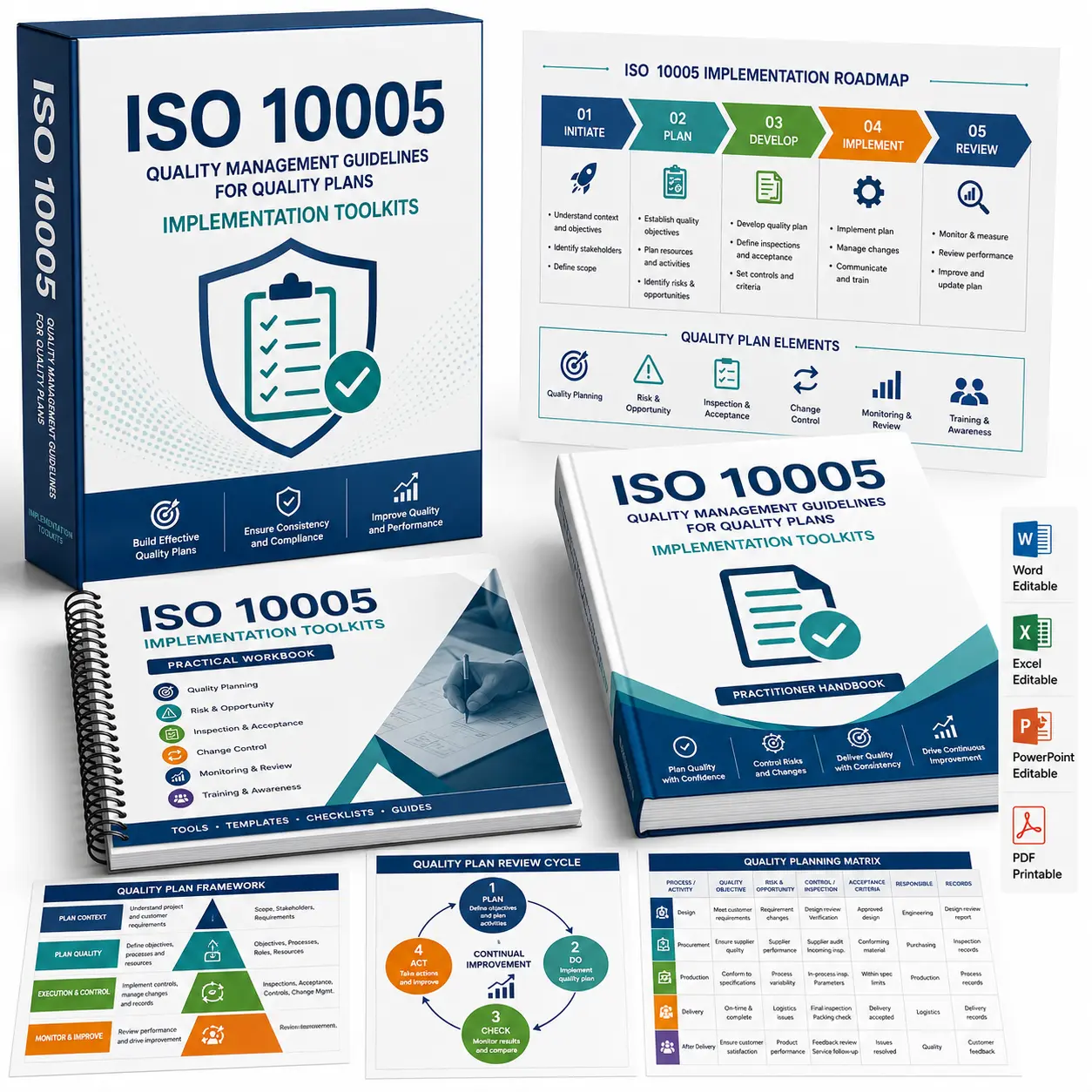
The ISO 10005:2018 Quality Plans Implementation Toolkit provides a comprehensive, easy to use set of premium templates and professionally structured planning resources to help organizations define, develop, implement, communicate, monitor, review, revise, and close out effective quality plans for specific products, services, processes, projects, and contracts.
Aligned with ISO 10005:2018 guidance, this toolkit translates quality planning principles into practical documents, matrices, registers, workbooks, checklists, forms, and presentation materials. It helps teams clarify quality objectives and acceptance criteria, assign responsibilities, identify risks and opportunities, plan process controls and verification activities, manage suppliers and design changes, maintain traceability, monitor plan performance, and capture quality records and lessons learned.
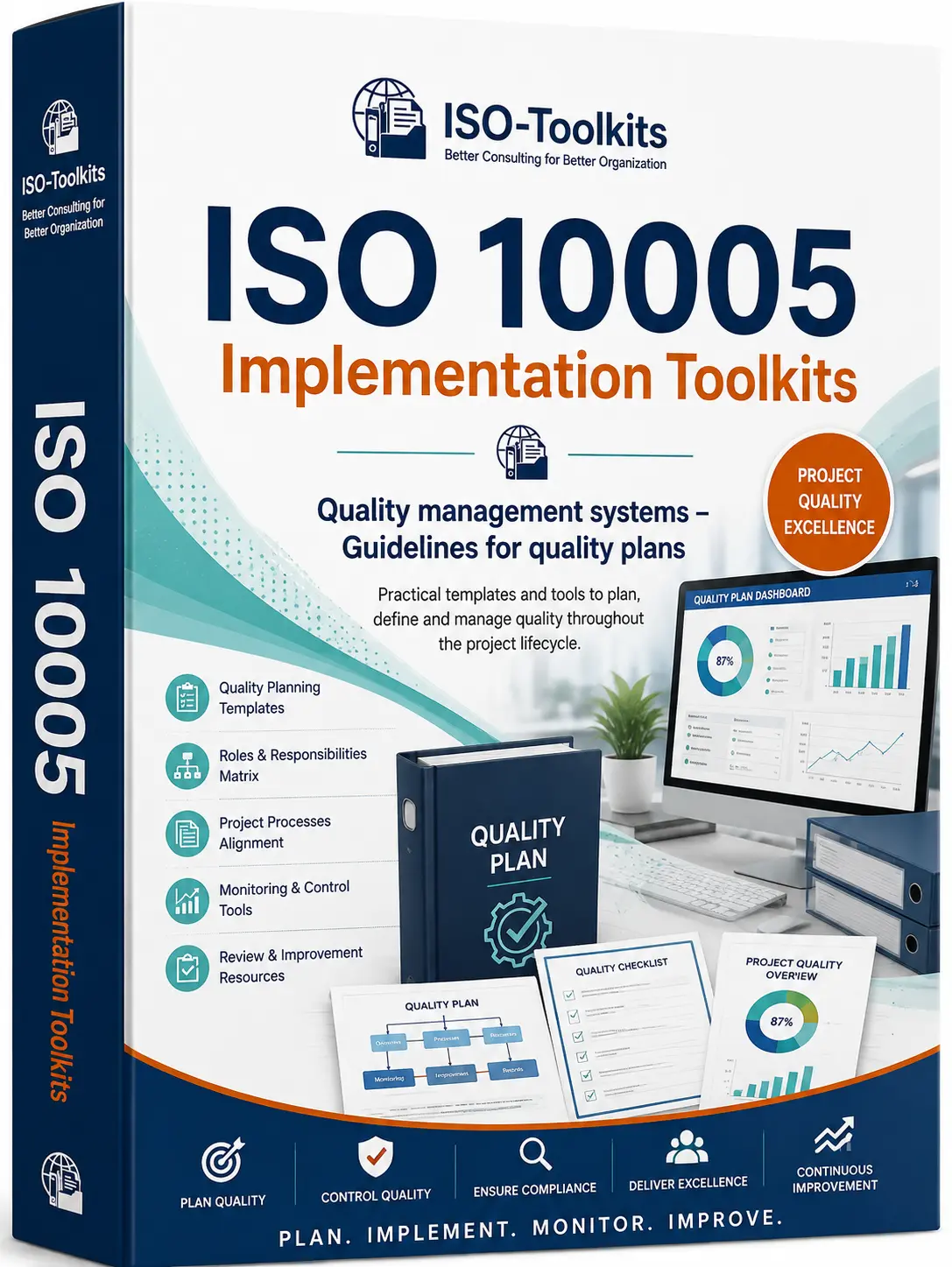
Developing and controlling quality plans for projects, contracts, products, services, or processes can be demanding and requires disciplined coordination of requirements, objectives, responsibilities, risks, resources, process controls, verification activities, acceptance criteria, records, changes, and final closeout.
The ISO 10005:2018 Quality Plans Implementation Toolkit provides a comprehensive collection of easy to use templates and structured quality planning documents in Word, Excel, and PowerPoint formats. It helps your organization define the specific case, establish quality objectives and acceptance criteria, develop quality plans, coordinate operational controls, manage suppliers and design changes, verify results, review performance, maintain evidence, and close out quality activities with greater efficiency and consistency.

Below is the structured list of documents included in the package. Use the quick navigation or expand each part to review the files before downloading the index file.
 Part 1. Program Initiation & Quality Plan Applicability
 ISO 10005 Implementation Charter.docx
 Quality Plan Applicability & Need Assessment.xlsx Current Quality Planning Practice Assessment.xlsx Existing Quality Plan Review Checklist.xlsx Implementation Action Plan.xlsx Quality Planning Roles & RACI Matrix.xlsx
 ISO 10005 Implementation Kick-off Deck.pptx
Part 2. Specific Case Definition & Quality Plan Inputs
Specific Case Definition Template.docx Quality Plan Scope & Boundaries Worksheet.xlsx Customer & Contract Requirements Register.xlsx Statutory Regulatory & Other Requirements Register.xlsx Product Service Process Project Requirements Matrix.xlsx Interested Parties Requirements Register.xlsx Quality Plan Input Checklist.xlsx Assumptions Constraints & Dependencies Register.xlsx
Part 3. Quality Objectives, Acceptance Criteria & Risk-Based Planning
Quality Objectives & Targets Matrix.xlsx Critical-to-Quality Characteristics Register.xlsx Acceptance Criteria Matrix.xlsx Quality Risk & Opportunity Assessment.xlsx Risk-Based Quality Control Plan.xlsx Quality KPI & Measurement Matrix.xlsx Quality Requirements Traceability Matrix.xlsx
Part 4. Quality Plan Development, Responsibilities & Approval
Master Quality Plan Template.docx Product & Service Quality Plan Template.docx Project & Contract Quality Plan Template.docx Process Quality Plan Template.docx Quality Plan Content Checklist.xlsx Quality Plan Responsibility & Interface Matrix.xlsx Quality Plan Communication Matrix.xlsx Quality Plan Approval & Acceptance Form.docx Quality Plan Distribution & Access Register.xlsx
Part 5. Operational Process & Quality Control Planning
Process Sequence & Interaction Map.xlsx Process Control Plan.xlsx Inspection & Test Plan.xlsx Hold Witness & Review Point Matrix.xlsx Work Instruction & Procedure Requirements Matrix.xlsx Identification & Traceability Plan.xlsx Preservation Handling Storage & Packaging Control Plan.xlsx Special Process Validation Plan.xlsx Customer or External Provider Property Control Register.xlsx
Part 6. Resources, Competence & External Provider Controls
Resource Requirements Matrix.xlsx Personnel Competence Matrix.xlsx Infrastructure & Equipment Requirements Register.xlsx Work Environment Control Checklist.xlsx Monitoring & Measuring Resources Plan.xlsx Calibration & Verification Register.xlsx External Provider Quality Requirements Matrix.xlsx Supplier Qualification & Selection Checklist.xlsx Supplier Quality Requirements Schedule.docx Supplier Performance & Quality Issue Tracker.xlsx
Part 7. Design, Development & Change Control
Design & Development Quality Planning Checklist.xlsx Design Inputs & Outputs Traceability Matrix.xlsx Design Review Verification & Validation Plan.xlsx Design Review Record.docx Design Change Request Form.docx Design Change & Configuration Register.xlsx Design Release & Transfer Checklist.xlsx
Part 8. Verification, Validation, Inspection & Acceptance
Verification & Validation Plan.xlsx Inspection & Test Checklist.xlsx Sampling & Inspection Plan.xlsx Measurement & Data Collection Plan.xlsx Inspection Test Results Register.xlsx Product Service Release Checklist.xlsx Customer Acceptance & Handover Record.docx Verification Validation Summary Report.docx
Part 9. Nonconformity, Monitoring, Review & Revision
Nonconforming Output Report.docx Nonconformity Register.xlsx Deviation Waiver & Concession Request.docx Corrective Action Request.docx Root Cause Analysis Template.docx Corrective Action Tracker.xlsx Quality Plan Implementation Monitoring Checklist.xlsx Quality Plan Performance Review.xlsx Quality Plan Change Request.docx Quality Plan Revision & Change Log.xlsx Quality Plan Re-approval & Acceptance Record.docx
Part 10. Quality Records, Closeout & Continual Improvement
Quality Records & Evidence Index.xlsx Quality Plan Closeout Checklist.xlsx Final Quality Dossier Index.xlsx Records Handover Checklist.xlsx Final Quality Performance Report.docx Lessons Learned Register.xlsx Quality Plan Template Improvement Register.xlsx Final Quality Closeout Deck.pptxUse these quick links to review the full file list and payment instructions.


| Date File Updated | 25/03/2025 |
| File Format | pdf, xls, doc, docx, xlsx, pptx |
| No. of files | 84 File; 10 Folders |
| File download size | 8.59 MB (rar). |
| Language |
 English
|
| Purchase code | ISO10005-Toolkits |
The quality plan content checklist is a very practical way to confirm that nothing important has been missed before approval.
The scope and boundaries worksheet helped us separate contract-specific controls from our normal QMS procedures.
The inspection and test plan format works well for construction packages and makes hold points much clearer for contractors.
The requirements traceability matrix improved our design and acceptance reviews because every requirement had a clear verification route.
We adapted the product quality plan template quickly and the structure was easy for process owners to understand.
The supplier quality requirements schedule gave procurement and QA a common document for communicating expectations to vendors.
The quality objectives and KPI matrix is useful because it links measurable targets directly to the quality plan.
The quality plan change request and revision log made it much easier to control updates during project execution.
The closeout checklist and quality dossier index are strong tools for preparing final handover documentation.
The templates are structured but not rigid, which made them easy to adapt to our existing project management process.
The risk-based quality control plan helped our team focus inspection resources on the most critical characteristics.
The overall toolkit is well organized from initial applicability assessment through approval, monitoring, revision, and closeout.