

The ISO 50006:2023 Energy Performance Evaluation Implementation Toolkit provides a structured set of practical templates, calculation workbooks, registers, checklists, reports, and implementation tools to help organizations evaluate energy performance using energy performance indicators (EnPIs) and energy baselines (EnBs).
Built around the implementation topics contained in the supplied ISO 50006 toolkit index, the package supports energy performance scope and boundaries, energy data collection, metering and data quality, relevant variables and static factors, EnPI design, energy baseline establishment, normalization, performance modelling, monitoring, reporting, review, change control, and operational handover.
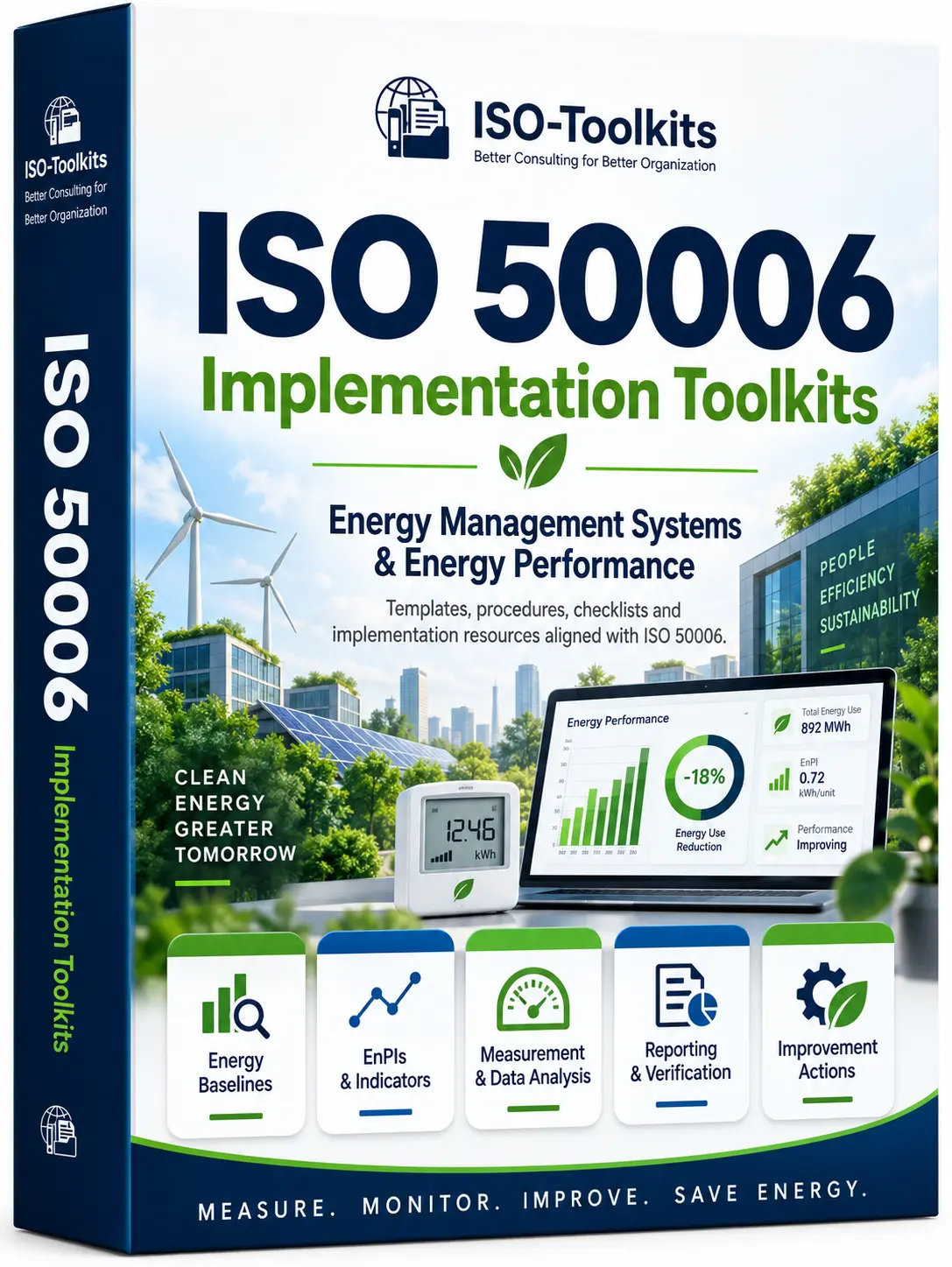
Developing reliable energy performance indicators and energy baselines requires consistent energy data, clearly defined boundaries, suitable relevant variables, documented assumptions, appropriate normalization methods, and repeatable performance evaluation controls. Building these records independently can require substantial technical and documentation effort.
The ISO 50006:2023 Energy Performance Evaluation Implementation Toolkit provides a structured collection of editable templates, calculation workbooks, registers, checklists, reports, and presentation resources in Word, Excel, and PowerPoint formats. It helps energy teams organize EnPI and EnB methodology, improve calculation traceability, evaluate performance consistently, and maintain review-ready evidence.

Below is the structured list of documents included in the package. Use the quick navigation or expand each part to review the files before downloading the index file.
 Part 1. Program Initiation & ISO 50006 Applicability
 ISO 50006 Implementation Charter.docx
 Energy Performance Evaluation Applicability Assessment.xlsx Current EnPI & EnB Practice Assessment.xlsx Existing Energy Performance Data & Methodology Review.xlsx ISO 50006 Gap & Improvement Action Plan.xlsx Implementation Roadmap.xlsx Energy Performance Roles & RACI Matrix.xlsx Energy Performance Stakeholder Register.xlsx
 Project Kick-off Slide.pptx
Part 2. Energy Performance Scope, Boundaries & Energy Review Inputs
Energy Performance Evaluation Framework.docx Energy Performance Scope & Boundary Worksheet.xlsx Energy Sources Register.xlsx Energy Uses & Consumption Register.xlsx Energy Flow Mapping Workbook.xlsx Significant Energy Use Register.xlsx SEU Boundary & Responsibility Matrix.xlsx Energy Performance Evaluation Objectives Worksheet.xlsx Operating Conditions & Production Output Register.xlsx Energy Performance Data Requirements Matrix.xlsx Energy Performance Assumptions & Constraints Register.xlsx Scope & Boundary Approval Record.docx
Part 3. Energy Data Collection, Metering & Data Quality
Energy Data Collection Plan.xlsx Energy Metering & Measurement Plan.xlsx Energy Meter & Measurement Device Register.xlsx Energy Data Source Register.xlsx Energy Data Ownership Matrix.xlsx Interval Energy Data Collection Workbook.xlsx Manual Energy Data Collection Log.xlsx Production & Activity Data Collection Workbook.xlsx Environmental & Operating Variable Data Workbook.xlsx Energy Data Quality Criteria.xlsx Energy Data Completeness & Accuracy Assessment.xlsx Missing Data & Estimation Register.xlsx Energy Data Validation & Reconciliation Checklist.xlsx Energy Data Evidence & Source Index.xlsx
Part 4. Relevant Variables, Static Factors & Operating Conditions
Relevant Variable & Static Factor Assessment Method.docx Candidate Relevant Variable Register.xlsx Static Factor Register.xlsx Operating Condition Classification Matrix.xlsx Variable-to-Energy Relationship Screening Workbook.xlsx Correlation & Significance Analysis Workbook.xlsx Relevant Variable Selection Matrix.xlsx Variable Data Quality Assessment.xlsx Static Factor Change Assessment.xlsx Normalization Requirement Assessment.xlsx Variable & Static Factor Assumptions Register.xlsx Relevant Variable Review & Approval Record.docx
Part 5. EnPI Design, Selection & Documentation
EnPI Development & Selection Guide.docx Candidate EnPI Register.xlsx EnPI Selection Criteria Matrix.xlsx EnPI Boundary & Energy Flow Mapping.xlsx Simple Energy Consumption EnPI Workbook.xlsx Ratio-Based EnPI Calculation Workbook.xlsx Statistical Model EnPI Workbook.xlsx SEU-Specific EnPI Workbook.xlsx Organization-Level EnPI Workbook.xlsx EnPI Formula Unit & Frequency Register.xlsx EnPI Data Source & Responsibility Matrix.xlsx EnPI Definition Sheet.docx EnPI Suitability Review Checklist.xlsx EnPI Selection & Approval Record.docx
Part 6. Energy Baseline Establishment & Baseline Period Selection
Energy Baseline Establishment Procedure.docx EnB Candidate Period Assessment.xlsx Baseline Period Selection Matrix.xlsx Baseline Data Sufficiency Assessment.xlsx Baseline Representativeness Assessment.xlsx Energy Baseline Calculation Workbook.xlsx SEU Energy Baseline Workbook.xlsx Organization-Level Energy Baseline Workbook.xlsx Baseline Conditions & Assumptions Register.xlsx EnB Boundary & Data Source Register.xlsx Energy Baseline Register.xlsx EnB Establishment Review Checklist.xlsx Energy Baseline Approval Record.docx
Part 7. Normalization, Energy Performance Modelling & EnB Adjustment
Energy Performance Normalization Methodology.docx Normalization Model Selection Matrix.xlsx Energy Performance Regression Model Workbook.xlsx Multivariable Energy Model Workbook.xlsx Model Coefficient & Parameter Register.xlsx Model Fit & Diagnostic Assessment.xlsx Model Residual & Outlier Analysis.xlsx Normalized Energy Consumption Workbook.xlsx Expected Energy Consumption Calculation.xlsx Static Factor Change Impact Assessment.xlsx Energy Baseline Adjustment Assessment.xlsx Energy Baseline Adjustment Workbook.xlsx EnPI Adjustment Assessment.xlsx Energy Model Version & Change Log.xlsx Normalization Model Review & Approval Record.docx
Part 8. Energy Performance Evaluation & Improvement Quantification
Energy Performance Evaluation Workbook.xlsx Actual vs Baseline Energy Performance Analysis.xlsx Normalized Energy Performance Comparison.xlsx SEU Energy Performance Evaluation Workbook.xlsx Organization Energy Performance Evaluation Workbook.xlsx Energy Performance Improvement Calculation.xlsx Energy Savings & Avoided Energy Calculation Workbook.xlsx Energy Objective & Target Performance Tracker.xlsx Cumulative Energy Performance Improvement Tracker.xlsx Energy Performance Variance Analysis.xlsx Energy Performance Sensitivity Analysis.xlsx Energy Performance Uncertainty Assessment.xlsx Significant Deviation Investigation Form.docx Energy Performance Results Verification Checklist.xlsx
Part 9. Monitoring, Trending & Performance Control
Energy Performance Monitoring Plan.xlsx EnPI Monitoring Frequency Matrix.xlsx EnPI Performance Dashboard.xlsx SEU Performance Dashboard.xlsx Energy Performance Trend Analysis.xlsx Energy Performance Control Chart Workbook.xlsx Cumulative Sum Energy Performance Tracker.xlsx Energy Performance Alert & Threshold Register.xlsx Energy Performance Deviation Log.xlsx Energy Performance Corrective Action Tracker.xlsx Monthly Energy Performance Review Pack.pptx
Part 10. Energy Performance Reporting, Communication & Evidence
Energy Performance Report Template.docx EnPI & EnB Summary Register.xlsx Energy Performance Executive Dashboard.xlsx SEU Energy Performance Reporting Workbook.xlsx Energy Performance Improvement Summary.xlsx EnPI EnB Methodology & Calculation Disclosure.docx Energy Performance Assumptions Limitations & Data Gaps Register.xlsx Energy Performance Evidence Pack Index.xlsx Energy Data Lineage & Traceability Matrix.xlsx Energy Performance Results Presentation Slide.pptx Energy Performance Report Review & Approval Record.docx
Part 11. EnPI & EnB Review, Update, Change Control & Handover
EnPI & EnB Periodic Review Checklist.xlsx EnPI Review & Revision Trigger Register.xlsx EnB Review & Revision Trigger Register.xlsx Relevant Variable Change Review.xlsx Static Factor Change Review.xlsx Energy Performance Boundary Change Assessment.xlsx Significant Operational Change Impact Assessment.xlsx EnPI Revision Assessment.xlsx EnB Revision & Adjustment Record.docx Energy Performance Methodology Change Log.xlsx Energy Performance Lessons Learned Register.xlsx Energy Performance Improvement Opportunities Register.xlsx Annual EnPI & EnB Review Plan.xlsx Energy Performance Records Retention Register.xlsx Operational Handover Checklist.xlsx Consultant Handover Checklist.xlsx Final Implementation Report.docx Final Executive Handover Slide.pptxUse these quick links to review the full file list and payment instructions.


| Date File Updated | 25/03/2025 |
| File Format | pdf, xls, doc, docx, xlsx, pptx |
| No. of files | 143 File; 11 Folders |
| File download size | 10.07 MB (rar). |
| Language |
 English
|
| Purchase code | ISO50006-Toolkits |
The EnPI selection workbooks gave our energy team a much clearer way to document why each indicator was chosen and how the calculation should be maintained when operating conditions change.
We used the baseline period and data sufficiency templates during an energy review project. They helped us identify missing information before we committed to the final EnB.
The normalization and relevant variable tools are useful for sites where production volume has a strong influence on consumption. The structure makes technical discussions easier to document.
I found the data ownership and evidence index particularly practical. Our energy reports are now easier to trace back to meters, source files, assumptions and responsible people.
The toolkit is well suited to consultants because the files follow a logical progression from scope and data collection through modelling, evaluation, reporting and handover.
The EnPI dashboard and performance trend files helped us standardize monthly energy reviews across our facilities rather than relying on separate spreadsheets from each site.
The change assessment templates are valuable when equipment, production schedules or static factors change. They give us a consistent record of whether the baseline needs adjustment.
The energy savings and avoided energy calculation workbooks provided a useful starting point for documenting improvement results and the assumptions behind them.
For our ISO 50001 program, this toolkit filled the gap between having energy data and having a repeatable method for evaluating performance against a controlled baseline.
The package is detailed without being difficult to navigate. The file names make it clear which records are needed for EnPIs, EnBs, normalization, monitoring and reporting.
The periodic review checklists and revision triggers are very useful for maintaining the methodology after the initial implementation project has finished.
This toolkit helped our team create a more professional handover package for energy performance management, with clear responsibilities, records and review actions for ongoing use.