
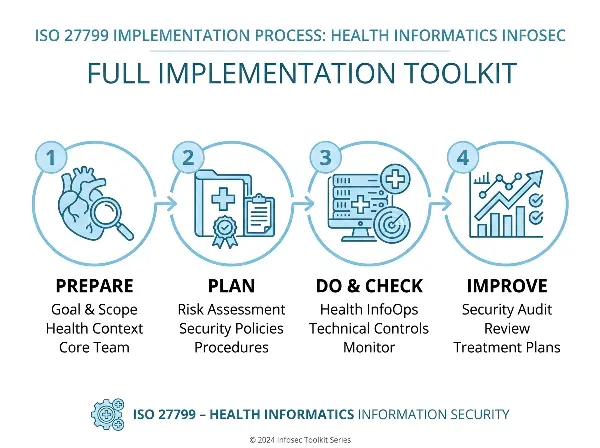
The ISO 27799 Health Informatics Information Security Implementation Toolkit provides a comprehensive, easy to use set of professional templates and practical resources to help healthcare organizations establish, implement, manage, and strengthen information security controls for health information.
Aligned with ISO 27799 guidance, this toolkit translates healthcare-specific information security expectations into actionable policies, procedures, risk workbooks, registers, evidence records, slides, and monitoring tools. It helps organizations protect sensitive health data, strengthen patient information confidentiality, support regulatory and audit readiness, improve clinical information governance, and build a more secure, accountable, and resilient healthcare information environment.
Implementing health information security guidance aligned with ISO 27799 can be complex and time-consuming, especially for healthcare organizations that must protect sensitive health information, strengthen privacy controls, manage clinical system risks, and maintain consistent documentation across clinical, administrative, technical, and third-party environments.
The ISO 27799 Health Informatics Information Security Implementation Toolkit provides a comprehensive collection of easy to use templates and structured implementation documents in Word, Excel, and PowerPoint formats. It helps your organization accelerate health information security implementation, standardize controls and evidence records, strengthen healthcare security governance, support audit readiness, and improve the protection of patient and clinical information with greater confidence.

Below is the structured list of documents included in the package. Use the quick navigation or expand each part to review the files before downloading the index file.
 Part 1. Program Governance, Clinical Oversight & Implementation Direction
Objective: To establish executive sponsorship, clinical governance, security leadership, program scope, implementation objectives, decision rights, and organizational direction required to launch and govern the Health Information Security Management Program with enterprise-wide accountability.
 Health Information Security Program Charter.docx Health Information Security Governance Framework.docx ISO 27799 Implementation Scope Definition.docx Health Information Security Policy Framework.docx Master Health Information Security Policy.docx Clinical Information Protection Objectives.docx Information Security Roles & Clinical Responsibilities.docx Legal, Regulatory & Healthcare Compliance Mapping.docx ISO 27799 Implementation Roadmap.docx
 Governance Stakeholder Register.xlsx Program RACI Matrix.xlsx Security Objectives & KPI Register.xlsx Healthcare Compliance Obligations Register.xlsx Governance Meeting Calendar.xlsx Program Budget & Resource Tracker.xlsx
 ISO 27799 Executive Kickoff Slides.pptx Board & Clinical Leadership Awareness Slides.pptx
Part 2. Health Information Asset Inventory & Classification
Objective: To define how health information assets, clinical records, diagnostic content, research data, and supporting systems are identified, owned, classified, labelled, handled, transferred, retained, and disposed of according to sensitivity, care impact, and regulatory requirements.
Health Information Asset Management Policy.docx Health Data Classification Policy.docx Data Labelling & Handling Standard.docx Clinical Record Handling Procedure.docx Acceptable Use of Health Information Resources Policy.docx Media Handling & Secure Disposal Procedure.docx Information Ownership & Custodianship Guideline.docx Health Information Asset Register.xlsx Asset Ownership Register.xlsx Data Classification Register.xlsx Information Transfer Register.xlsx Secure Disposal Log.xlsx Critical Clinical Information Asset Register.xlsx Health Data Classification Awareness Slides.pptx
Part 3. Health Information Risk Assessment & Treatment
Objective: To provide the governance, methodology, criteria, and working records required to identify, assess, evaluate, prioritize, accept, and treat risks affecting the confidentiality, integrity, availability, and safety-related use of health information and healthcare systems.
Health Information Risk Management Policy.docx Risk Assessment Methodology for Healthcare Environments.docx Risk Assessment Procedure.docx Risk Treatment Strategy.docx Risk Acceptance Criteria.docx Risk Evaluation Criteria.docx Clinical Impact & Business Impact Analysis Methodology.docx Health Information Risk Register.xlsx Risk Treatment Plan.xlsx Healthcare Threat & Vulnerability Register.xlsx Risk Scenario Library.xlsx Clinical Impact Assessment.xlsx Risk Heat Map.xlsx Risk Acceptance Log.xlsx Healthcare Risk Workshop Slides.pptx Risk Reporting Deck for Management.pptx
Part 4. Control Selection, Statement of Applicability & Implementation
Objective: To define the approach for selecting, tailoring, implementing, tracking, and evidencing security controls appropriate for health organizations, with clear linkage to risk treatment decisions and healthcare operating realities.
Control Selection & Implementation Strategy.docx Control Design Specification.docx Healthcare Control Implementation Guidelines.docx Compensating Control Justification Template.docx Control Gap Assessment Report.docx Control Operating Procedure Template.docx Statement of Applicability (SoA).xlsx Control Implementation Plan.xlsx Control Mapping Matrix.xlsx Control Implementation Tracker.xlsx Control Ownership Register.xlsx Control Effectiveness Tracker.xlsx ISO 27799 Control Implementation Overview Slides.pptx Control Gap Assessment Presentation.pptx
Part 5. Identity, Access Control & Workforce Authorization
Objective: To establish strong identity governance, access authorization, authentication, privileged access control, role-based access design, segregation of duties, and periodic access review for employees, clinicians, contractors, and third-party users.
Access Control Policy.docx Identity & Access Management Standard.docx User Access Provisioning Procedure.docx Privileged Access Management Procedure.docx Authentication & Password Standard.docx Role-Based Access Matrix Methodology.docx Workforce Identity Lifecycle Procedure.docx User Access Request Register.xlsx Privileged Access Register.xlsx Access Review Log.xlsx Segregation of Duties Matrix.xlsx Dormant & Disabled Account Register.xlsx Access Violation Log.xlsx Access Control Awareness Slides.pptx
Part 6. Clinical Applications, EHR/EMR & Health Software Security
Objective: To define security requirements, operational safeguards, and assurance records for EHR/EMR platforms, laboratory systems, radiology systems, pharmacy systems, clinical portals, and other health software supporting diagnosis, treatment, and care delivery.
Clinical Application Security Policy.docx EHR/EMR Security Standard.docx Health Software Security Requirements.docx Clinical System Configuration Baseline.docx Application Change & Release Procedure.docx Audit Trail & Logging Requirements for Clinical Systems.docx Downtime & Emergency Access Procedure.docx Clinical Systems Inventory.xlsx Application Access Role Matrix.xlsx EHR Security Review Checklist.xlsx Emergency Access Log.xlsx Clinical Application Vulnerability Log.xlsx Clinical Application Security Slides.pptx
Part 7. Medical Device, Connected Care & Biomedical Technology Security
Objective: To protect medical devices, connected clinical equipment, biomedical technologies, and supporting operational environments through secure onboarding, ownership assignment, configuration control, patch coordination, network segregation, and lifecycle oversight.
Medical Device Security Policy.docx Connected Clinical Technology Security Standard.docx Medical Device Risk Assessment Procedure.docx Device Configuration & Change Control Procedure.docx Medical Device Patch & Exception Management Procedure.docx Biomedical Asset Ownership Guideline.docx Clinical Equipment Network Segmentation Standard.docx Medical Device Inventory Register.xlsx Device Security Classification Register.xlsx Device Risk Assessment Log.xlsx Device Patch & Exception Register.xlsx Biomedical Maintenance & Security Coordination Log.xlsx Medical Device Security Awareness Slides.pptx
Part 8. Cryptography, Privacy Safeguards & Data Protection
Objective: To define requirements for encryption, key management, privacy protection, secure storage, controlled disclosure, retention, masking, anonymization support, backup, restore, and secure transfer of sensitive health information.
Cryptographic Protection Policy.docx Encryption Standard for Health Information.docx Key Management Procedure.docx Health Data Protection Policy.docx Data Retention & Secure Disposal Policy.docx Data Masking & De-identification Guideline.docx Backup & Restore Procedure.docx Secure Information Transfer Standard.docx Encryption Usage Register.xlsx Cryptographic Key Inventory.xlsx Data Retention Schedule.xlsx Backup Monitoring Log.xlsx Health Data Protection Awareness Slides.pptx
Part 9. Interoperability, Information Exchange & Telehealth Security
Objective: To establish security controls for health information exchange, interoperability services, remote care channels, telehealth operations, messaging, APIs, and trusted data sharing with internal and external healthcare stakeholders.
Health Information Exchange Security Policy.docx Interoperability Security Standard.docx Secure API & Interface Control Procedure.docx Telehealth Security Requirements.docx Remote Consultation Protection Guideline.docx Third-Party Data Exchange Agreement Template.docx Interface Inventory Register.xlsx External Data Exchange Register.xlsx API Access Approval Log.xlsx Telehealth Risk Assessment.xlsx Data Sharing Review Register.xlsx Telehealth & Interoperability Security Slides.pptx
Part 10. Operations Security, Infrastructure & Network Protection
Objective: To define secure operational practices for infrastructure administration, change control, patching, configuration management, monitoring, logging, vulnerability management, backup operations, and network protection across healthcare IT environments.
Operations Security Policy.docx Configuration Management Standard.docx Change Management Procedure.docx Patch & Vulnerability Management Procedure.docx Security Monitoring & Log Management Procedure.docx Network Security Standard.docx Firewall & Segmentation Management Procedure.docx Change Request Log.xlsx Configuration Register.xlsx Patch Compliance Tracker.xlsx Vulnerability Register.xlsx Firewall Rule Register.xlsx Monitoring Alert Log.xlsx Infrastructure Security Overview Slides.pptx
Part 11. Physical, Facility & Environmental Security
Objective: To protect facilities, secure areas, records rooms, data centres, biomedical spaces, workstations, and supporting environments through controlled physical access, environmental safeguards, visitor oversight, and secure working practices.
Physical Security Policy.docx Facility Access Control Procedure.docx Secure Clinical Area Definition.docx Equipment Security Standard.docx Clean Desk, Clear Screen & Record Protection Policy.docx Environmental Protection Procedure.docx Visitor Log Register.xlsx Physical Access Register.xlsx Secure Area Checklist.xlsx Environmental Control Checklist.xlsx Physical Security Incident Log.xlsx Physical Security Awareness Slides.pptx
Part 12. Supplier, Cloud, Outsourcing & Third-Party Assurance
Objective: To ensure suppliers, cloud providers, service partners, outsourced processing arrangements, and third-party health information handlers are governed by appropriate security requirements, due diligence, contractual safeguards, and risk-based performance oversight.
Supplier Security Policy.docx Third-Party Risk Management Procedure.docx Cloud Security Requirements Standard.docx Vendor Security Due Diligence Guideline.docx Health Information Processing Agreement Template.docx Outsourcing Security Policy.docx Third-Party Risk Assessment.xlsx Supplier Register.xlsx Vendor Due Diligence Checklist.xlsx Cloud Service Security Review.xlsx Supplier Performance Review.xlsx Third-Party Incident Log.xlsx Third-Party Assurance Slides.pptx
Part 13. Security Incident, Breach Response & Investigation
Objective: To establish a structured capability for identifying, classifying, escalating, containing, investigating, recovering from, and learning from information security incidents and personal health information breaches in healthcare settings.
Health Information Security Incident Management Policy.docx Incident Response Plan.docx Incident Response Procedure.docx Breach Notification & Escalation Procedure.docx Incident Classification Standard.docx Root Cause Analysis Template.docx Digital Forensics & Evidence Handling Guideline.docx Incident Classification Matrix.xlsx Security Incident Register.xlsx Personal Health Information Breach Log.xlsx Lessons Learned Register.xlsx Incident KPI Dashboard.xlsx Incident Response Training Slides.pptx
Part 14. Business Continuity, Clinical Downtime & Disaster Recovery
Objective: To define resilience strategies, continuity arrangements, downtime procedures, recovery plans, testing requirements, and crisis coordination needed to restore critical clinical and administrative services after disruptive events.
Business Continuity Policy.docx Clinical Continuity Strategy.docx Clinical Downtime Procedure.docx Business Continuity Plan (BCP).docx Disaster Recovery Plan (DRP).docx Crisis Communication Plan.docx Recovery Testing Procedure.docx Business Impact Analysis.xlsx Critical Clinical Service Register.xlsx RTO/RPO Register.xlsx DR Test Plan.xlsx DR Test Report.xlsx Clinical Continuity & DR Awareness Slides.pptx
Part 15. Compliance, Internal Audit & Assurance Management
Objective: To support internal audit, compliance monitoring, nonconformity management, corrective actions, management assurance, and evidence readiness across the Health Information Security Management Program lifecycle.
Internal Audit Policy.docx Audit Procedure.docx Audit Report Template.docx Compliance Monitoring Procedure.docx Nonconformity & Corrective Action Procedure.docx Internal Audit Plan.xlsx ISO 27799 Audit Checklist.xlsx Nonconformity Register.xlsx Corrective Action Tracker.xlsx Compliance Monitoring Report.xlsx Control Effectiveness Assessment.xlsx Evidence Register.xlsx Audit & Assurance Results Slides.pptx
Part 16. Workforce Awareness, Monitoring, Reporting & Continual Improvement
Objective: To establish a sustained security culture, formal reporting discipline, management review cadence, performance measurement structure, and continual improvement process for maintaining and maturing health information security over time.
Security Awareness & Training Policy.docx Health Information Security Awareness Program Plan.docx Reporting & Management Review Procedure.docx Continual Improvement Procedure.docx Document & Record Control Procedure.docx Training Attendance Register.xlsx Awareness Campaign Calendar.xlsx Security Metrics Dashboard.xlsx KPI/KRI Register.xlsx Continual Improvement Register.xlsx Policy Review Schedule.xlsx Document Version Control Register.xlsx Security Awareness Training Slides.pptx Management Review & Improvement Slides.pptxUse these quick links to review the full file list and payment instructions.


| Date File Updated | 25/03/2025 |
| File Format | pdf, xls, doc, docx, xlsx, pptx |
| No. of files | 218 Files, 16 Folders |
| File download size | 43.18 MB (.rar) |
| Language |
 English
|
| Purchase code | ISO27799-Toolkits |
The ISO Toolkit has helped us structure our implementation work clearly. It gave our team practical templates, organized procedures, and a reliable starting point for building our management system documentation.
After using the ISO Toolkit, our ISO preparation became much more organized. The documents are professional, easy to adapt, and helpful for aligning internal teams around clear compliance requirements.
Our consultants and internal managers found the toolkit very practical. It saved time, improved documentation consistency, and gave us a better framework for ISO implementation across departments.
The toolkit provides a strong foundation for ISO best practices. It helped us organize policies, procedures, records, and improvement actions in a way that is simple to maintain.