
ISO/IEC 17020:2026 Inspection Body Competence Implementation Toolkit
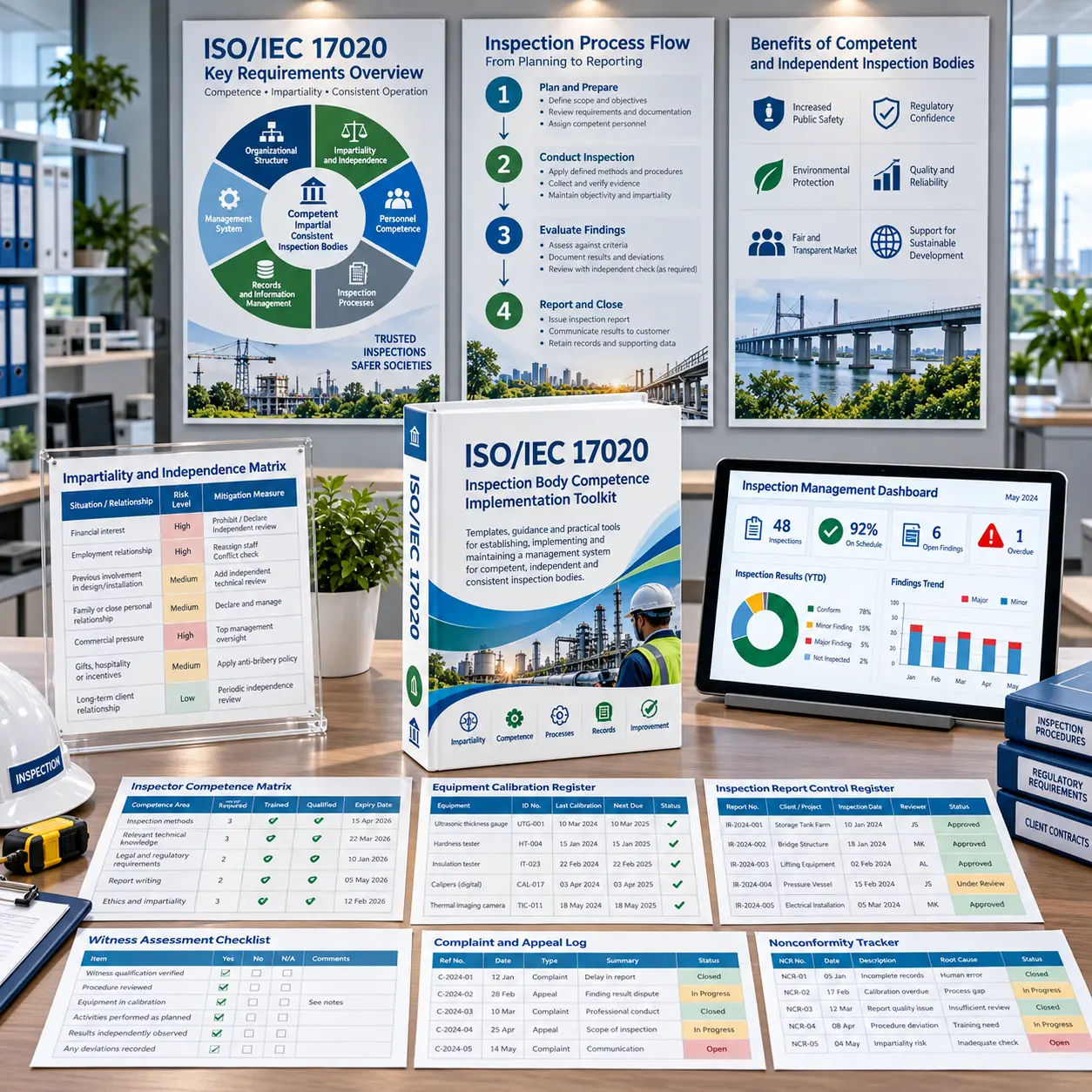
The ISO/IEC 17020:2026 Inspection Body Competence Implementation Toolkit provides a comprehensive, easy to use set of premium templates and professionally structured implementation resources to help inspection bodies establish, document, operate, monitor, and continually improve competent, impartial, and consistent inspection activities.
Aligned with ISO/IEC 17020:2026, the toolkit translates inspection body requirements into practical policies, procedures, registers, matrices, checklists, workbooks, plans, and presentations. It supports governance, accreditation scope, legal status and liability, impartiality and independence, confidentiality, personnel competence, inspector authorization and witnessing, external providers, equipment and metrological traceability, inspection methods, enquiry and contract review, planning and sampling, inspection item handling and chain of custody, field execution, technical records, conformity determination, independent technical review, reports and certificates, nonconforming inspection work, complaints and appeals, digital information integrity, risk and business continuity, internal audit, management review, corrective action, and accreditation readiness.
ISO/IEC 17020 Toolkit Value & Pricing
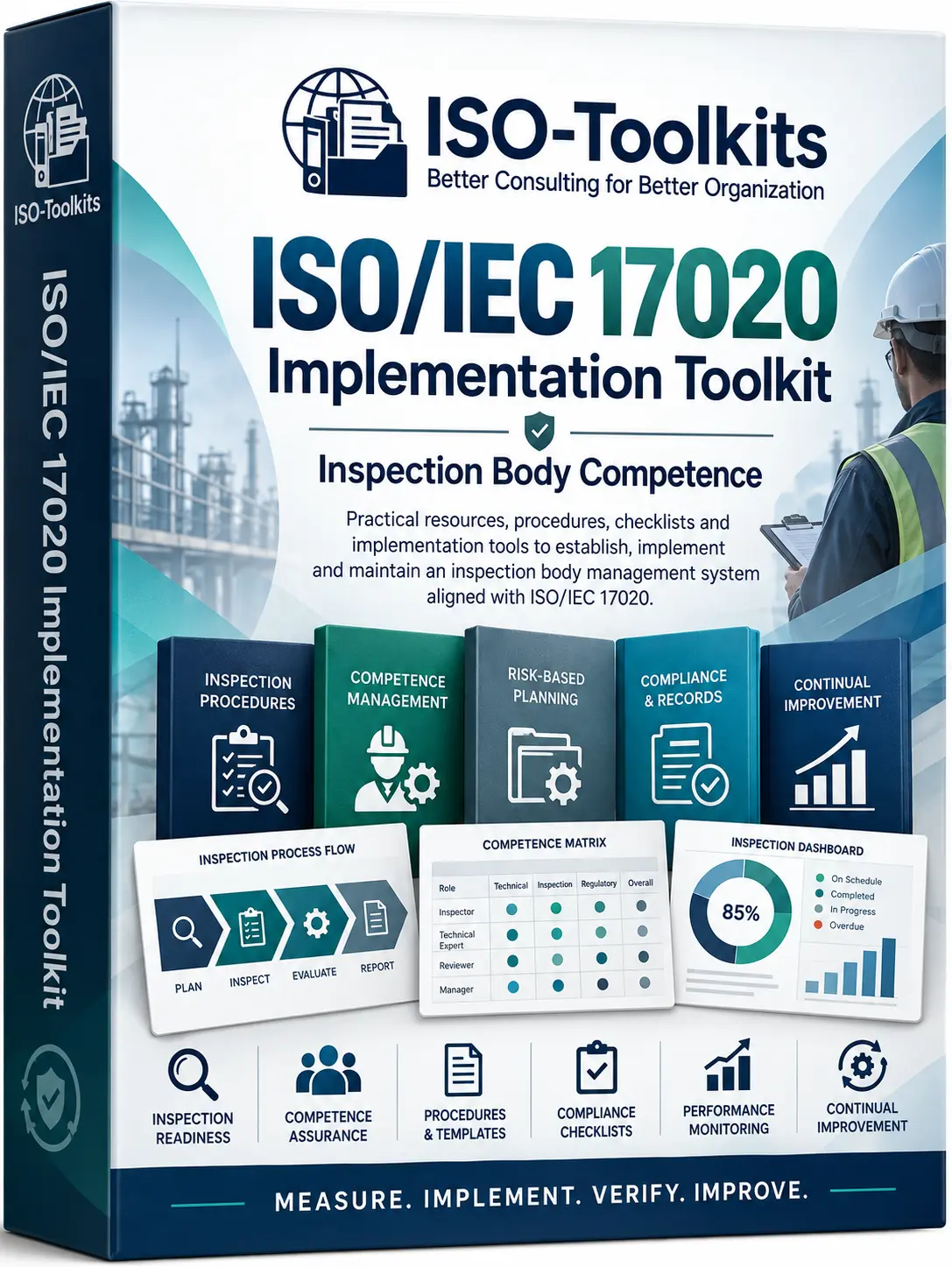
Implementing ISO/IEC 17020 can be demanding because inspection bodies must control impartiality, independence, competence, equipment, methods, sampling, item handling, field activities, technical records, decision rules, report authorization, nonconforming work, complaints, appeals, outsourced activities, information integrity, risk, continuity, audit, corrective action, and management review while maintaining consistent technical outcomes.
The ISO/IEC 17020:2026 Inspection Body Competence Implementation Toolkit provides a comprehensive collection of easy to use templates and structured implementation documents in Word, Excel, and PowerPoint formats. It helps inspection bodies accelerate implementation, standardize accreditation evidence, strengthen inspector competence and authorization, improve impartiality and technical control, support reliable conformity decisions and reports, and maintain stronger documentation for internal audit, management review, corrective action, and accreditation readiness.

ISO/IEC 17020 Toolkit Document Index
Below is the structured list of documents included in the package. Expand each part to review the files before downloading the index file.
 Part 1. Enterprise Inspection Body Governance and Programme Initiation
 Enterprise Inspection Body Governance Policy.docx ISO IEC 17020 Implementation Charter.docx Inspection Body Organization and Management Procedure.docx
 Enterprise Inspection Body Site and Activity Register.xlsx Inspection Body Governance RACI Matrix.xlsx ISO IEC 17020 Implementation Roadmap and Action Register.xlsx
 Enterprise Inspection Body Implementation Kickoff.pptx
Part 2. Inspection Scope, Accreditation Requirements and Gap Assessment
Inspection Activities Scope and Accreditation Boundaries.docx ISO IEC 17020 Readiness and Gap Assessment Plan.docx ISO IEC 17020 2026 Requirements and Evidence Matrix.xlsx Inspection Field Item Range and Method Scope Register.xlsx Multi Site Inspection Body Gap Assessment.xlsx Accreditation Readiness and Gap Closure Register.xlsx Inspection Scope and Accreditation Readiness Review.pptxPart 3. Legal Status, Structural Responsibilities and Liability
Inspection Body Legal Status and Liability Procedure.docx Inspection Body Authority and Reporting Lines Framework.docx Legal Entity and Inspection Authorization Register.xlsx Professional Liability and Insurance Coverage Register.xlsx Inspection Body Management and Technical Authority Matrix.xlsx Legal Regulatory and Contractual Obligations Register.xlsx Structural Responsibility and Liability Review.pptxPart 4. Impartiality, Independence and Conflict of Interest Control
Inspection Impartiality and Independence Policy.docx Type A or Type Non A Independence Classification Assessment.docx Conflict of Interest and Impartiality Risk Control Procedure.docx Inspection Body Independence Classification and Evidence Matrix.xlsx Impartiality Threat and Safeguard Risk Register.xlsx Inspector Relationship and Conflict of Interest Declaration Log.xlsx Impartiality Risk Mitigation and Periodic Review Register.xlsx Impartiality and Independence Safeguards Review.pptxPart 5. Confidentiality, Data Protection and Authorized Disclosure
Inspection Information Confidentiality and Disclosure Procedure.docx Confidentiality Commitment and Authorized Access Agreement.docx Confidential Data Class and Authorized Access Matrix.xlsx Staff and External Personnel Confidentiality Undertaking Register.xlsx Client Information Disclosure and Approval Register.xlsx Confidentiality Breach and Remediation Log.xlsx Inspection Confidentiality and Data Protection Briefing.pptxPart 6. Inspection Personnel Competence Criteria and Technical Coverage
Inspection Personnel Competence Management Procedure.docx Technical Inspection Role and Competence Profile.docx Inspection Field and Method Competence Criteria Matrix.xlsx Inspector Qualification Experience and Training Register.xlsx Technical Management and Reviewer Competence Matrix.xlsx Competence Gap and Development Plan.xlsx Inspection Personnel Competence Framework Review.pptxPart 7. Inspector Evaluation, Authorization and Ongoing Monitoring
Inspector Initial Evaluation and Authorization Procedure.docx Inspector Witnessing Performance and Reauthorization Procedure.docx Inspector Initial Competence Evaluation Checklist.xlsx Inspector Field Method and Scope Authorization Register.xlsx Inspector Witnessing and Onsite Observation Log.xlsx Inspector Performance Monitoring and Reauthorization Tracker.xlsx Inspector Authorization and Performance Review.pptxPart 8. External Providers, Subcontracting and Exceptional Outsourcing
External Inspection Service Provider Qualification Procedure.docx Exceptional Outsourcing Justification and Authorization Record.docx External Inspection Activity Agreement and Control Plan.docx Approved External Inspection Provider Register.xlsx External Provider Competence Impartiality and Scope Assessment.xlsx Exceptional Outsourced Inspection Approval and Traceability Log.xlsx Outsourced Inspection Result Acceptance and Performance Register.xlsx External Provider and Outsourcing Controls Review.pptxPart 9. Inspection Facilities, Equipment and Metrological Traceability
Inspection Equipment Suitability and Lifecycle Procedure.docx Measurement Equipment Calibration and Traceability Procedure.docx Inspection Equipment Handling and Out of Service Procedure.docx Inspection Equipment Master Register.xlsx Equipment Inspection Maintenance and Functional Check Log.xlsx Calibration Traceability and Intermediate Check Schedule.xlsx Equipment Defect Repair and Return to Service Register.xlsx Reference Standard and Calibration Certificate Verification.xlsx Inspection Equipment and Metrology Readiness Review.pptxPart 10. Inspection Methods, Criteria and Technical Procedure Control
Inspection Method Selection and Validation Procedure.docx Inspection Method and Acceptance Criteria Specification.docx Inspection Technical Instruction Approval and Change Procedure.docx Approved Inspection Method and Technical Standard Register.xlsx Inspection Method Validation and Suitability Evidence Matrix.xlsx Inspection Item Requirement and Acceptance Criteria Register.xlsx Inspection Method Revision and Technical Change Log.xlsx Inspection Method and Technical Criteria Review.pptxPart 11. Inspection Enquiries, Contract Review and Work Acceptance
Inspection Enquiry Quotation and Contract Review Procedure.docx Inspection Service Request and Contract Review Form.docx Customer Inspection Request and Enquiry Register.xlsx Inspection Scope Standards and Requirements Review Checklist.xlsx Inspection Competence Resources and Impartiality Feasibility Check.xlsx Inspection Contract Amendment and Approval Register.xlsx Inspection Request Acceptance and Contract Review.pptxPart 12. Inspection Planning, Sampling and Assignment Control
Inspection Planning and Work Order Authorization Procedure.docx Inspection Sampling and Sample Selection Procedure.docx Inspection Assignment Plan and Technical Brief.docx Inspection Work Order and Schedule Register.xlsx Inspection Plan Item Criteria and Hold Point Matrix.xlsx Risk Based Inspection Sampling and Selection Plan.xlsx Inspector Assignment Competence and Independence Checklist.xlsx Inspection Plan and Team Readiness Review.pptxPart 13. Inspection Item Identification, Handling and Chain of Custody
Inspection Item Identification Handling and Protection Procedure.docx Inspection Sample Custody and Traceability Procedure.docx Inspection Item Receipt and Identification Register.xlsx Inspection Item Condition and Suitability Checklist.xlsx Sample Selection Sealing and Chain of Custody Log.xlsx Inspection Item Storage Movement and Disposition Register.xlsx Inspection Item Handling and Traceability Review.pptxPart 14. Inspection Execution and Site Operational Controls
Inspection Execution and Field Activity Control Procedure.docx Site Inspection Readiness and Safe Access Procedure.docx Inspection Deviation and Unforeseen Condition Response Procedure.docx Pre Inspection Site and Equipment Readiness Checklist.xlsx Inspection Field Activity and Site Visit Log.xlsx Inspection Method Execution and Process Control Checklist.xlsx Site Hazard Access Restriction and Incident Register.xlsx Inspection Field Operations and Site Control Review.pptxPart 15. Inspection Observations, Measurements and Technical Records
Inspection Objective Evidence and Technical Record Procedure.docx Inspection Measurement and Data Recording Instruction.docx Inspection Raw Data and Measurement Record.xlsx Inspection Observations Photographs and Evidence Index.xlsx Inspection Test and Measurement Traceability Matrix.xlsx Inspection Data Completeness and Integrity Checklist.xlsx Inspection Technical Record Correction and Approval Log.xlsx Inspection Evidence and Technical Record Review.pptxPart 16. Conformity Determination and Technical Result Review
Inspection Conformity Determination and Decision Rule Procedure.docx Independent Technical Review and Inspection Conclusion Procedure.docx Inspection Results Against Acceptance Criteria Matrix.xlsx Inspection Nonconformity and Technical Finding Register.xlsx Conformity Determination Rationale and Approval Log.xlsx Technical Review Comments and Resolution Checklist.xlsx Inspection Conformity and Technical Review Meeting.pptxPart 17. Inspection Reports, Certificates and Release Authorization
Inspection Report Preparation Review and Issuance Procedure.docx Inspection Report and Results Template.docx Inspection Certificate and Authorized Signatory Template.docx Inspection Report Completeness and Mandatory Content Checklist.xlsx Authorized Report Reviewer and Signatory Register.xlsx Inspection Report Certificate and Issue Number Register.xlsx Report Amendment Reissue and Customer Notification Log.xlsx Inspection Report and Certificate Release Review.pptxPart 18. Nonconforming Inspection Work, Reinspection and Corrective Control
Nonconforming Inspection Work and Result Control Procedure.docx Reinspection Correction and Client Notification Procedure.docx Nonconforming Inspection Work and Impact Register.xlsx Inspection Result Correction and Reinspection Tracker.xlsx Affected Report Client and Accreditation Impact Assessment.xlsx Technical Nonconformity Corrective Action and Verification Log.xlsx Nonconforming Inspection Work and Recovery Review.pptxPart 19. Complaints, Appeals and Independent Resolution
Inspection Complaint Handling and Resolution Procedure.docx Inspection Appeal Investigation and Independent Decision Procedure.docx Inspection Complaint Receipt Investigation and Closure Register.xlsx Appeal Independence Review and Decision Register.xlsx Complaint Appeal Communication and Response Time Log.xlsx Complaint and Appeal Root Cause and Action Tracker.xlsx Complaints Appeals and Resolution Review.pptxPart 20. Inspection Records, Digital Systems and Information Integrity
Inspection Records Retention Access and Disposal Procedure.docx Digital Inspection Data Integrity and System Validation Procedure.docx Inspection Case File and Record Completeness Checklist.xlsx Inspection Record Retention and Archival Register.xlsx Inspection IT System Access and Audit Trail Register.xlsx Electronic Inspection System Validation and Change Test Log.xlsx Inspection Data Governance and Information Integrity Review.pptxPart 21. Risk Management, Change Control and Business Continuity
Inspection Body Risk and Opportunity Management Procedure.docx Inspection Service Continuity and Emergency Response Plan.docx Inspection Operational Change and Impact Control Procedure.docx Inspection Body Operational Risk and Opportunity Register.xlsx Critical Inspection Service Continuity and Resource Matrix.xlsx Inspection Method Personnel and Scope Change Impact Tracker.xlsx Service Disruption Recovery and Contingency Test Register.xlsx Inspection Risk and Service Resilience Review.pptxPart 22. Internal Audit, Management Review and Implementation Closeout
ISO IEC 17020 Internal Audit and Corrective Action Procedure.docx Inspection Body Management Review Procedure.docx Enterprise Inspection Body Implementation Handover and Sustainment Plan.docx ISO IEC 17020 2026 Internal Audit Checklist.xlsx Inspection Body Internal Audit Programme and Schedule.xlsx Inspection Quality Competence and Impartiality KPI Dashboard.xlsx Audit Findings Root Cause and Corrective Action Register.xlsx Accreditation Readiness and Implementation Closeout Checklist.xlsx Enterprise Inspection Body Management Review and Closeout.pptxReview the complete file index, preview free sample templates, or check the purchase and payment guide.
ISO/IEC 17020 Toolkit Package & Download Information
| Date File Updated | 03/02/2026 |
| File Format | doc, docx, xls, xlsx, ppt, pptx |
| No. of files | 107 File; 10 Folders |
| File download size | 10.12 MB (rar). |
| Language |
 English |
| Purchase code | ISO17020-Toolkits |
Ready to Implement ISO/IEC 17020:2026?
Start with the complete ISO/IEC 17020 inspection body competence toolkit or review the free sample before purchasing.
The ISO/IEC 17020 toolkit helped us bring governance, technical operations, inspection records, and accreditation evidence into one consistent system instead of separate departmental files.
The scope, legal status, liability, authority, impartiality, conflict of interest, and confidentiality templates made our accreditation baseline review much more systematic.
The inspector competence, qualification, authorization, witnessing, performance, reauthorization, and technical management matrices strengthened our personnel control process.
The external provider, exceptional outsourcing, competence, impartiality, result acceptance, and performance records were very practical for occasional subcontracted inspection work.
The equipment, maintenance, calibration, intermediate check, defect, reference standard, and metrological traceability tools improved technical readiness.
The method selection, validation, acceptance criteria, technical instruction, revision, and change control records gave us stronger technical procedure governance.
The enquiry, contract review, scope, feasibility, planning, sampling, work order, hold point, and inspector assignment tools made work acceptance more consistent.
The item receipt, identification, sample custody, sealing, storage, movement, site readiness, field activity, and deviation records were useful across multiple inspection schemes.
The raw data, measurements, photographs, evidence index, data integrity, correction, conformity determination, and technical review templates strengthened our case files.
The inspection report, certificate, authorized signatory, issue register, reissue, client notification, and nonconforming work templates improved our release process.
The complaints, appeals, independence review, response time, root cause, digital records, audit trail, and system validation tools improved governance and transparency.
The risk, continuity, operational change, internal audit, KPI, corrective action, management review, closeout, and accreditation readiness templates gave us a clear sustainment framework.