ISO 22095:2020 Chain of Custody Implementation Toolkit
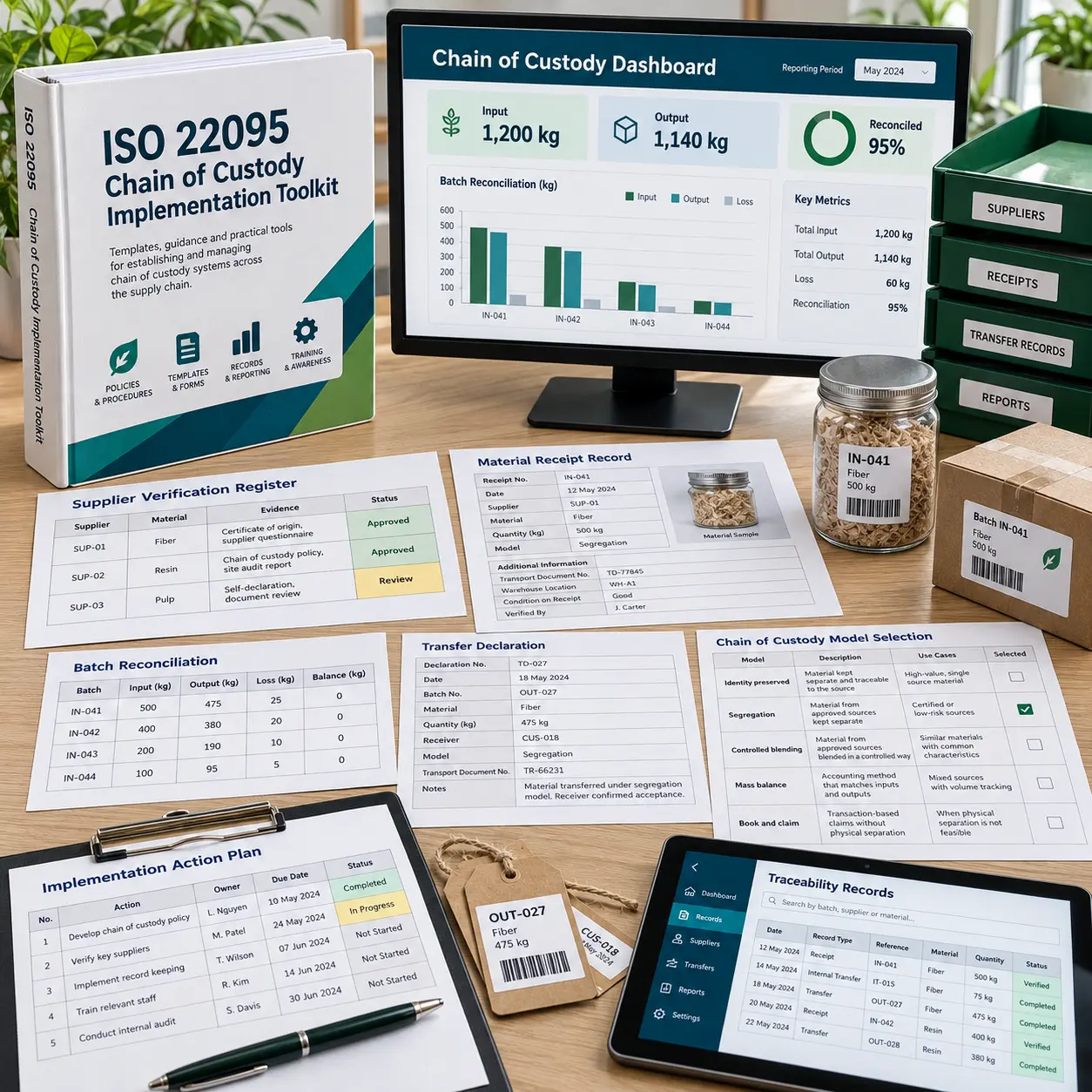
The ISO 22095 Chain of Custody Implementation Toolkit provides editable procedures, registers, workbooks and training presentations to help organizations define and manage custody controls for materials and products across their supply chains.
Its 18 implementation areas support scope definition, supplier qualification, identification, input eligibility, transformation, inventory reconciliation and claim control. Dedicated tools cover identity preserved, segregated, controlled blending, mass balance and book and claim models. Apply the relevant model and programme criteria: a custody system alone does not prove a product characteristic or authorize a claim.
ISO 22095 Toolkit Value & Pricing
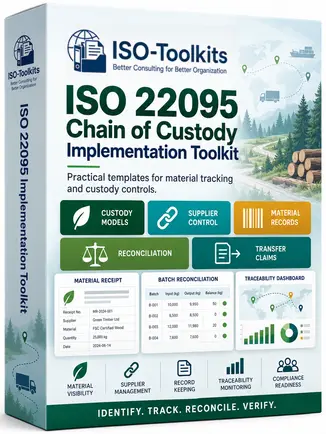
Implementing chain of custody controls requires a defined scope, suitable models, reliable supplier evidence and consistent accounting. Teams need to maintain eligible input records, control material handling and transformation, reconcile quantities or attributes and review the claims communicated with outputs.
The ISO 22095 Chain of Custody Implementation Toolkit provides a comprehensive collection of editable templates and structured implementation documents in Word, Excel and PowerPoint formats. It helps your organization document responsibilities, manage physical and accounting controls, improve transaction records and prepare for internal verification using the ISO 22095:2020 framework and applicable programme rules.

ISO 22095 Toolkit Document Index
Below is the structured list of documents included in the package. Expand each part to review the files before downloading the index file.
 Part 1. Chain of Custody Governance and Project Initiation
 ISO 22095 Implementation Project Charter.docx Chain of Custody Governance Framework.docx Chain of Custody Implementation Plan.docx CoC Team Terms of Reference.docx CoC Roles Responsibilities and Authorities.docx CoC Document Control Procedure.docx
 ISO 22095 Project RACI Matrix.xlsx ISO 22095 Stakeholder Register.xlsx ISO 22095 Project Schedule and Milestone Tracker.xlsx ISO 22095 Requirements Traceability Matrix.xlsx CoC Document Register.xlsx
 ISO 22095 Project Kickoff Presentation.pptx ISO 22095 Executive Awareness Presentation.pptx
Part 2. Organizational Context, Scope and Chain of Custody Boundaries
CoC Organizational Context Assessment.docx Chain of Custody Scope Definition.docx CoC System Boundary Definition.docx Product and Material Scope Definition.docx Site and Legal Entity Scope Definition.docx Supply Chain Boundary Definition.docx Outsourced Activity Scope Assessment.docx CoC Scope Register.xlsx Site and Legal Entity Register.xlsx Product and Material Scope Register.xlsx Supply Chain Participant Register.xlsx Outsourced Process Register.xlsx CoC Scope and Boundary Workshop.pptx
Part 3. Specified Characteristics, Claims and Chain of Custody Objectives
Specified Characteristic Definition Form.docx Chain of Custody Objectives and Claims Framework.docx Claim Eligibility and Use Criteria.docx Claim Wording Approval Form.docx Claim Evidence Requirements Definition.docx Claim Risk Assessment Form.docx Specified Characteristic Register.xlsx Approved Claim Register.xlsx Claim to Evidence Traceability Matrix.xlsx Claim Risk Register.xlsx Claim Approval and Expiry Tracker.xlsx CoC Claims and Specified Characteristics Workshop.pptx
Part 4. Chain of Custody Model Selection and Applicability
Chain of Custody Model Selection Procedure.docx CoC Model Applicability Assessment.docx Identity Preserved Model Selection Record.docx Segregated Model Selection Record.docx Controlled Blending Model Selection Record.docx Mass Balance Model Selection Record.docx Book and Claim Model Selection Record.docx CoC Model Selection Matrix.xlsx Product and Material to CoC Model Mapping.xlsx CoC Model Risk and Control Matrix.xlsx CoC Model Approval Register.xlsx Chain of Custody Model Selection Workshop.pptx
Part 5. Supply Chain Mapping and Participant Qualification
Supply Chain Mapping Procedure.docx Supply Chain Participant Qualification Procedure.docx Supplier CoC Assessment Questionnaire.docx Supplier CoC Audit Checklist.docx CoC Supplier Declaration Template.docx CoC Supplier Agreement Template.docx Supplier Change Notification Form.docx Supply Chain Map Register.xlsx Approved CoC Supplier List.xlsx Supplier CoC Risk Rating Workbook.xlsx Supplier Assessment and Audit Tracker.xlsx Supplier Certificate and Claim Status Register.xlsx Supplier Change Notification Register.xlsx Supply Chain and Supplier CoC Workshop.pptx
Part 6. Material and Product Identification, Coding and Status Control
CoC Material Identification and Coding Procedure.docx CoC Product Status Control Procedure.docx CoC Labeling and Marking Procedure.docx CoC Lot Batch and Serial Identification Procedure.docx CoC Status Change Authorization Form.docx CoC Identification Exception Form.docx CoC Material Master Register.xlsx CoC Product Master Register.xlsx CoC Lot Batch Serial Register.xlsx CoC Status and Eligibility Register.xlsx CoC Label and Marking Control Register.xlsx CoC Identification and Status Control Training.pptx
Part 7. Receiving, Verification and Input Eligibility Control
CoC Incoming Material Verification Procedure.docx CoC Input Eligibility Verification Checklist.docx Supplier Document and Claim Verification Form.docx Incoming Discrepancy and Hold Form.docx CoC Input Acceptance and Rejection Procedure.docx CoC Input Exception Approval Form.docx Incoming CoC Material Log.xlsx Input Eligibility and Claim Verification Register.xlsx Incoming Document Verification Tracker.xlsx Input Hold and Discrepancy Register.xlsx Accepted and Rejected Input Register.xlsx Incoming CoC Control Training.pptx
Part 8. Physical Segregation, Storage and Handling Control
CoC Segregation and Handling Procedure.docx Identity Preserved Handling Procedure.docx Segregated Material Handling Procedure.docx CoC Warehouse and Storage Control Procedure.docx CoC Line Clearance and Changeover Procedure.docx CoC Contamination and Mixing Prevention Procedure.docx CoC Storage Location Register.xlsx Segregated Inventory Status Register.xlsx Identity Preserved Lot Traceability Log.xlsx Line Clearance and Changeover Checklist.xlsx Mixing and Contamination Incident Register.xlsx Physical Segregation and Handling Training.pptx
Part 9. Production, Transformation and Conversion Factor Control
CoC Production and Transformation Control Procedure.docx CoC Conversion Factor Determination Procedure.docx CoC Yield and Loss Accounting Procedure.docx CoC Rework and Reprocessing Control Procedure.docx CoC By Product and Co Product Allocation Rules.docx CoC Production Record Template.docx CoC Conversion Factor Register.xlsx CoC Production and Transformation Log.xlsx Yield Loss and Waste Reconciliation Workbook.xlsx Rework and Reprocessing Register.xlsx Co Product and By Product Allocation Workbook.xlsx CoC Production Control Training.pptx
Part 10. Identity Preserved and Segregated Model Control
Identity Preserved CoC Control Procedure.docx Identity Preserved Traceability Record.docx Segregated CoC Control Procedure.docx Segregated Product Eligibility Record.docx Identity Preserved and Segregated Exception Form.docx Identity Preserved Input Output Reconciliation.xlsx Identity Preserved Genealogy Register.xlsx Segregated Input Output Reconciliation.xlsx Segregated Inventory Ledger.xlsx Identity Preserved and Segregated Compliance Check.xlsx Identity Preserved and Segregated Model Training.pptx
Part 11. Controlled Blending Model Control
Controlled Blending CoC Procedure.docx Controlled Blending Ratio Definition.docx Controlled Blending Production Record.docx Controlled Blending Claim Calculation Method.docx Controlled Blending Exception and Adjustment Form.docx Controlled Blending Input Output Ledger.xlsx Controlled Blending Ratio Calculator.xlsx Controlled Blending Batch Reconciliation.xlsx Controlled Blending Claim Calculation Workbook.xlsx Controlled Blending Variance and Adjustment Register.xlsx Controlled Blending Model Training.pptx
Part 12. Mass Balance Model Control
Mass Balance CoC Procedure.docx Mass Balance System Boundary Definition.docx Mass Balance Credit Period and Reconciliation Rules.docx Mass Balance Input Output Attribution Rules.docx Mass Balance Conversion Factor and Yield Rules.docx Mass Balance Credit Transfer and Carry Forward Rules.docx Mass Balance Exception and Adjustment Form.docx Mass Balance Input Output Ledger.xlsx Mass Balance Credit Account.xlsx Mass Balance Conversion and Attribution Calculator.xlsx Mass Balance Reconciliation Workbook.xlsx Mass Balance Carry Forward and Expiry Tracker.xlsx Mass Balance Variance and Adjustment Register.xlsx Mass Balance Model Training.pptx Mass Balance Reconciliation Review Presentation.pptx
Part 13. Book and Claim Model Control
Book and Claim CoC Procedure.docx Book and Claim System Boundary Definition.docx Book and Claim Attribute Creation Rules.docx Book and Claim Attribute Transfer Rules.docx Book and Claim Retirement and Cancellation Procedure.docx Book and Claim Double Counting Prevention Procedure.docx Book and Claim Claim Eligibility Form.docx Book and Claim Attribute Ledger.xlsx Book and Claim Attribute Issuance Register.xlsx Book and Claim Transfer Register.xlsx Book and Claim Retirement and Cancellation Register.xlsx Book and Claim Balance and Reconciliation Workbook.xlsx Book and Claim Double Counting Control Log.xlsx Book and Claim Model Training.pptx Book and Claim Reconciliation Review Presentation.pptx
Part 14. Inventory Accounting, Reconciliation and Loss Control
CoC Inventory Accounting Procedure.docx CoC Periodic Reconciliation Procedure.docx CoC Stock Adjustment and Loss Approval Procedure.docx CoC Negative Balance Prevention and Response Procedure.docx CoC Inventory Exception Investigation Form.docx CoC Master Inventory Ledger.xlsx CoC Input Output Reconciliation Workbook.xlsx CoC Stock Adjustment Register.xlsx CoC Loss Waste and Shrinkage Register.xlsx CoC Negative Balance Exception Register.xlsx CoC Monthly Quarterly Reconciliation Tracker.xlsx CoC Inventory Reconciliation Review.pptx
Part 15. Sales, Transactions, Transfer Documents and Customer Claims
CoC Sales and Transaction Control Procedure.docx CoC Transfer Document Requirements.docx Chain of Custody Transaction Certificate Template.docx CoC Customer Claim and Statement Template.docx CoC Sales Order Eligibility Verification Form.docx CoC Dispatch and Transfer Verification Checklist.docx CoC Transaction Register.xlsx CoC Transfer Document Register.xlsx CoC Sales Claim Eligibility Tracker.xlsx CoC Dispatch and Customer Traceability Register.xlsx CoC Claim Quantity Reconciliation.xlsx CoC Transaction and Claim Control Training.pptx
Part 16. Traceability, Data Integrity and Record Retention
CoC Traceability Procedure.docx CoC Traceability Test and Mass Balance Test Procedure.docx CoC Data Integrity and Access Control Procedure.docx CoC Electronic System Control Procedure.docx CoC Record Retention and Archiving Procedure.docx CoC Traceability Test Record.docx End to End Traceability Register.xlsx Backward and Forward Traceability Test Log.xlsx CoC Data Access and Authorization Register.xlsx CoC Record Retention Schedule.xlsx CoC System Interface and Data Flow Register.xlsx CoC Traceability and Data Integrity Training.pptx
Part 17. Nonconformity, Fraud Risk, Corrective Action and Change Control
CoC Nonconformity and Corrective Action Procedure.docx CoC Nonconformity Investigation Form.docx CoC Fraud and Integrity Risk Assessment Procedure.docx CoC Suspicious Transaction Investigation Form.docx CoC Change Control Procedure.docx CoC Change Impact Assessment Form.docx CoC Claim Withdrawal and Correction Procedure.docx CoC Nonconformity Register.xlsx CoC CAPA Tracker.xlsx CoC Fraud and Integrity Risk Register.xlsx Suspicious Transaction and Claim Register.xlsx CoC Change Control Register.xlsx CoC Claim Withdrawal and Correction Register.xlsx CoC Nonconformity CAPA and Integrity Training.pptx
Part 18. Internal Verification, Management Review and Implementation Closeout
CoC Internal Audit and Verification Procedure.docx ISO 22095 Internal Audit Checklist.docx CoC Model Specific Verification Checklist.docx CoC Claim Verification Checklist.docx CoC Management Review Procedure.docx CoC Management Review Agenda and Minutes Template.docx CoC Implementation Closeout Report.docx CoC System Handover and Ownership Record.docx CoC Lessons Learned Record.docx CoC Internal Audit Programme.xlsx CoC Audit Findings and Action Register.xlsx CoC Model Compliance Verification Matrix.xlsx CoC Claim Verification Register.xlsx CoC KPI and Performance Dashboard.xlsx CoC Management Review Action Tracker.xlsx CoC Implementation Closeout Checklist.xlsx ISO 22095 Internal Auditor Training.pptx CoC Management Review Presentation.pptx ISO 22095 Implementation Closeout and Handover.pptxReview the complete file index, preview free sample templates, or check the purchase and payment guide.
ISO 22095 Toolkit Package & Download Information
| Date File Updated | 08/09/2022 |
| File Format | doc, docx, xls, xlsx, ppt, pptx |
| No. of files | 235 Files, 18 Folders |
| File download size | 49.73 MB (.rar) |
| Language |
 English |
| Purchase code | ISO22095-Toolkits |
Ready to Strengthen Your Chain of Custody Controls?
Start with the ISO 22095 Chain of Custody Implementation Toolkit or review the free sample before purchasing.
The model selection matrix helped us document why segregation suited our material flow. It was a useful way to align procurement and operations before introducing new records.
We adapted the conversion factor workbook to our production units. Testing it against actual batch data helped us identify where our old loss records were incomplete.
The receiving checklists gave our warehouse staff a clearer distinction between accepted, held and rejected inputs. We added our own supplier document requirements.
The claim wording approval form was particularly helpful. It encouraged our team to connect each statement to evidence and the selected custody model before release.
We used the supplier assessment register to organize expiry dates and missing custody evidence. It made our follow up with purchasing more focused.
The segregation and line clearance documents were easy to adapt. We used them to clarify responsibility when changing between eligible and non eligible production lots.
The mass balance ledger provided a useful baseline for our monthly review. We adjusted the credit period rules to our programme and tested the reconciliation before use.
The transaction certificate and transfer register helped us standardize the information sent with dispatches. The quantity and claim checks are much clearer now.
I liked having a separate register for stock adjustments and losses. It makes unusual entries easier to review instead of burying them in the general inventory sheet.
The book and claim retirement register helped our team document when attributes had been used. We also found the double counting control log a useful review tool.
The traceability test records helped us plan a backward and forward exercise with our suppliers. We could record gaps and assign actions in a consistent format.
The internal verification checklist and management review slides were practical starting points. We adapted them to our approved claims and used them for the first programme review.