
ISO 22002-5:2025 Food Transport & Storage Prerequisite Programmes Implementation Toolkit
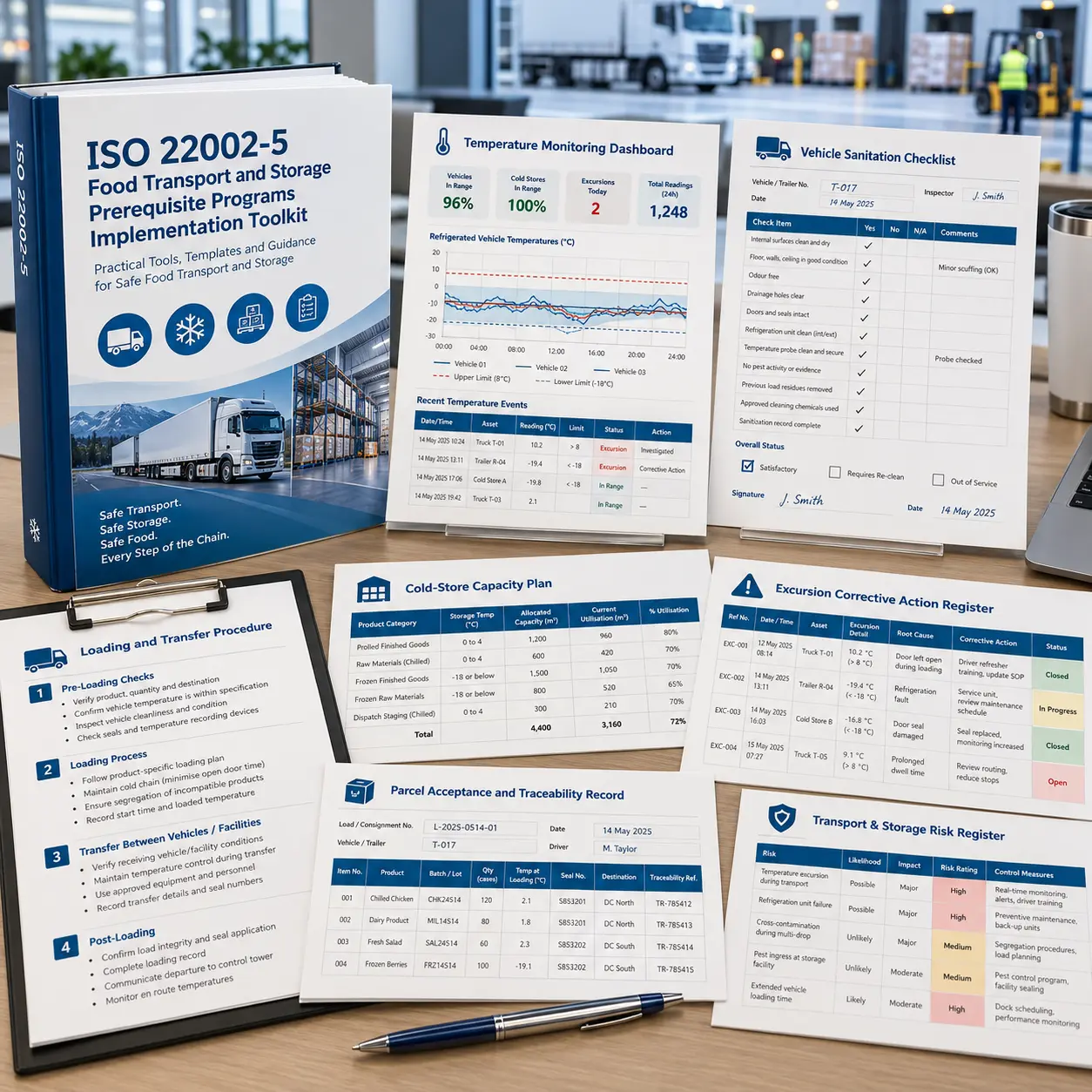
The ISO 22002-5:2025 Food Transport & Storage Prerequisite Programmes Implementation Toolkit provides a comprehensive, easy to use set of premium templates and professionally structured resources to help logistics, warehousing, transport, and storage organizations establish, implement, verify, and sustain effective prerequisite programmes (PRPs) for controlling food safety hazards.
Aligned with ISO 22002-5:2025 and ISO 22002-100:2025, the toolkit translates transport and storage PRP requirements into practical policies, procedures, registers, checklists, matrices, workbooks, and presentations. It supports warehouse premises and hygienic zoning, utilities and infrastructure, vehicles and containers, handling equipment, external logistics providers, receiving, segregation, warehousing, stock rotation, controlled temperature and cold chain, cross docking and transshipment, dispatch and journey control, cleaning and contamination prevention, pest and waste controls, personnel hygiene and driver practices, traceability, product withdrawal, incident response, food defence, food fraud, cargo integrity, internal audit, corrective action, management review, and enterprise handover.
ISO 22002-5 Toolkit Value & Pricing
Implementing prerequisite programmes across food transport and storage operations can be demanding because controls extend across warehouses, docks, vehicles, containers, external providers, receiving, stock segregation, temperature controlled storage, cross docking, dispatch, journey conditions, sanitation, pest prevention, personnel hygiene, traceability, withdrawal support, food defence, and cargo security.
The ISO 22002-5:2025 Food Transport & Storage Prerequisite Programmes Implementation Toolkit provides a comprehensive collection of easy to use templates and structured implementation documents in Word, Excel, and PowerPoint formats. It helps logistics organizations accelerate PRP implementation, standardize warehouse and transport controls, strengthen cold chain and cargo integrity assurance, improve traceability and incident response, and maintain stronger verification and audit evidence across multi site operations.

ISO 22002-5 Toolkit Document Index
Below is the structured list of documents included in the package. Expand each part to review the files before downloading the index file.
 Part 1. Enterprise Transport and Storage PRP Governance and Programme Initiation
 Enterprise Transport and Storage PRP Policy.docx ISO 22002 5 Implementation Charter.docx Multi Site Logistics PRP Governance Procedure.docx
 Warehouse and Transport Operations Scope Register.xlsx Enterprise Logistics PRP RACI Matrix.xlsx PRP Implementation Roadmap and Action Tracker.xlsx
 Enterprise Logistics PRP Programme Kickoff.pptx
Part 2. PRP Applicability, Gap Assessment and Risk-Based Rollout
Transport and Storage PRP Applicability and Exclusion Plan.docx Logistics PRP Gap Assessment and Remediation Method.docx ISO 22002 5 and 22002 100 Requirements Matrix.xlsx Multi Site and Fleet PRP Gap Assessment.xlsx Food Safety Exposure and Control Priority Register.xlsx PRP Gap Closure and Investment Tracker.xlsx PRP Gap Assessment and Rollout Review.pptxPart 3. Warehouse Premises, Site Layout and Hygienic Zoning
Warehouse Building and Premises Hygiene Procedure.docx Storage Dock and Personnel Flow Segregation Plan.docx Warehouse Premises and Building Condition Inspection.xlsx Hygienic Zone Dock and Access Control Matrix.xlsx Goods Personnel and Waste Flow Assessment.xlsx Premises Defect and Remediation Register.xlsx Warehouse Layout and Hygienic Zoning Review.pptxPart 4. Utilities, Environmental Conditions and Site Infrastructure
Warehouse Utilities and Environmental Control Procedure.docx Water Air Lighting and Drainage Hygiene Procedure.docx Warehouse Utility and Environmental Inspection Checklist.xlsx Ventilation Lighting and Condensation Monitoring Log.xlsx Utility Testing Deviation and Remediation Register.xlsx Warehouse Utilities and Infrastructure Review.pptxPart 5. Vehicle, Container, Handling Equipment and Maintenance Control
Vehicle Container and Load Unit Hygienic Suitability Procedure.docx Material Handling Equipment Maintenance Procedure.docx Vehicle and Equipment Post Maintenance Release Procedure.docx Vehicle Container and Trailer Hygiene Inspection.xlsx Pallet Racking and Handling Equipment Inspection.xlsx Fleet and Warehouse Equipment Preventive Maintenance Plan.xlsx Vehicle and Equipment Defect and Release Register.xlsx Measurement Device Calibration and Verification Register.xlsx Fleet Container and Equipment Readiness Review.pptxPart 6. Logistics Service Provider and Purchased Service Controls
Transport and Warehousing Service Provider Approval Procedure.docx External Logistics Provider PRP Management Procedure.docx Approved Logistics Provider and Subcontractor Register.xlsx Carrier and Third Party Warehouse PRP Assessment.xlsx Purchased Service Food Safety Requirements Matrix.xlsx External Provider Performance and Corrective Action Log.xlsx Third Party Logistics PRP Alignment Review.pptxPart 7. Inbound Receiving and Goods Acceptance
Inbound Goods Receipt Inspection and Acceptance Procedure.docx Nonconforming Inbound Goods Hold and Disposition Procedure.docx Inbound Vehicle and Goods Condition Checklist.xlsx Receiving Temperature Packaging and Seal Inspection Log.xlsx Inbound Lot Identification and Document Verification Register.xlsx Rejected And Held Inbound Goods Register.xlsx Goods Receiving and Acceptance Control Review.pptxPart 8. Goods Categorization, Segregation and Identification
Food Feed and Packaging Goods Categorization Procedure.docx Incompatible Goods and Allergen Segregation Procedure.docx Logistics Unit Identification and Status Control Procedure.docx Product Handling and Storage Requirement Matrix.xlsx Allergen Chemical and Odour Transfer Segregation Matrix.xlsx Pallet Lot and Logistics Unit Identification Register.xlsx Quarantine Hold Release and Status Control Log.xlsx Goods Segregation and Identification Workshop.pptxPart 9. Storage, Warehousing and Stock Rotation
Warehouse Storage Stowage and Stock Rotation Procedure.docx Racking Palletization and Stock Protection Procedure.docx Warehouse Storage Condition and Housekeeping Checklist.xlsx FIFO FEFO Expiry and Inventory Rotation Audit.xlsx Pallet Racking Stacking and Clearance Inspection.xlsx Warehouse Stock Damage and Disposition Register.xlsx Warehouse Storage and Stock Rotation Review.pptxPart 10. Controlled Temperature, Humidity and Cold Chain Management
Ambient Chilled Frozen and Humidity Control Procedure.docx Temperature Excursion Escalation and Product Disposition Procedure.docx Temperature and Humidity Requirement Matrix.xlsx Cold Room Freezer and Controlled Storage Monitoring Log.xlsx Refrigerated Vehicle Pre Cooling and Setpoint Checklist.xlsx Temperature Data Logger Review and Alarm Register.xlsx Temperature Excursion Assessment and Disposition Log.xlsx Controlled Conditions and Cold Chain Assurance Review.pptxPart 11. Cross-Docking, Transshipment and Intermediate Handling
Cross Docking and Transshipment Food Safety Procedure.docx Intermediate Transfer and Dwell Time Control Procedure.docx Cross Dock Area and Handling Readiness Checklist.xlsx Cross Dock Transfer and Dwell Time Register.xlsx Transshipment Seal Integrity and Condition Log.xlsx Intermediate Transfer Deviation and Action Register.xlsx Cross Docking and Transshipment Control Review.pptxPart 12. Dispatch, Loading and Transport Journey Control
Outbound Dispatch and Load Authorization Procedure.docx Vehicle Loading Compatibility and Load Securing Procedure.docx Transport Journey and Delivery Condition Control Procedure.docx Dispatch Readiness and Pick Verification Checklist.xlsx Outbound Vehicle Hygiene Pre Cooling and Seal Checklist.xlsx Load Compatibility and Segregation Checklist.xlsx Transport Journey Condition and Seal Monitoring Log.xlsx Delivery Condition Proof of Delivery and Exception Register.xlsx Dispatch Loading and Transport Operations Review.pptxPart 13. Cleaning, Disinfection and Contamination Prevention
Warehouse Vehicle and Container Cleaning Procedure.docx Bulk Tanker and Returnable Container Cleanliness Procedure.docx Physical Chemical and Microbiological Contamination Response Procedure.docx Master Warehouse and Fleet Cleaning Schedule.xlsx Vehicle Container and Handling Equipment Cleaning Log.xlsx Cleaning Agent Concentration and Storage Control Log.xlsx Cleaning Effectiveness and Contamination Incident Register.xlsx Cleaning and Contamination Prevention Review.pptxPart 14. Pest Prevention, Waste and Food Loss Controls
Warehouse and Vehicle Pest Prevention Procedure.docx Logistics Waste Spillage and Food Loss Procedure.docx Pest Control Device Inspection and Sighting Log.xlsx Pest Contractor Service and Treatment Register.xlsx Waste Container and Disposal Inspection Checklist.xlsx Food Loss Spill and Waste Disposition Register.xlsx Pest Waste and Food Loss Control Review.pptxPart 15. Personnel Hygiene, Driver Practices and Competence
Warehouse Personnel and Driver Hygiene Procedure.docx Visitor Contractor and Driver Site Entry Procedure.docx Warehouse Driver and Contractor Hygiene Checklist.xlsx Logistics PRP Training and Competence Matrix.xlsx Personnel Welfare and Hygiene Facilities Inspection.xlsx Driver PRP Induction and Authorization Register.xlsx Logistics Personnel Hygiene and Driver Awareness.pptxPart 16. Traceability, Product Withdrawal and Incident Response
Lot Traceability and Logistics Movement Tracking Procedure.docx Product Hold Withdrawal and Recall Support Procedure.docx Transport Storage Food Safety Incident and Continuity Plan.docx Shipment Lot and Location Traceability Register.xlsx Traceability Test and Mass Balance Record.xlsx Product Hold Withdrawal and Returns Control Register.xlsx Food Safety Incident Deviation and Corrective Action Log.xlsx Refrigeration Failure and Emergency Transfer Tracker.xlsx Logistics Traceability and Incident Response Exercise.pptxPart 17. Food Defence, Food Fraud and Cargo Integrity
Warehouse and Transport Food Defence Plan.docx Cargo Tampering Fraud and Security Incident Procedure.docx Warehouse Fleet and Route Threat Assessment.xlsx Food Fraud and Transport Integrity Vulnerability Register.xlsx Cargo Seal Access and Chain of Custody Log.xlsx Food Defence Control Verification Checklist.xlsx Logistics Food Defence and Cargo Integrity Review.pptxPart 18. PRP Verification, Internal Audit and Enterprise Handover
Transport and Storage PRP Verification Procedure.docx Internal Audit and Nonconformity Control Procedure.docx Enterprise Logistics PRP Handover and Sustainment Plan.docx Multi Site Fleet PRP Verification and Audit Schedule.xlsx ISO 22002 5 and 22002 100 Internal Audit Checklist.xlsx PRP Nonconformity and Corrective Action Register.xlsx Logistics PRP KPI and Management Review Dashboard.xlsx PRP Implementation Closeout and Site Acceptance Checklist.xlsx Enterprise Logistics PRP Management Review and Closeout.pptxReview the complete file index, preview free sample templates, or check the purchase and payment guide.
ISO 22002-5 Toolkit Package & Download Information
| Date File Updated | 15/01/2025 |
| File Format | doc, docx, xls, xlsx, ppt, pptx |
| No. of files | 136 File; 18 Folders |
| File download size | 39.00 MB (rar). |
| Language |
 English |
| Purchase code | ISO22002-5-Toolkits |
Ready to Apply ISO 22002-5:2025?
Start with the complete ISO 22002-5 food transport and storage PRP toolkit or review the free sample before purchasing.
The ISO 22002-5 toolkit helped us structure warehouse and transport PRPs around the actual logistics flow from receipt through storage, dispatch, journey, and delivery.
The warehouse zoning, dock, personnel, goods, and waste flow templates made our site layout review much more systematic.
The vehicle, container, trailer, pallet, racking, maintenance, and calibration records were practical for linking fleet and warehouse equipment controls.
The third party provider approval and performance tools helped us apply the same food safety expectations to subcontracted carriers and external warehouses.
The receiving, temperature, packaging, seal, document, and hold records made inbound acceptance much more consistent across sites.
The segregation and stock rotation templates helped us improve allergen, chemical, odour transfer, quarantine, FIFO, FEFO, and inventory status controls.
The cold chain section was particularly useful for setpoints, pre cooling, data loggers, alarms, excursion assessment, and product disposition decisions.
The cross dock, dispatch, loading, seal, journey, and proof of delivery records strengthened control over intermediate handling and transport handovers.
The warehouse, vehicle, and container cleaning programme gave us clearer schedules, execution records, chemical controls, and verification evidence.
The driver hygiene, contractor entry, training, welfare, pest, waste, and food loss records helped standardize operational discipline across our logistics sites.
The traceability, mass balance, hold, withdrawal, refrigeration failure, and emergency transfer tools gave us a stronger response framework for logistics incidents.
The food defence, cargo seal, chain of custody, internal audit, corrective action, KPI, management review, and handover tools provided a clear way to sustain the programme.