ISO 22002-1:2025 Food Manufacturing Prerequisite Programmes Implementation Toolkit
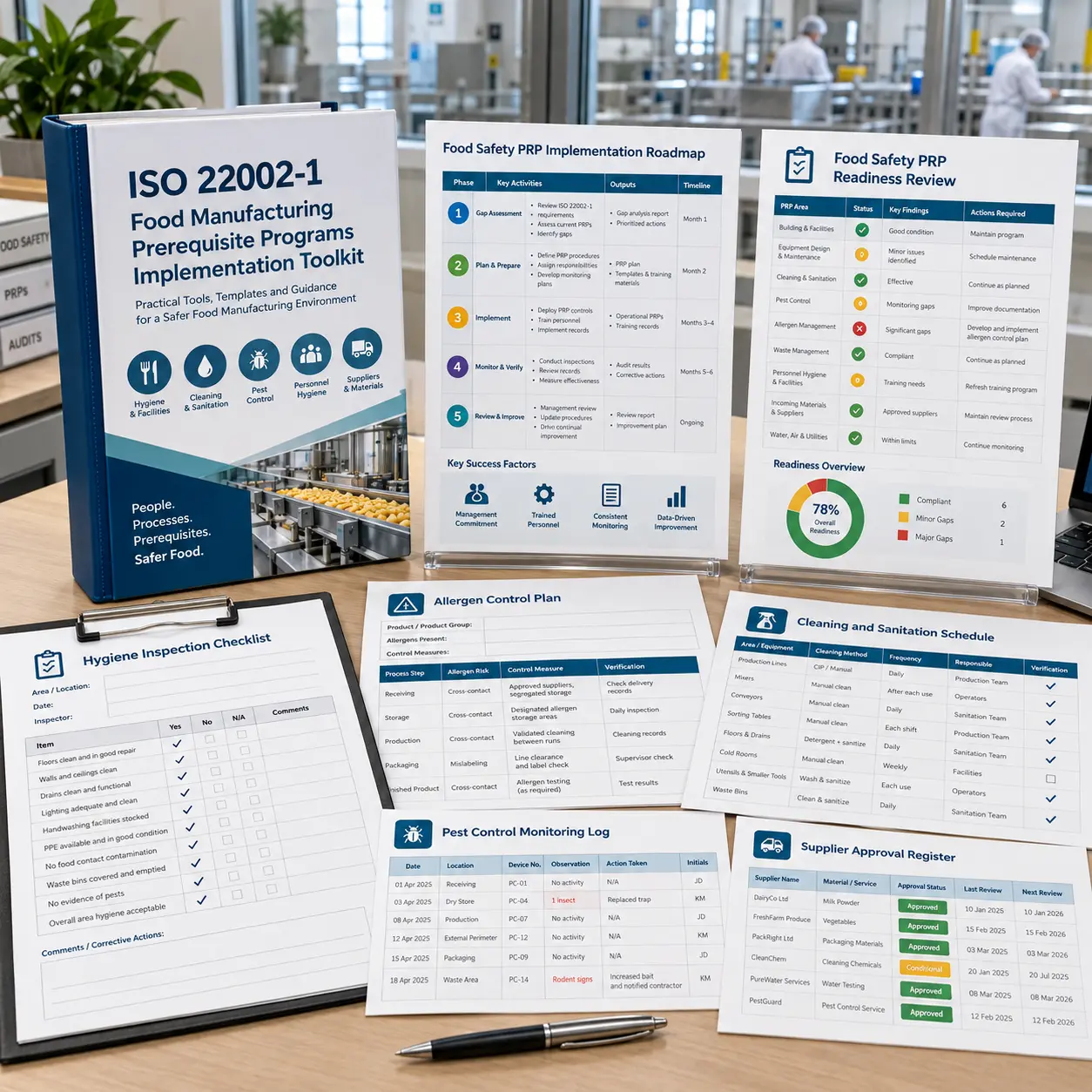
The ISO 22002-1:2025 Food Manufacturing Prerequisite Programmes Implementation Toolkit provides a comprehensive, easy to use set of premium templates and professionally structured resources to help food manufacturing organizations establish, implement, verify, and sustain effective prerequisite programmes (PRPs) for controlling food safety hazards.
Aligned with ISO 22002-1:2025 and the supporting ISO 22002-100:2025 common PRP requirements referenced in the supplied implementation register, the toolkit translates food manufacturing hygiene and prerequisite programme requirements into practical policies, procedures, registers, checklists, matrices, workbooks, and presentations. It supports site governance, gap assessment, hygienic zoning, production utilities, equipment hygiene, approved suppliers, receiving and storage, personnel hygiene, cleaning and CIP, pest control, microbiological cross contamination, allergen control, physical and chemical contamination, rework, waste, product information, traceability support, food defence, food fraud, verification, internal audit, corrective action, management review, and programme handover.
ISO 22002-1 Toolkit Value & Pricing
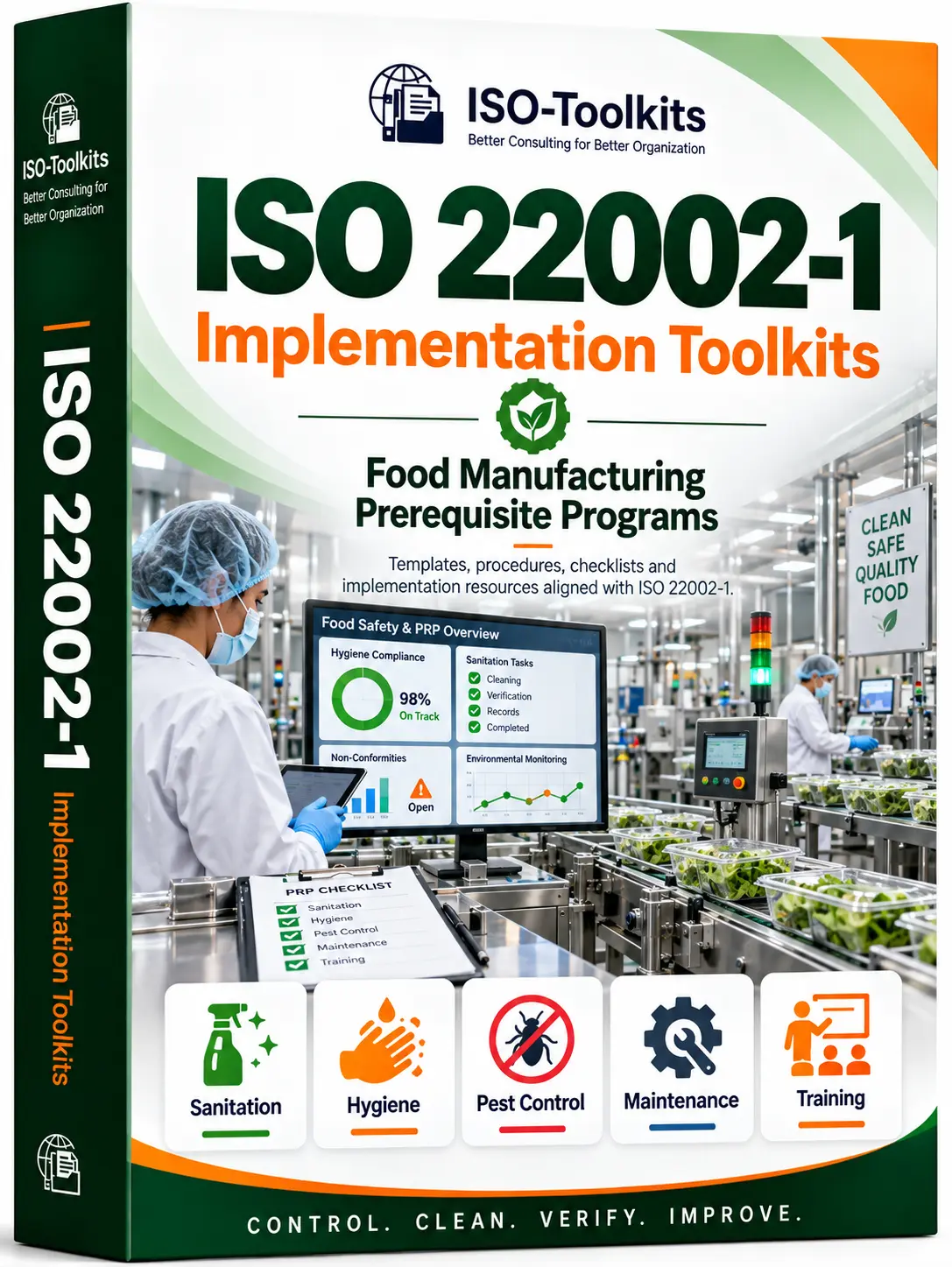
Implementing prerequisite programmes across a food manufacturing facility can require substantial coordination because food safety controls extend across premises, hygienic zoning, utilities, equipment, suppliers, incoming materials, storage, personnel hygiene, cleaning, pest control, microbiological risks, allergens, physical and chemical contaminants, rework, waste, traceability, food defence, food fraud, verification, and corrective action.
The ISO 22002-1:2025 Food Manufacturing Prerequisite Programmes Implementation Toolkit provides a comprehensive collection of easy to use templates and structured implementation documents in Word, Excel, and PowerPoint formats. It helps food manufacturers accelerate PRP implementation, standardize site hygiene controls, improve verification evidence, strengthen contamination prevention, coordinate operational responsibilities, and support food safety management system implementation with greater consistency and control.

ISO 22002-1 Toolkit Document Index
Below is the structured list of documents included in the package. Expand each part to review the files before downloading the index file.
 Part 1. Enterprise PRP Governance and Implementation Initiation
 • Enterprise Food Manufacturing PRP Policy.docx • ISO 22002 1 PRP Implementation Charter.docx • Food Manufacturing PRP Governance and Accountability Procedure.docx
 • ISO 22002 1 and 22002 100 Applicability Matrix.xlsx • Enterprise Site PRP RACI Matrix.xlsx • PRP Implementation Milestone and Action Plan.xlsx
 • Enterprise PRP Implementation Kickoff.pptx
Part 2. PRP Gap Assessment and Site Implementation Planning
• Food Manufacturing PRP Gap Assessment Methodology.docx • Site Specific PRP Implementation and Exclusion Plan.docx • Multi Site PRP Gap Assessment Checklist.xlsx • PRP Requirement and Control Traceability Matrix.xlsx • PRP Hazard Exposure and Control Priority Register.xlsx • Site PRP Remediation and Investment Tracker.xlsx • PRP Gap Analysis and Rollout Prioritization.pptxPart 3. Factory Premises, Hygienic Layout and Zoning
• Factory Premises and Site Boundary Control Procedure.docx • Hygienic Zoning and Personnel Material Flow Plan.docx • Building Fabric and Drainage Hygiene Procedure.docx • Factory Site and Building Condition Inspection.xlsx • Hygienic Zone and Access Control Matrix.xlsx • Personnel Material and Waste Flow Assessment.xlsx • Building Fabric Repair and Improvement Register.xlsx • Factory Layout and Hygienic Zoning Review.pptxPart 4. Production Utilities and Environmental Conditions
• Food Contact Water Ice and Steam Control Procedure.docx • Air Ventilation Compressed Gas and Lighting Control Procedure.docx • Potable Water Ice and Steam Monitoring Log.xlsx • Air Handling Filtration and Pressure Monitoring Log.xlsx • Compressed Air and Food Contact Gas Test Register.xlsx • Utility Hygiene Testing and Deviation Register.xlsx • Production Utilities Hygiene Control Review.pptxPart 5. Equipment Hygienic Design and Maintenance
• Equipment Hygienic Design and Acceptance Procedure.docx • Hygienic Maintenance and Post Maintenance Release Procedure.docx • Food Contact Equipment Hygienic Suitability Checklist.xlsx • Preventive Maintenance and Lubricant Control Register.xlsx • Equipment Cleanability and Inspection Record.xlsx • Post Maintenance Hygiene Release Checklist.xlsx • Equipment Hygiene and Maintenance Readiness Review.pptxPart 6. Approved Suppliers and Purchased Materials
• Raw Material and Food Contact Packaging Approval Procedure.docx • Incoming Materials Hygiene and Release Procedure.docx • Approved Supplier and Material Register.xlsx • Supplier PRP and Hygiene Assessment Checklist.xlsx • Incoming Materials Inspection and Release Log.xlsx • Raw Material Certificate and Specification Verification Register.xlsx • Supplier and Incoming Material Control Review.pptxPart 7. Receiving, Storage, Warehousing and Dispatch
• Receiving Storage and Stock Rotation Procedure.docx • Warehouse and Dispatch Hygiene Procedure.docx • Storage Condition and Temperature Monitoring Log.xlsx • Warehouse Hygiene and Stock Rotation Checklist.xlsx • Loading Vehicle Hygiene and Seal Inspection.xlsx • Warehouse Deviation and Hold Register.xlsx • Warehouse and Dispatch PRP Readiness Review.pptxPart 8. Personnel Hygiene and Employee Facilities
• Personnel Health Hygiene and Behaviour Procedure.docx • Gowning Handwashing and Hygienic Entry Procedure.docx • Personnel Hygiene and Gowning Inspection Checklist.xlsx • Employee Facility and Handwash Station Checklist.xlsx • Hygiene Training and Competence Matrix.xlsx • Visitor and Contractor Hygiene Compliance Log.xlsx • Personnel Hygiene and Entry Control Training.pptxPart 9. Cleaning, Disinfection and CIP Programmes
• Master Cleaning and Disinfection Procedure.docx • Cleaning in Place CIP Operation and Release Procedure.docx • Cleaning Chemical Preparation and Control Procedure.docx • Master Sanitation Schedule and Responsibility Matrix.xlsx • Cleaning and Disinfection Execution Log.xlsx • CIP Cycle Parameter and Release Log.xlsx • Cleaning Validation and Verification Register.xlsx • Cleaning Chemical Concentration and Usage Log.xlsx • Sanitation CIP and Cleaning Verification Workshop.pptxPart 10. Pest Exclusion, Monitoring and Treatment
• Integrated Pest Prevention and Control Procedure.docx • Pest Infestation Response and Product Protection Procedure.docx • Pest Device Location and Service Register.xlsx • Pest Inspection and Trend Analysis Log.xlsx • Pest Control Chemical and Application Record.xlsx • Pest Sighting Incident and Corrective Action Log.xlsx • Integrated Pest Control Programme Review.pptxPart 11. Microbiological Cross-Contamination Prevention
• Microbiological Cross Contamination Control Procedure.docx • Environmental Hygiene Sampling and Response Procedure.docx • Cross Contamination Pathway and Control Matrix.xlsx • Environmental Sampling Plan and Result Log.xlsx • Hygienic Zone Compliance and Transfer Checklist.xlsx • Microbiological Trend and Corrective Action Register.xlsx • Microbiological Contamination Prevention Review.pptxPart 12. Allergen Segregation and Production Changeover
• Manufacturing Allergen Management Procedure.docx • Allergen Line Changeover and Cleaning Release Procedure.docx • Allergen Label and Rework Compatibility Procedure.docx • Raw Material and Finished Product Allergen Matrix.xlsx • Allergen Segregation and Production Sequence Plan.xlsx • Allergen Changeover Verification Checklist.xlsx • Allergen Cleaning Validation and Test Log.xlsx • Allergen Incident and Cross Contact Register.xlsx • Allergen Control and Changeover Workshop.pptxPart 13. Physical and Chemical Contamination Prevention
• Foreign Material Prevention and Detection Procedure.docx • Glass Brittle Plastic and Breakage Control Procedure.docx • Non Food Chemical Storage and Use Procedure.docx • Foreign Material Inspection and Control Checklist.xlsx • Metal Detector X Ray and Sieve Verification Log.xlsx • Glass and Brittle Plastic Register and Inspection.xlsx • Chemical Inventory Segregation and Authorization Register.xlsx • Contamination Incident Hold and Disposition Log.xlsx • Physical and Chemical Contamination Control Review.pptxPart 14. Rework Segregation, Identification and Usage
• Rework Approval Identification and Traceability Procedure.docx • Rework Incorporation and Allergen Compatibility Procedure.docx • Rework Batch Origin and Traceability Register.xlsx • Rework Storage Condition and Segregation Checklist.xlsx • Rework Usage Authorization and Incorporation Log.xlsx • Rework Quantity Limit and Shelf Life Control Matrix.xlsx • Rework Management and Traceability Review.pptxPart 15. Waste, Food Loss and Hygienic Housekeeping
• Waste Handling Segregation and Removal Procedure.docx • Food Loss Recycling and By Product Control Procedure.docx • Waste Container and Removal Inspection Checklist.xlsx • Food Loss Waste and Recycling Tracking Log.xlsx • External Waste Service Hygiene Inspection Register.xlsx • Waste and Hygienic Housekeeping Review.pptxPart 16. Product Information and PRP Traceability Support
• Product Label and Allergen Information Verification Procedure.docx • PRP Related Product Hold and Traceability Escalation Procedure.docx • Product Label and Packaging Information Checklist.xlsx • Packaging Material and Label Release Log.xlsx • PRP Incident Product Identification and Hold Register.xlsx • Product and Ingredient Traceability Test Record.xlsx • Product Information and PRP Traceability Review.pptxPart 17. Food Defence, Food Fraud and Site Protection
• Food Defence Site Protection and Access Control Plan.docx • Food Fraud Vulnerability and Mitigation Procedure.docx • Food Defence Threat and Site Vulnerability Assessment.xlsx • Food Fraud Vulnerability and Mitigation Register.xlsx • Sensitive Area Access and Incident Log.xlsx • Food Defence and Fraud Control Verification Checklist.xlsx • Food Defence and Food Fraud Readiness Review.pptxPart 18. PRP Verification, Internal Audit and Programme Handover
• PRP Monitoring Verification and Trend Review Procedure.docx • PRP Internal Audit and Corrective Action Procedure.docx • Enterprise PRP Handover and Sustainment Plan.docx • Site PRP Verification and Inspection Schedule.xlsx • ISO 22002 1 and 22002 100 Internal Audit Checklist.xlsx • PRP Nonconformity and Corrective Action Register.xlsx • PRP KPI and Management Review Dashboard.xlsx • PRP Implementation Closeout and Site Acceptance Checklist.xlsx • Enterprise PRP Management Review and Closeout.pptxReview the complete file index, preview free sample templates, or check the purchase and payment guide.
ISO 22002-1 Toolkit Package & Download Information
| Date File Updated | 08/08/2025 |
| File Format | doc, docx, xls, xlsx, ppt, pptx |
| No. of files | 132 File; 18 Folders |
| File download size | 38.46 MB (rar). |
| Language |
 English |
| Purchase code | ISO22002-1-Toolkits |
Ready to Apply ISO 22002-1:2025?
Start with the complete ISO 22002-1 food manufacturing PRP toolkit or review the free sample before purchasing.
The ISO 22002-1 toolkit helped us structure the PRP rollout instead of treating each hygiene issue as a separate improvement project.
The factory zoning, personnel and material flow, and building condition templates made our site hygiene review much more systematic.
The utilities and equipment hygiene tools gave our engineering and food safety teams one common set of records for verification and follow up.
The approved supplier, incoming material, and warehouse controls were straightforward to adapt and helped us close several gaps identified during internal review.
The personnel hygiene, gowning, handwashing, and contractor records made daily compliance checks more consistent across shifts.
The sanitation and CIP templates were very practical. We could connect schedules, execution records, chemical control, validation, and release in one structured programme.
The pest control and environmental monitoring registers made trending easier and gave management a clearer view of recurring hygiene issues.
The allergen changeover and cleaning verification tools helped us improve line release decisions and reduce ambiguity between production and QA.
The foreign material, glass and brittle plastic, and chemical control records were useful for strengthening contamination prevention across the plant.
The rework and waste sections helped us formalize segregation, traceability, storage, authorization, and disposal decisions.
The product information, hold, traceability, food defence, and food fraud templates created a much stronger connection between PRPs and incident response.
The verification schedule, internal audit checklist, corrective action register, KPI dashboard, and closeout tools gave us a clear method for sustaining the programme after implementation.