
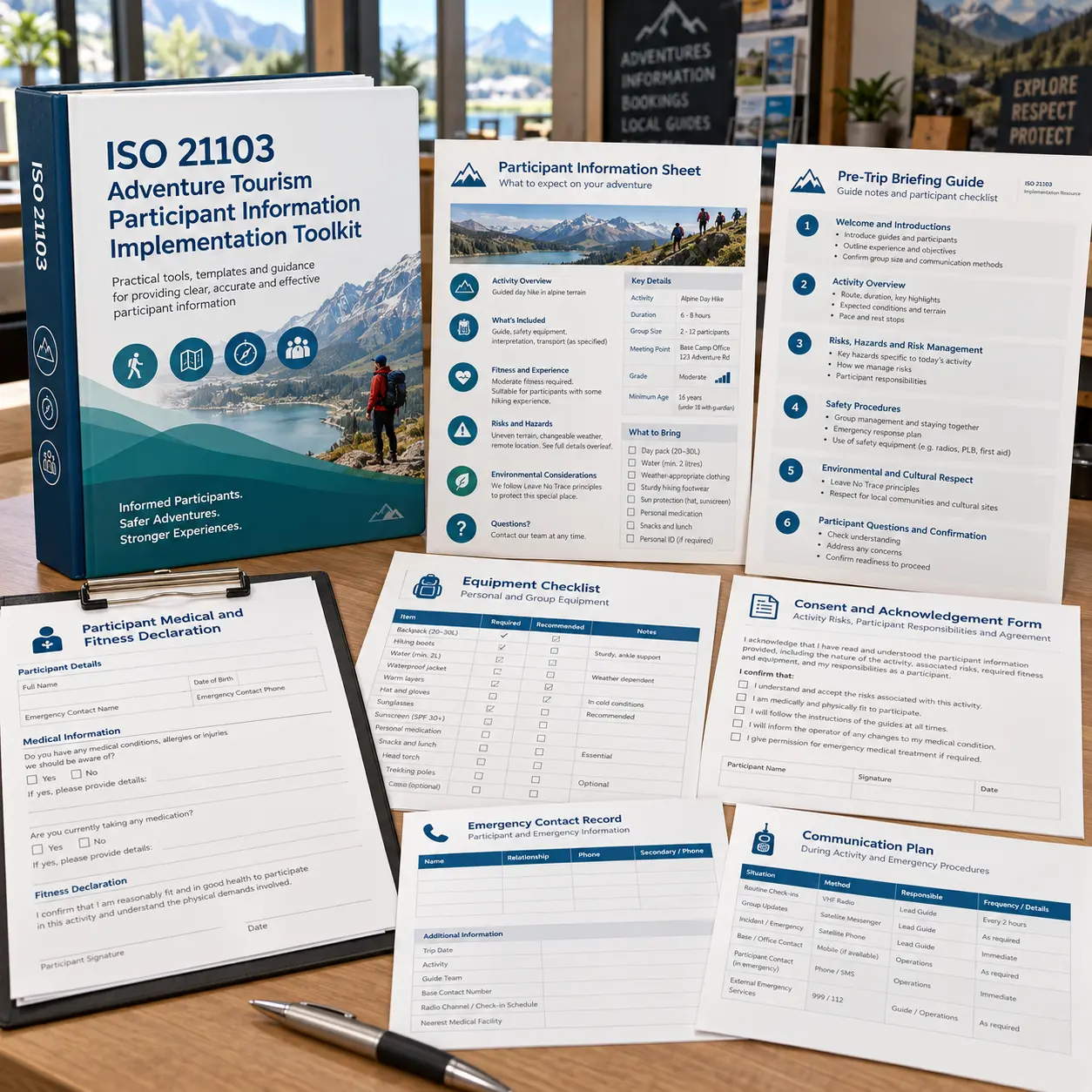
ISO 21103:2014 Adventure Tourism Participant Information Implementation Toolkit
The ISO 21103:2014 Adventure Tourism Participant Information Implementation Toolkit provides a comprehensive, easy to use set of premium templates and professionally structured resources to help adventure tourism providers plan, approve, deliver, verify, and maintain accurate information for participants before, during, and after activities.
Aligned with ISO 21103:2014, the toolkit translates participant information requirements into practical policies, procedures, information sheets, acknowledgement forms, registers, checklists, matrices, and presentations. It supports activity descriptions, difficulty and suitability information, pre booking risk disclosure, eligibility and health information, booking terms, pre activity packs, equipment and preparation guidance, access and environmental information, informed participation, minors and assisted participation, check in and safety briefings, on activity instructions, change notifications, emergency contact information, incident communication, post activity information, feedback, accessibility, records, internal audit, and programme closeout.
ISO 21103 Toolkit Value & Pricing
Providing complete and consistent information to adventure tourism participants can be demanding because information must remain accurate across websites, booking channels, pre trip communications, activity briefings, changing conditions, emergency communications, and post activity follow up while addressing suitability, risks, equipment, health, access, minors, accessibility, consent, cancellations, and local conditions.
The ISO 21103:2014 Adventure Tourism Participant Information Implementation Toolkit provides a comprehensive collection of easy to use templates and structured implementation documents in Word, Excel, and PowerPoint formats. It helps adventure tourism organizations accelerate implementation, standardize participant information, improve pre booking and pre activity disclosure, control acknowledgements and updates, strengthen incident and emergency communication, and maintain a consistent information management framework.

ISO 21103 Toolkit Document Index
Below is the structured list of documents included in the package. Expand each part to review the files before downloading the index file.
 Part 1. Enterprise Participant Information Governance and Programme Initiation
 Enterprise Participant Information Policy.docx ISO 21103 Implementation Charter.docx Participant Information Governance and Approval Procedure.docx
 Enterprise Activity and Destination Scope Register.xlsx Participant Information RACI Matrix.xlsx ISO 21103 Implementation Roadmap and Action Tracker.xlsx
 Enterprise ISO 21103 Implementation Kickoff.pptx
Part 2. Scope, Compliance and Participant Information Gap Assessment
ISO 21103 Scope and Applicability Statement.docx Participant Information Gap Assessment and Remediation Plan.docx ISO 21103 Requirements and Evidence Matrix.xlsx Multi Site Participant Information Gap Assessment.xlsx Activity Specific Information Applicability Matrix.xlsx Information Gap Remediation and Priority Register.xlsx Participant Information Readiness and Gap Review.pptxPart 3. Activity Portfolio and Participant Information Architecture
Participant Information Lifecycle and Channel Control Procedure.docx Activity Information Standard and Content Ownership Guideline.docx Activity Product and Participant Journey Register.xlsx Before During After Information Delivery Matrix.xlsx Information Content Owner Channel and Version Register.xlsx Participant Information Approval and Publication Checklist.xlsx Participant Information Journey Design Workshop.pptxPart 4. Activity Description, Difficulty and Suitability Information
Adventure Activity Description and Suitability Template.docx Activity Difficulty and Participation Requirements Guideline.docx Activity Duration Distance Terrain and Difficulty Register.xlsx Activity Physical Skill and Experience Requirements Matrix.xlsx Activity Inclusions Exclusions and Service Limitations Checklist.xlsx Activity Description Completeness and Accuracy Review.xlsx Activity Description and Suitability Review.pptxPart 5. Pre-Booking Risk Disclosure and Decision Information
Pre Booking Activity Risk and Safety Information Sheet.docx Participant Risk Disclosure and Communication Procedure.docx Activity Hazard and Participant Risk Information Matrix.xlsx Pre Booking Risk Disclosure Completeness Checklist.xlsx Activity Restrictions and Environmental Risk Notice Register.xlsx Pre Booking Risk Information Publication and Approval Log.xlsx Pre Booking Risk Information Review.pptxPart 6. Eligibility, Health and Participant Support Needs Information
Participant Eligibility Health and Support Needs Information Form.docx Participant Health Information Confidentiality and Review Procedure.docx Activity Eligibility and Participation Restrictions Matrix.xlsx Participant Disclosed Support Needs and Arrangements Register.xlsx Health Information Request and Consent Checklist.xlsx Eligibility Clarification and Referral Decision Log.xlsx Participant Eligibility and Support Needs Review.pptxPart 7. Booking Conditions, Price and Cancellation Information
Adventure Activity Booking Terms and Conditions Template.docx Pre Contract Price Cancellation and Refund Information Procedure.docx Booking Terms Fees and Inclusions Disclosure Checklist.xlsx Cancellation Refund and Change Policy Matrix.xlsx Booking Information Acknowledgement Register.xlsx Published Terms and Price Change Approval Log.xlsx Booking Terms and Participant Transparency Review.pptxPart 8. Booking Confirmation and Pre-Activity Information Pack
Participant Booking Confirmation and Pre Activity Information Pack.docx Pre Activity Information Distribution and Follow Up Procedure.docx Pre Activity Information Pack Contents Checklist.xlsx Participant Confirmation and Information Delivery Log.xlsx Pre Trip Participant Queries and Response Register.xlsx Pre Activity Information Receipt and Acknowledgement Tracker.xlsx Pre Activity Information Pack Readiness Review.pptxPart 9. Equipment, Clothing and Participant Preparation Information
Participant Equipment Clothing and Preparation Checklist.docx Equipment Requirements and Usage Information Procedure.docx Activity Required Provided and Optional Equipment Matrix.xlsx Clothing Footwear and Personal Preparation Information Checklist.xlsx Participant Equipment Sizing and Assistance Request Register.xlsx Equipment Information Accuracy and Revision Check.xlsx Participant Equipment and Preparation Briefing.pptxPart 10. Meeting Points, Access and Environmental Conditions Information
Activity Meeting Point Transport and Access Information Sheet.docx Destination Weather Seasonal and Local Conditions Information Procedure.docx Meeting Point Access Transfer and Travel Information Register.xlsx Activity Weather Seasonal and Terrain Advisory Matrix.xlsx Destination Communication and Connectivity Limitations Register.xlsx Location and Condition Information Verification Checklist.xlsx Destination and Environmental Information Review.pptxPart 11. Informed Participation and Risk Acknowledgement
Participant Informed Participation and Risk Acknowledgement Form.docx Participant Information Understanding and Acknowledgement Procedure.docx Risk Acknowledgement and Consent Status Register.xlsx Participant Questions and Risk Clarification Log.xlsx Informed Participation Content and Language Checklist.xlsx Missing Acknowledgement and Pre Activity Follow Up Register.xlsx Informed Participation and Disclosure Review.pptxPart 12. Minors, Groups and Assisted Participation Information
Parent Guardian Information and Authorization Form.docx Group Booking Accessibility and Assisted Participation Information Procedure.docx Minor Participant Guardian Authorization Register.xlsx Group Organizer and Individual Information Delivery Matrix.xlsx Accessibility Adaptation and Communication Needs Checklist.xlsx Minor Group and Assisted Participant Acknowledgement Log.xlsx Group Minor and Accessibility Information Review.pptxPart 13. Participant Check-In and Pre-Departure Safety Briefing
Pre Departure Participant Safety Briefing Script.docx Participant Check In and Briefing Verification Procedure.docx Pre Departure Briefing Content and Delivery Checklist.xlsx Participant Check In Attendance and Identity Log.xlsx Equipment Briefing and Understanding Confirmation Register.xlsx Late Arrival and Missed Briefing Resolution Log.xlsx Pre Departure Safety Briefing Presentation.pptxPart 14. Information During Activities and Participant Instructions
On Activity Participant Instruction and Communication Procedure.docx Participant Safety Signals and Behavioural Information Sheet.docx Activity Stage Safety Message and Instruction Matrix.xlsx On Activity Communication and Instruction Log.xlsx Safety Signal and Participant Comprehension Checklist.xlsx On Activity Information Issue and Resolution Register.xlsx On Activity Safety Information Briefing.pptxPart 15. Activity Changes, Emerging Conditions and Re-Briefing
Activity Change and Participant Re Briefing Procedure.docx Weather Route and Activity Change Notification Template.docx Activity Change Impact and Information Update Matrix.xlsx Participant Change Notification and Acknowledgement Log.xlsx Re Briefing Content Attendance and Confirmation Checklist.xlsx Cancellation Delay and Alternative Activity Communication Log.xlsx Activity Change and Re Briefing Review.pptxPart 16. Emergency Contact Information and Help-Seeking Instructions
Participant Emergency Contact and Help Information Sheet.docx Emergency Communication and Participant Notification Procedure.docx Emergency Contact and Communication Channel Register.xlsx Participant Emergency Contact Details and Data Access Checklist.xlsx Activity Emergency Signal and Help Seeking Instructions Matrix.xlsx Emergency Information Review and Briefing Checklist.xlsx Emergency Contact and Communication Briefing.pptxPart 17. Participant Information During Incidents and Disruptions
Participant Incident Information and Status Update Procedure.docx Participant Incident Notification and Follow Up Message Template.docx Incident Participant Notification and Timestamp Log.xlsx Incident Communication Role and Recipient Matrix.xlsx Participant Status Information and Communication Checklist.xlsx Incident Communication Issues and Correction Register.xlsx Incident Participant Communication Review.pptxPart 18. Activity Completion and Post-Activity Information
Post Activity Participant Information and Follow Up Sheet.docx Activity Completion and Participant Debriefing Procedure.docx Post Activity Safety and Follow Up Information Checklist.xlsx Activity Completion and Participant Debriefing Register.xlsx Equipment Return and Participant Final Instructions Log.xlsx Post Activity Information Delivery and Confirmation Tracker.xlsx Post Activity Information and Debriefing Review.pptxPart 19. Participant Feedback, Complaints and Information Corrections
Participant Feedback and Information Complaint Handling Procedure.docx Participant Feedback and Information Clarity Questionnaire.docx Participant Feedback Complaint and Response Register.xlsx Information Clarity Comprehension and Usefulness Analysis.xlsx Misleading Outdated or Incomplete Information Correction Log.xlsx Participant Information Improvement Action Register.xlsx Participant Feedback and Information Improvement Review.pptxPart 20. Information Accessibility, Records, Audit and Programme Closeout
Participant Information Language Accessibility and Format Procedure.docx ISO 21103 Information Audit and Record Control Procedure.docx Enterprise ISO 21103 Handover and Sustainment Plan.docx Multilingual and Accessible Information Quality Checklist.xlsx ISO 21103 Participant Information Internal Audit Checklist.xlsx Participant Information Record Retention and Version Register.xlsx Information Delivery Compliance and Quality KPI Dashboard.xlsx Implementation Closeout and Multi Site Acceptance Checklist.xlsx Enterprise Participant Information Management Review and Closeout.pptxReview the complete file index, preview free sample templates, or check the purchase and payment guide.
ISO 21103 Toolkit Package & Download Information
| Date File Updated | 22/02/2018 |
| File Format | doc, docx, xls, xlsx, ppt, pptx |
| No. of files | 142 File; 20 Folders |
| File download size | 50.35 MB (rar). |
| Language |
 English |
| Purchase code | ISO21103-Toolkits |
Ready to Apply ISO 21103:2014?
Start with the complete ISO 21103 participant information toolkit or review the free sample before purchasing.
The ISO 21103 toolkit helped us map exactly what information participants should receive before booking, before departure, during the activity, and after completion.
The activity description and suitability templates helped us make difficulty, physical demands, experience requirements, and service limitations much clearer.
The pre booking risk disclosure tools were useful for separating meaningful participant safety information from general marketing content.
The health, eligibility, and support needs forms helped us improve confidentiality while still getting the information needed to make participation decisions.
The booking conditions and pre activity information pack made our customer communication much more consistent across email, website, and reservation channels.
The equipment, clothing, access, weather, and connectivity information templates were particularly practical for remote activities.
The informed participation and risk acknowledgement section gave us a clear process for questions, clarification, language checks, and missing acknowledgements.
The minors, group booking, and accessibility templates helped us handle different participant types without relying on informal email chains.
The check in and safety briefing records improved evidence that important information had actually been delivered and understood before departure.
The change notification and re briefing tools were very useful when weather or route changes required new participant information at short notice.
The incident communication templates gave us a more controlled way to manage status updates, recipients, timestamps, and corrections during disruptions.
The feedback, information correction, accessibility, audit, version control, and closeout tools helped us keep participant information current after implementation.