
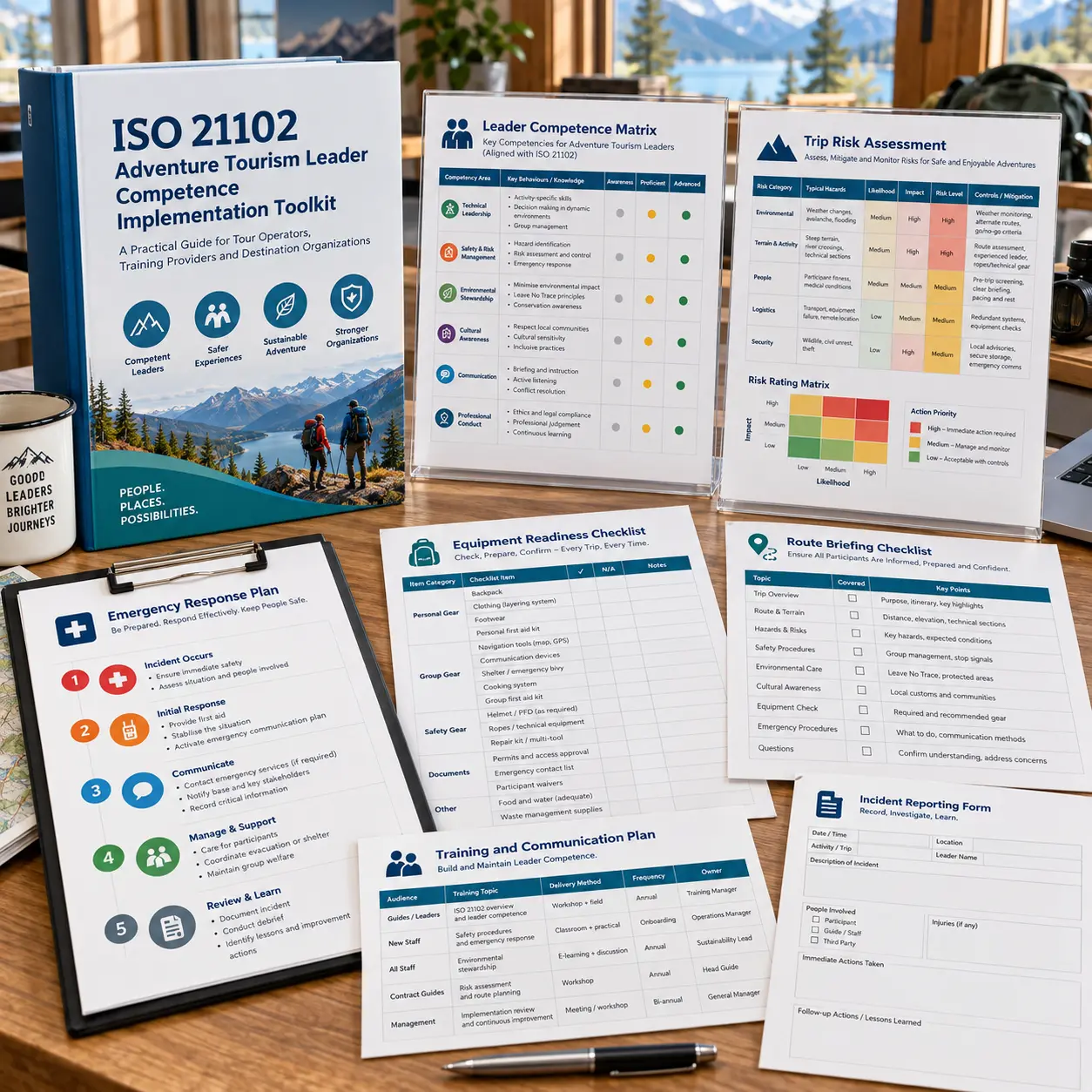
ISO 21102:2020 Adventure Tourism Leader Competence Implementation Toolkit
The ISO 21102:2020 Adventure Tourism Leader Competence Implementation Toolkit provides a comprehensive, easy to use set of premium templates and professionally structured resources to help adventure tourism providers define, assess, develop, authorize, deploy, monitor, and maintain the competence of activity leaders.
Aligned with ISO 21102:2020, the toolkit translates leader competence requirements and expected competence results into practical policies, procedures, matrices, registers, checklists, assessment tools, and presentations. It supports legal compliance, role profiles, recruitment, training, participant briefing, group leadership, route and weather decisions, navigation, technical skills, equipment knowledge, dynamic risk management, first aid, rescue, professional conduct, practical field assessment, authorization, deployment readiness, performance monitoring, incident triggered reassessment, continuing professional development, reauthorization, internal review, and management oversight.
ISO 21102 Toolkit Value & Pricing
Managing adventure tourism leader competence can be demanding because providers must connect recruitment, qualifications, practical training, activity specific skills, participant communication, environmental awareness, technical decisions, dynamic risk assessment, emergency competence, professional conduct, field performance, incident learning, and ongoing reauthorization.
The ISO 21102:2020 Adventure Tourism Leader Competence Implementation Toolkit provides a comprehensive collection of easy to use templates and structured implementation documents in Word, Excel, and PowerPoint formats. It helps adventure tourism organizations accelerate competence programme implementation, standardize leader assessment, document evidence, improve authorization and deployment control, strengthen emergency and field decision competence, and maintain consistent competence assurance across activities and locations.

ISO 21102 Toolkit Document Index
Below is the structured list of documents included in the package. Expand each part to review the files before downloading the index file.
 Part 1. Enterprise Leader Competence Governance and Programme Initiation
 Enterprise Adventure Leader Competence Policy.docx ISO 21102 Implementation Charter.docx Adventure Leader Competence Governance Procedure.docx
 Enterprise Activity Location and Leader Scope Register.xlsx Leader Competence Governance RACI Matrix.xlsx ISO 21102 Implementation Roadmap and Action Tracker.xlsx
 Enterprise Leader Competence Programme Kickoff.pptx
Part 2. Applicability, Requirements Mapping and Gap Assessment
ISO 21102 Scope and Applicability Statement.docx Leader Competence Gap Assessment and Remediation Plan.docx ISO 21102 Requirements and Evidence Matrix.xlsx Multi Site Leader Competence Gap Assessment.xlsx Adventure Activity and Leader Category Register.xlsx Competence Gap Closure and Investment Tracker.xlsx ISO 21102 Readiness and Applicability Review.pptxPart 3. Legal Compliance and Activity-Specific Leader Obligations
Adventure Leader Legal Compliance and Professional Duty Procedure.docx Activity Specific Regulatory Competence Requirements.docx Destination Legal Permit and Leader Licensing Register.xlsx Activity Specific Regulatory Requirement Matrix.xlsx Leader Licence Certificate and Expiry Tracker.xlsx Local Authority Restriction and Compliance Checklist.xlsx Leader Legal Compliance and Duty Review.pptxPart 4. Leader Roles, Competency Framework and Expected Outcomes
Adventure Leader Role and Competence Profile.docx Core Leader Knowledge Skills and Attributes Framework.docx Leader Competence Requirements and Assessment Procedure.docx ISO 21102 Expected Results to Competence Matrix.xlsx Activity Specific Leader Technical Competence Matrix.xlsx Lead Assistant and Rescue Role Responsibility Matrix.xlsx Competence Evidence and Acceptance Criteria Register.xlsx Leader Competence Framework Alignment Workshop.pptxPart 5. Leader Recruitment, Eligibility and Prior Qualification Assessment
Adventure Leader Recruitment and Eligibility Procedure.docx Prior Experience and Qualification Recognition Procedure.docx Leader Application and Experience Assessment.xlsx Qualification Experience and Reference Verification Log.xlsx Leader Activity Eligibility and Restrictions Checklist.xlsx Recruitment Competence Gap and Development Register.xlsx Leader Recruitment and Qualification Review.pptxPart 6. Competence Development, Instruction and Practical Training
Adventure Leader Training and Development Plan.docx Practical Instruction Coaching and Mentoring Procedure.docx Annual Leader Training and Development Matrix.xlsx Training Course Attendance and Result Register.xlsx Supervised Practice and Mentored Leading Log.xlsx Training Effectiveness and Skills Gap Tracker.xlsx Adventure Leader Competence Development Workshop.pptxPart 7. Participant Briefing, Communication and Instruction Skills
Participant Briefing and Instruction Competence Standard.docx Inclusive Communication and Participant Information Procedure.docx Leader Safety Briefing Demonstration Assessment.xlsx Participant Understanding and Instruction Checklist.xlsx Language Accessibility and Communication Competence Matrix.xlsx Briefing Quality and Participant Feedback Log.xlsx Participant Briefing and Communication Skills Review.pptxPart 8. Group Leadership, Supervision and Participant Assistance
Group Leadership and Participant Supervision Procedure.docx Participant Capability Assessment and Assistance Guideline.docx Group Leadership Observation and Assessment Checklist.xlsx Participant Capability and Support Needs Assessment.xlsx Group Control Headcount and Buddy System Checklist.xlsx Conflict Mediation and Group Decision Assessment Log.xlsx Group Leadership and Participant Care Workshop.pptxPart 9. Activity Planning, Route Decisions and Weather Awareness
Leader Activity Planning and Route Selection Procedure.docx Weather Terrain and Operating Conditions Decision Guideline.docx Leader Route and Activity Plan Competence Checklist.xlsx Weather Terrain and Local Conditions Assessment Log.xlsx Alternative Route Cancellation and Go No Go Decision Register.xlsx Activity Timing Group Capability and Leader Resource Matrix.xlsx Activity Planning and Adaptive Decision Review.pptxPart 10. Navigation, Activity-Specific Technical Skills and Demonstration
Navigation Orientation and Technical Leadership Competence Procedure.docx Activity Specific Skills Demonstration and Assessment Plan.docx Navigation Orientation and Route Finding Skills Checklist.xlsx Activity Specific Technical Skills Assessment Register.xlsx Technical Skill Demonstration and Assessor Observation Log.xlsx Leader Technical Competence Limitations and Restrictions Matrix.xlsx Technical Leader Skills and Navigation Review.pptxPart 11. Equipment Knowledge, Inspection and Participant Instruction
Leader Equipment Inspection and Safe Use Competence Procedure.docx Equipment Fitting Instruction and Basic Repair Guideline.docx Leader PPE and Activity Equipment Inspection Checklist.xlsx Equipment Fitting and Participant Demonstration Assessment.xlsx Basic Equipment Repair and Fault Response Skills Log.xlsx Equipment Competence and Authorized Use Matrix.xlsx Adventure Equipment Competence Review.pptxPart 12. Dynamic Risk Management and Safety Decision-Making
Leader Dynamic Risk Assessment and Decision Procedure.docx Participant Fatigue Distress and Exposure Response Guideline.docx Dynamic Hazard Recognition and Risk Assessment Checklist.xlsx Leader Risk Control and Contingency Decision Log.xlsx Participant Fatigue Distress and Exposure Observation Register.xlsx Go No Go and Stop Activity Decision Competence Assessment.xlsx Dynamic Risk Management and Decision Workshop.pptxPart 13. First Aid, Rescue and Emergency Response Competence
Leader First Aid and Emergency Response Competence Procedure.docx Activity Specific Rescue and Evacuation Skills Plan.docx Emergency Communication and Command Role Guideline.docx First Aid Qualification and Practical Skills Register.xlsx Rescue Evacuation and Casualty Management Assessment.xlsx Emergency Communication and Incident Command Drill Log.xlsx Scenario Based Emergency Response Competence Checklist.xlsx Emergency Response and Rescue Skills Exercise.pptxPart 14. Professional Conduct, Ethics and Sustainable Practices
Adventure Leader Professional Conduct and Ethics Code.docx Sustainable Tourism Leader Practice and Local Cultural Respect Guideline.docx Professional Behaviour and Ethics Assessment Checklist.xlsx Sustainability and Minimum Impact Practice Observation.xlsx Cultural Sensitivity and Community Interaction Register.xlsx Leader Conduct Concern and Resolution Log.xlsx Professional Ethics and Sustainability Workshop.pptxPart 15. Competence Evaluation, Field Assessment and Evidence Validation
Leader Competence Assessment and Reassessment Procedure.docx Practical Field Assessment and Witnessing Plan.docx Leader Competence Assessment Report.docx ISO 21102 Knowledge Skills and Attributes Assessment Matrix.xlsx Practical Leadership Scenario and Assessor Scoring Sheet.xlsx Observed Field Leadership and Witness Evidence Log.xlsx Assessor Independence and Competence Verification Register.xlsx Competence Assessment Findings and Remedial Action Tracker.xlsx Leader Practical Assessment and Qualification Board.pptxPart 16. Leader Authorization, Activity Allocation and Deployment Readiness
Adventure Leader Authorization and Deployment Procedure.docx Activity Specific Leader Appointment and Approval Record.docx Authorized Leader Master and Activity Scope Register.xlsx Leader Authorization Certificate and Validity Tracker.xlsx Leader to Activity Risk Competence and Experience Matching Matrix.xlsx Pre Deployment Leader Competence and Readiness Checklist.xlsx Leader Authorization and Deployment Review.pptxPart 17. Field Performance, Supervision and Participant Feedback
Leader Field Performance Monitoring and Coaching Procedure.docx Participant Experience and Leader Performance Feedback Procedure.docx Leader Field Observation and Trip Performance Checklist.xlsx Participant Safety Briefing and Service Feedback Analysis.xlsx Leader Supervision Coaching and Feedback Log.xlsx Field Performance Trends and Competence Concern Register.xlsx Field Leader Performance and Supervision Review.pptxPart 18. Leader-Related Incidents, Near Misses and Learning Actions
Leader Incident Reporting and Competence Reassessment Procedure.docx Leader Incident Lessons Learned and Debrief Procedure.docx Leader Related Incident and Near Miss Register.xlsx Leader Response Performance and Incident Evidence Checklist.xlsx Incident Triggered Competence Reassessment and Action Log.xlsx Safety Lessons Learned and Field Briefing Tracker.xlsx Leader Incident Debrief and Learning Review.pptxPart 19. Competence Maintenance, Continued Development and Reauthorization
Leader Continuing Professional Development and Refresher Plan.docx Competence Validity Review and Reauthorization Procedure.docx Leader Continuing Professional Development CPD Log.xlsx Recency of Practice and Activity Experience Tracker.xlsx Leader Refresher Training and Reassessment Schedule.xlsx Reauthorization Eligibility Competence and Approval Register.xlsx Leader Competence Maintenance and Reauthorization Review.pptxPart 20. Internal Review, Management Oversight and Programme Handover
ISO 21102 Competence Assurance Internal Review Procedure.docx Adventure Leader Competence Management Review Procedure.docx Enterprise Leader Competence Implementation Closeout and Handover Plan.docx ISO 21102 Competence and Evidence Internal Review Checklist.xlsx Enterprise Leader Competence KPI and Qualification Dashboard.xlsx Competence Nonconformity Corrective Action and Effectiveness Register.xlsx Management Review Decisions and Improvement Tracker.xlsx Implementation Closeout and Multi Site Acceptance Checklist.xlsx Enterprise Leader Competence Management Review and Closeout.pptxReview the complete file index, preview free sample templates, or check the purchase and payment guide.
ISO 21102 Toolkit Package & Download Information
| Date File Updated | 23/04/2021 |
| File Format | doc, docx, xls, xlsx, ppt, pptx |
| No. of files | 145 File; 20 Folders |
| File download size | 44.18 MB (rar). |
| Language |
 English |
| Purchase code | ISO21102-Toolkits |
Ready to Apply ISO 21102:2020?
Start with the complete ISO 21102 adventure tourism leader competence toolkit or review the free sample before purchasing.
The ISO 21102 toolkit helped us define leader competence in a much more structured way. We moved from general job descriptions to activity specific requirements and evidence.
The recruitment, prior qualification, and training records were easy to adapt to our seasonal guide programme. They gave supervisors a consistent way to identify development needs.
The participant briefing and communication assessment tools were useful because technical skill alone is not enough for our guides. We now assess how clearly safety information is delivered.
The route planning, weather awareness, and alternative route decision records helped us document practical judgement rather than relying only on certificates.
The navigation and technical skills assessment matrices gave our assessors a clear format for observations and competence limitations.
The dynamic risk management tools were very practical in the field. They helped us document fatigue, environmental changes, go/no go decisions, and stop activity judgement.
The first aid and rescue section helped us link certificates with practical rescue drills and scenario based competence evidence.
We used the professional conduct and sustainability templates to include ethics, cultural respect, and minimum impact practices in our leader assessment programme.
The field assessment and assessor evidence templates improved consistency between different supervisors and made qualification decisions easier to justify.
The authorization and deployment readiness tools helped us avoid assigning leaders outside their approved activity scope or current experience.
The performance monitoring and participant feedback records gave us a better way to identify coaching needs before they became serious competence issues.
The CPD, recency of practice, reauthorization, internal review, and management oversight files provided a practical structure for maintaining competence over time.