
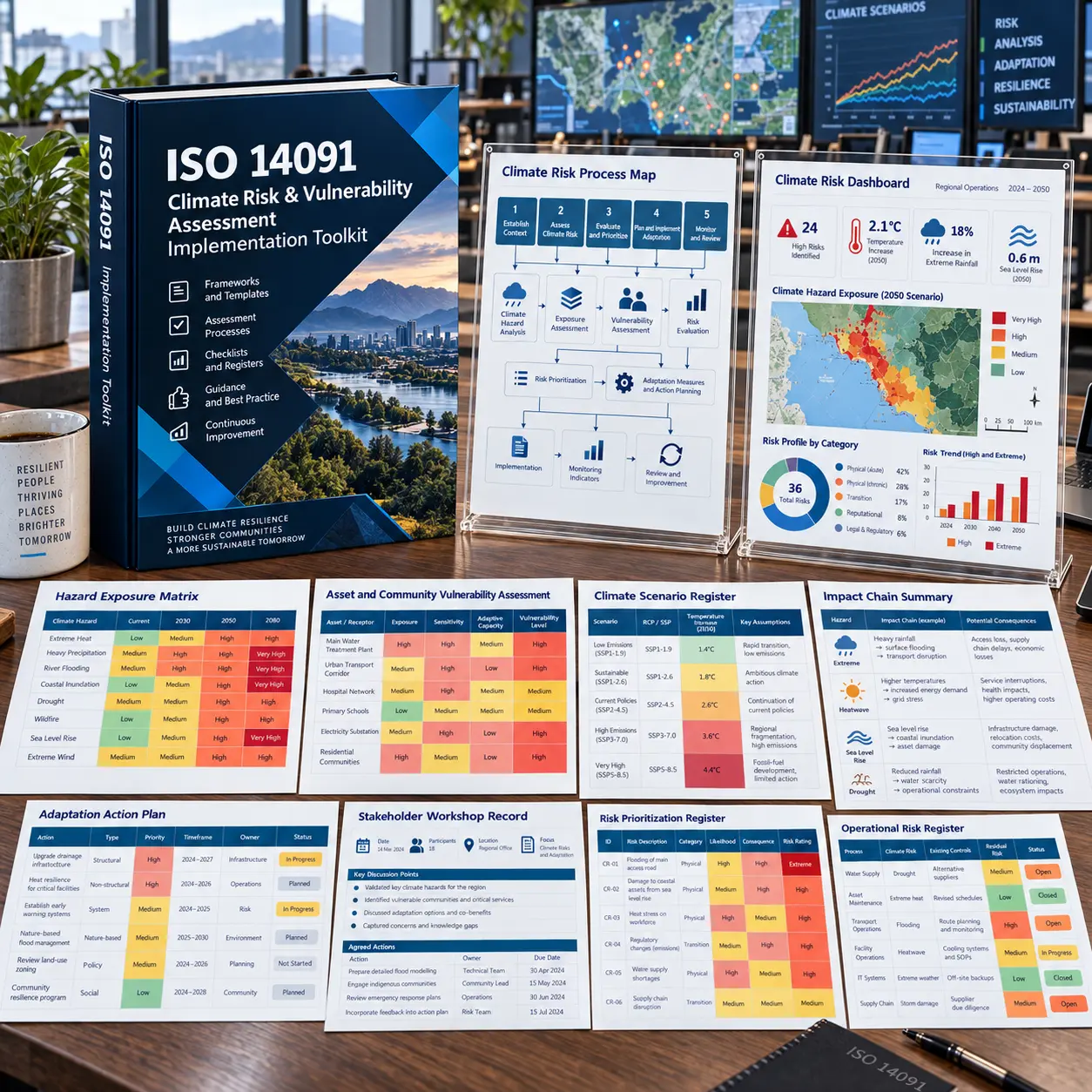
ISO 14091:2021 Climate Risk & Vulnerability Assessment Implementation Toolkit
The ISO 14091:2021 Climate Risk & Vulnerability Assessment Implementation Toolkit provides a comprehensive, easy to use set of premium templates and professionally structured resources to help organizations assess present and future climate related risks, understand vulnerability, evaluate exposure and sensitivity, and support robust climate adaptation decision making.
Aligned with ISO 14091:2021, this toolkit translates climate risk assessment guidance into practical policies, procedures, registers, workbooks, dashboards, review tools, reports, and workshop presentations. It supports enterprise context analysis, climate data management, hazard characterization, exposure and sensitivity assessment, adaptive capacity evaluation, impact chain analysis, risk prioritization, validation, reporting, monitoring, and reassessment.
ISO 14091 Toolkit Value & Pricing
Assessing climate risks in line with ISO 14091:2021 can require significant coordination across climate data, assets, operations, geographies, value chains, stakeholders, scenarios, uncertainty, and management decision making. Without a structured documentation framework, assessment methods and evidence can become fragmented across teams.
The ISO 14091:2021 Climate Risk & Vulnerability Assessment Implementation Toolkit provides a comprehensive collection of easy to use templates and structured implementation documents in Word, Excel, and PowerPoint formats. It helps organizations organize climate risk evidence, standardize assessment criteria, document exposure and vulnerability, evaluate uncertainty, prioritize material risks, and communicate decision ready results more efficiently.

ISO 14091 Toolkit Document Index
Below is the structured list of documents included in the package. Expand each part to review the files before downloading the index file.
 Part 1. Enterprise Climate Risk Assessment Governance and Programme Initiation
 Enterprise Climate Risk Assessment Policy.docx Climate Risk Assessment Project Charter.docx Climate Risk Assessment Governance and Decision Procedure.docx
 Assessment Programme RACI Matrix.xlsx Climate Risk Assessment Implementation Roadmap.xlsx Project Deliverables Milestones and Action Register.xlsx
 Climate Risk Assessment Project Kickoff Presentation.pptx
Part 2. Enterprise Context, Assessment Purpose and Decision Needs
Organization and System Context Profile.docx Climate Risk Assessment Objectives and Decision Use Cases.docx Climate Risk Assessment Scope and Assumptions Statement.docx Internal External Context and Climate Drivers Register.xlsx Enterprise Climate Risk Decision Needs Matrix.xlsx Assessment Assumptions and Constraints Register.xlsx ISO 14091 Guidance and Implementation Alignment Matrix.xlsx Enterprise Climate Risk Context Workshop.pptxPart 3. Critical Systems, Assets and Geographical Coverage
Critical Activities and Services Definition.docx Asset and Infrastructure Scope Definition.docx Supply Chain and Value Chain Scope Definition.docx Assessment System Boundaries and Geographical Coverage.docx Critical Asset and Infrastructure Register.xlsx Critical Business Process Register.xlsx Site and Geographical Coverage Register.xlsx Value Chain Dependency Register.xlsx Critical Service and Dependency Matrix.xlsx Climate Risk Scope and Critical Systems Review.pptxPart 4. Stakeholder Identification, Consultation and Local Knowledge
Climate Risk Stakeholder Engagement Plan.docx Stakeholder Consultation and Local Knowledge Procedure.docx Climate Risk Stakeholder and Expert Register.xlsx Stakeholder Influence Knowledge and Engagement Matrix.xlsx Stakeholder Consultation and Interview Record.xlsx Stakeholder Feedback and Assessment Action Log.xlsx Climate Risk Stakeholder Workshop.pptxPart 5. Assessment Methodology, Risk Criteria and Analytical Design
Climate Risk Assessment Methodology.docx Climate Risk Evaluation Criteria and Rating Guideline.docx Qualitative and Quantitative Assessment Design Plan.docx Assessment Method and Evidence Selection Matrix.xlsx Climate Risk Impact Likelihood and Consequence Criteria.xlsx Assessment Indicator and Scoring Method Register.xlsx Assessment Review and Approval Gates.xlsx Climate Risk Methodology and Criteria Workshop.pptxPart 6. Climate Data Requirements, Sources and Quality Assurance
Climate and Non Climate Data Management Plan.docx Climate Data Quality and Validation Procedure.docx Climate Data Requirement and Source Register.xlsx Climate Observations and Geospatial Data Inventory.xlsx Climate Data Quality Uncertainty and Gap Assessment.xlsx Data Provenance Version and Approval Register.xlsx Climate Data Quality and Evidence Review.pptxPart 7. Historical Climate Baseline and Observed Impact Assessment
Historical Climate Baseline Assessment Plan.docx Historical Climate Events and Observed Impacts Report.docx Baseline Climate Indicators and Reference Period Register.xlsx Historical Extreme Event and Loss Database.xlsx Observed Climate Trends and Variability Analysis.xlsx Historical Impact Evidence and Validation Register.xlsx Climate Baseline and Scenario Review.pptxPart 8. Future Climate Scenarios, Projections and Time Horizons
Climate Scenario Selection and Justification Plan.docx Future Climate Projection Analysis Procedure.docx Scenario Time Horizon and Baseline Assumptions Report.docx Climate Scenario Model and Emission Pathway Register.xlsx Climate Projection Period and Time Horizon Matrix.xlsx Projected Climate Change Indicator Register.xlsx Scenario Model Agreement and Limitations Log.xlsx Future Climate Scenario Assessment Workshop.pptxPart 9. Climate Hazard Identification and Initial Risk Screening
Climate Hazard Identification and Screening Procedure.docx Climate Hazard Selection and Screening Report.docx Climate Hazard and Impact Driver Register.xlsx Acute and Chronic Climate Hazard Screening Matrix.xlsx Hazard to Asset and Process Linkage Register.xlsx Climate Hazard Screening Rationale and Evidence Log.xlsx Climate Hazard Assessment Workshop.pptxPart 10. Climate Hazard Characterization and Spatial Analysis
Climate Hazard Characterization and Mapping Procedure.docx Site Specific Climate Hazard Profile.docx Hazard Intensity Frequency and Duration Assessment.xlsx Geospatial Hazard Layer and Resolution Register.xlsx Site and Region Hazard Severity Profile.xlsx Hazard Trend and Scenario Comparison Matrix.xlsx Climate Hazard Characterization Review.pptxPart 11. Exposure Assessment of Assets, Operations and Value Chains
Exposure Assessment Methodology and Indicator Selection.docx Enterprise Exposure Assessment Report.docx Asset Site and Operation Exposure Register.xlsx Hazard Exposure Geospatial Overlay Matrix.xlsx Supply Chain and Critical Service Exposure Register.xlsx Population Ecosystem and Community Exposure Register.xlsx Exposure Indicator Scoring and Evidence Matrix.xlsx Exposure Assessment Review.pptxPart 12. Sensitivity Assessment and System Response Factors
Sensitivity Assessment Methodology and Indicators.docx Critical System Sensitivity Assessment Report.docx Asset and Infrastructure Sensitivity Matrix.xlsx Business Process and Service Sensitivity Register.xlsx Sensitivity Thresholds and Damage Function Register.xlsx Sensitivity Evidence Scoring and Confidence Log.xlsx Sensitivity Assessment Review.pptxPart 13. Adaptive Capacity and Existing Adaptation Measures
Adaptive Capacity Assessment Methodology.docx Existing Adaptation Measures and Control Effectiveness Report.docx Adaptive Capacity Indicators and Assessment Matrix.xlsx Existing Adaptation and Resilience Measures Register.xlsx Financial Technical and Institutional Capacity Assessment.xlsx Adaptation Measure Effectiveness and Gap Register.xlsx Adaptive Capacity and Existing Controls Review.pptxPart 14. Climate Impact Chains and Causal Pathway Mapping
Climate Impact Chain Development Procedure.docx Climate Impact Chain Analysis Report.docx Hazard Exposure Sensitivity and Impact Chain Matrix.xlsx Direct Indirect and Cascading Impact Pathway Register.xlsx Impact Chain Assumptions Data and Indicator Mapping.xlsx Impact Chain Expert Validation and Revision Log.xlsx Climate Impact Chain Workshop.pptxPart 15. Climate Vulnerability Assessment and Hotspot Analysis
Climate Vulnerability Assessment Procedure.docx Vulnerability Profile and Hotspot Assessment Report.docx Exposure Sensitivity and Adaptive Capacity Integration Matrix.xlsx Climate Vulnerability Scoring and Classification Register.xlsx Location Asset and Population Vulnerability Hotspots.xlsx Vulnerability Assessment Evidence and Validation Checklist.xlsx Vulnerability Assessment Review.pptxPart 16. Present and Future Climate Impact and Risk Analysis
Climate Risk Analysis and Estimation Procedure.docx Current and Future Climate Impact Assessment Report.docx Physical Climate Risk Assessment Technical Report.docx Climate Risk Event Cause and Consequence Register.xlsx Current Climate Risk Assessment Matrix.xlsx Future Climate Risk by Scenario and Time Horizon.xlsx Asset Process and Service Impact Estimation Worksheet.xlsx Existing Adaptation Adjusted Risk Assessment.xlsx Climate Risk Identification Workshop.pptxPart 17. Uncertainty, Sensitivity Testing and Confidence Evaluation
Climate Risk Uncertainty and Confidence Analysis Procedure.docx Climate Assessment Uncertainty and Limitations Report.docx Climate Data Model and Scenario Uncertainty Register.xlsx Risk Score and Indicator Sensitivity Analysis.xlsx Expert Judgement Confidence and Evidence Quality Matrix.xlsx Climate Risk Robustness and Assumption Test Register.xlsx Uncertainty and Scenario Review.pptxPart 18. Enterprise Portfolio, Interdependencies and Cascading Risks
Enterprise Climate Risk Aggregation Methodology.docx Value Chain and Cascading Impact Assessment Report.docx Enterprise Site and Asset Climate Risk Portfolio.xlsx Critical Service and Value Chain Cascading Risk Matrix.xlsx Cross Site Concentration and Common Hazard Exposure.xlsx Enterprise Climate Risk Hotspot and Dependencies Dashboard.xlsx Executive Climate Risk Profile Presentation.pptxPart 19. Climate Risk Evaluation, Prioritization and Adaptation Entry Points
Climate Risk Evaluation and Prioritization Procedure.docx Climate Adaptation Entry Point Identification Report.docx Climate Risk Treatment Decision and Referral Record.docx Climate Risk Priority and Materiality Register.xlsx Risk Tolerance and Management Decision Matrix.xlsx Potential Adaptation Entry Point and Benefit Register.xlsx Adaptation Option Screening and Feasibility Matrix.xlsx Prioritized Risk Owner and Decision Action Log.xlsx Climate Risk Evaluation and Prioritization Workshop.pptxPart 20. Assessment Validation, Reporting and Communication
Climate Risk Assessment Review and Validation Procedure.docx Climate Risk Assessment Executive Summary.docx Climate Risk Assessment Results and Communication Plan.docx Assessment Result Review and Expert Validation Checklist.xlsx Climate Risk Findings and Evidence Traceability Matrix.xlsx Stakeholder Result Communication and Feedback Register.xlsx Climate Risk Reporting Approval and Disclosure Log.xlsx Climate Risk Executive Results Presentation.pptxPart 21. Monitoring, Reassessment and Programme Closeout
Climate Risk Monitoring and Reassessment Plan.docx Climate Risk Assessment Record and Data Handover Procedure.docx Climate Risk Assessment Project Closeout Report.docx Climate Risk KPI KRI and Threshold Monitoring Register.xlsx Climate Risk Reassessment Trigger and Review Schedule.xlsx Adaptation Action Owner and Follow Up Register.xlsx Assessment Data Method and Report Handover Checklist.xlsx Assessment Closeout Findings and Lessons Learned Register.xlsx Climate Risk Project Closeout and Handover.pptxReview the complete file index, preview free sample templates, or check the purchase and payment guide.
ISO 14091 Toolkit Package & Download Information
| Date File Updated | 02/06/2022 |
| File Format | doc, docx, xls, xlsx, ppt, pptx |
| No. of files | 196 File; 16 Folders |
| File download size | 50.52 MB (rar). |
| Language |
 English |
| Purchase code | ISO14091-Toolkits |
Ready to Apply ISO 14091:2021?
Start with the complete ISO 14091 climate risk and vulnerability assessment toolkit or review the free sample before purchasing.
The ISO 14091 toolkit gave our team a clear starting point for defining climate risk scope, decision needs, and responsibilities. It turned a broad climate resilience topic into a manageable assessment programme.
The climate data, scenario, and evidence templates were particularly useful. We were able to document assumptions and data gaps consistently across several sites.
We used the hazard, exposure, and vulnerability registers to organize information from engineering, operations, and sustainability teams. The structure made technical review much easier.
The impact chain and hotspot analysis tools helped us communicate climate risks to non technical stakeholders. They are practical and easy to adapt to different locations.
A strong toolkit for infrastructure risk work. The asset and service dependency registers helped us identify where climate hazards could create cascading operational impacts.
The risk prioritization and adaptation entry point templates were very useful for management workshops. They helped keep the discussion focused on evidence, ownership, and next decisions.
The uncertainty and confidence tools are a valuable addition. They helped us document where results were robust and where further data collection was needed.
The toolkit made our climate risk reporting process more consistent. We could trace findings back to data, assumptions, stakeholders, and assessment criteria.
The enterprise portfolio dashboard and cross site concentration tools were helpful for comparing climate risks across facilities rather than reviewing each site in isolation.
We found the stakeholder consultation records and local knowledge templates very practical for combining technical analysis with operational experience.
The reassessment schedule, KPI and KRI registers, and closeout tools gave us a clear method for keeping the assessment current after the initial project.
Overall, the toolkit is well structured for consultants and internal teams. It saves setup time while still leaving enough flexibility to tailor methods, scenarios, and evidence to each organization.