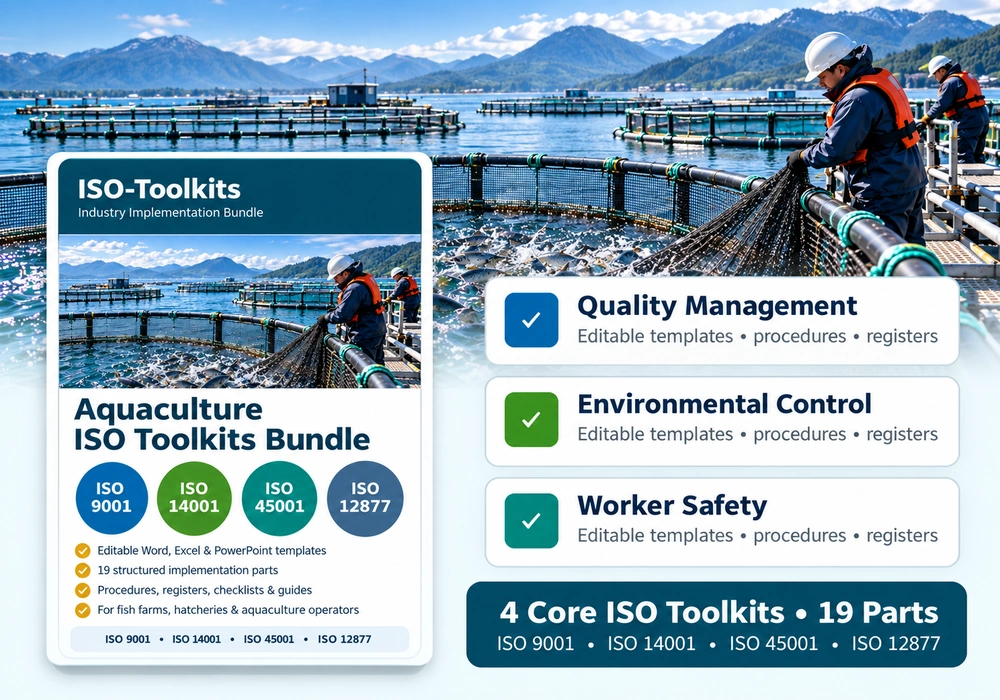
Aquaculture ISO Toolkits Bundle
A practical, industry focused documentation bundle combining ISO 9001, ISO 14001, ISO 45001 and ISO 12877 resources for fish farms, hatcheries and aquatic farming enterprises. It helps teams organize hatchery and stock management, aquatic feed and water quality and harvesting and packing through documented controls and implementation planning.
Editable implementation resources support water quality and effluent performance, fish welfare and disease risks and worker safety in floating and shore facilities; adapt every template to the organization’s actual scope, applicable requirements and operations.
Aquaculture ISO Toolkit Value & Pricing
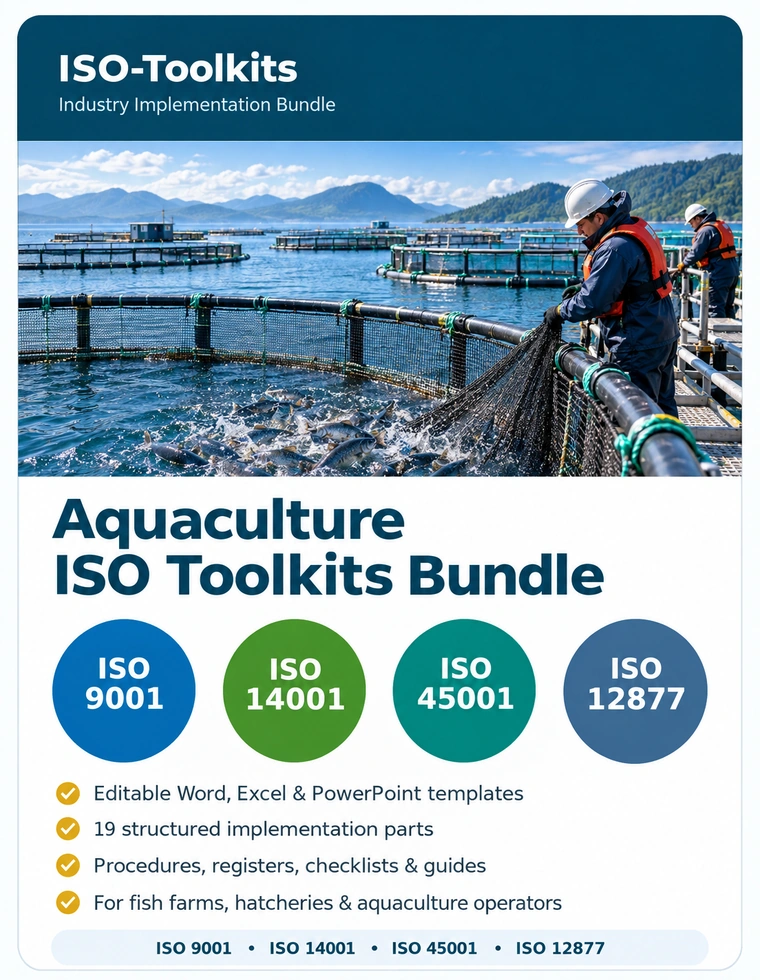
Implementing the management systems applicable to fish farms, hatcheries and aquatic farming enterprises calls for effective coordination across hatchery and stock management, aquatic feed and water quality, harvesting and packing and documented management reviews.
The Aquaculture ISO Toolkits Bundle brings together ISO 9001, ISO 14001, ISO 45001 and ISO 12877 implementation resources in one industry oriented documentation package. The included templates can help establish responsibilities, organize controls, manage relevant operational risks and prepare records for internal and external audits. Templates must be customized to actual site conditions and local requirements.

Aquaculture ISO Toolkit Document Index
Review the documented structure for each Core ISO Toolkit below. Review the folder outlines for each included Core ISO Toolkit. Where an ISO product page was not supplied, its folder outline is shown temporarily using the Agriculture & Farming master structure, with an explanation inside that ISO section.
 ISO 9001 Toolkits Quality Management System
This ISO Toolkit contains 16 verified implementation parts. Expand to review the exact folder headings from the individual toolkit page.
Part 1. QMS Program Initiation & Executive Governance Part 2. Process Architecture & Quality Manual Toolkit Part 3. Document Control & Record Management Part 4. Risk, Opportunity & Change Management Part 5. Customer Focus, Sales to Contract & Requirement Review Part 6. Design & Development Control Toolkit Part 7. Supplier Management & External Provider Control Part 8. Operations Planning, Production & Service Provision Part 9. Inspection, Testing, Calibration & Equipment Control Part 10. Nonconformity, CAPA & Problem Solving Toolkit Part 11. Competence, Awareness & Training Management Part 12. Internal Audit Toolkit Part 13. KPI, Monitoring, Measurement & Data Analysis Part 14. Management Review & Strategic Performance Oversight Part 15. Continuous Improvement & Lean Quality Excellence Part 16. Certification Readiness, Evidence Control & Audit DefenceISO 14001 Toolkits Environmental Management System
This ISO Toolkit contains 16 verified implementation parts. Expand to review the exact folder headings from the individual toolkit page.
Part 1. EMS Program Initiation & Governance Setup Part 2. Context, Stakeholders & EMS Scope Part 3. Environmental Aspects, Impacts & Life Cycle Perspective Part 4. Legal, Regulatory & Compliance Obligations Part 5. Risks, Opportunities & Planning Actions Part 6. Environmental Objectives, Targets & Monitoring Programs Part 7. Operational Control & Environmental Procedures Part 8. Waste Management, Resource Use & Pollution Prevention Part 9. Emissions, Effluents & Environmental Monitoring Part 10. Procurement, Suppliers & Outsourced Environmental Control Part 11. Emergency Preparedness & Environmental Incident Response Part 12. Competence, Awareness & Environmental Communication Part 13. Documented Information & Record Control Part 14. Compliance Evaluation, Internal Audit & Assurance Part 15. Nonconformity, Corrective Action & Continuous Improvement Part 16. Management Review, Performance Reporting & EMS Improvement RoadmapISO 45001 Toolkits Occupational Health & Safety Management System
This ISO Toolkit contains 15 verified implementation parts. Expand to review the exact folder headings from the individual toolkit page.
Part 1. OH&S Program Initiation & Leadership Governance Part 2. Context, Legal Requirements & Compliance Obligations Part 3. Hazard Identification, Risk Assessment & OH&S Opportunities Part 4. Operational Planning, Safe Work Controls & Permit to Work Part 5. Asset, Equipment Safety & Preventive Maintenance Part 6. Change Management & Project Safety Control Part 7. Worker Consultation, Communication & Participation Part 8. Competence, Training & Safety Awareness Part 9. Contractor, Supplier & Outsourced Process Safety Part 10. Occupational Health Monitoring & Worker Wellbeing Controls Part 11. Emergency Preparedness, Response & Crisis Management Part 12. Incident Reporting, Investigation & Corrective Action Part 13. Inspection, Monitoring, Measurement & Performance Reporting Part 14. Internal Audit, Compliance Evaluation & Management Review Part 15. Continual Improvement & OH&S System MaintenanceISO 12877 Toolkits Traceability of Farmed Finfish Products
This ISO 12877 component contains 19 implementation parts. The folder titles are reproduced from the supplied ISO 12877 implementation template register.
Part 1. Enterprise Traceability Governance and Programme Initiation Part 2. Supply Chain Mapping and ISO 12877 Information Requirements Part 3. Traceability Data Standards and Unit Identification Part 4. Fish Feed Production and Feed Lot Traceability Part 5. Breeder and Broodstock Origin Traceability Part 6. Hatchery Egg, Larvae and Fry Traceability Part 7. Nursery, Juvenile Fish and Live Stock Transfers Part 8. Aquaculture Farm Sites, Units and Stocking Records Part 9. Grow Out Stock Movement and Production Cycle Linkages Part 10. Feed Use, Veterinary Treatments and Farm Input Records Part 11. Harvest Events, Harvest Lots and Farm Dispatch Part 12. Processor Receipt and Raw Fish Lot Registration Part 13. Processing Transformation, Rework and Mass Balance Part 14. Finished Product, Packaging and Logistic Unit Identification Part 15. Storage, Transport and Distribution Custody Tracking Part 16. Trading, Wholesale, Retail and Catering Traceability Part 17. Digital Traceability Systems, Integration and Data Quality Part 18. Traceability Verification, Incident Response and Withdrawal Support Part 19. Internal Audit, Competence and Enterprise HandoverExplore the Core Toolkit folder structure, preview free templates and review the purchase guide.
Aquaculture ISO Toolkit Package & Download Information
| Date File Updated | 12/02/2025 |
| File Format | doc, docx, xls, xlsx, ppt, pptx |
| No. of ISO | ISO 9001 Toolkits (43.01 Mb; .rar) ISO 14001 Toolkits (31.95 Mb; .rar) ISO 45001 Toolkits (36.52 Mb; .rar) ISO 12877 Toolkits (19.20 Mb; .rar) |
| File download size | 130.68 Mb (.rar) |
| Language |  English |
| Purchase code | Aquaculture ISO-Toolkits |
Ready to Improve Aquaculture Management Systems?
Get an implementation baseline covering ISO 9001, ISO 14001, ISO 45001 and ISO 12877, with documentation you can tailor to your own processes.
We used the templates to organize responsibilities for improving water quality control. The related records gave our team clearer checkpoints for follow up.
Our supervisors found the material on strengthening farm biosecurity helpful for agreeing controls and keeping the supporting evidence together.
The toolkit gave us a practical starting point for standardizing hatchery records. We still had to tailor the procedures, but the initial structure saved effort.
Our internal team used the checklists to review controls for supporting aquaculture traceability, then assigned follow up actions to the appropriate people.
We brought the templates for protecting operational teams to a process owner workshop. That made it much easier to agree what evidence would be kept.
We found the preparing integrated audits material relevant to our operational reviews and adapted the templates to our existing approval process.
In our aquaculture operations, we needed better alignment between departments. The templates supported a clearer approach to improve water quality control.
We used the implementation structure to coordinate training, responsibilities and documentation for strengthening farm biosecurity.
I appreciated having the implementation parts separated by standard. For work on standardizing hatchery records, it was easier to identify the records to review.
The material made discussions about supporting aquaculture traceability more specific, with defined actions and evidence expectations.
The industry examples and document folders were helpful when adapting controls for protecting operational teams to our own procedures.
The documents helped our aquaculture team organize evidence for preparing integrated audits and prepare for internal audit discussions.