ISO 29993:2017 Non Formal Learning Services Implementation Toolkit
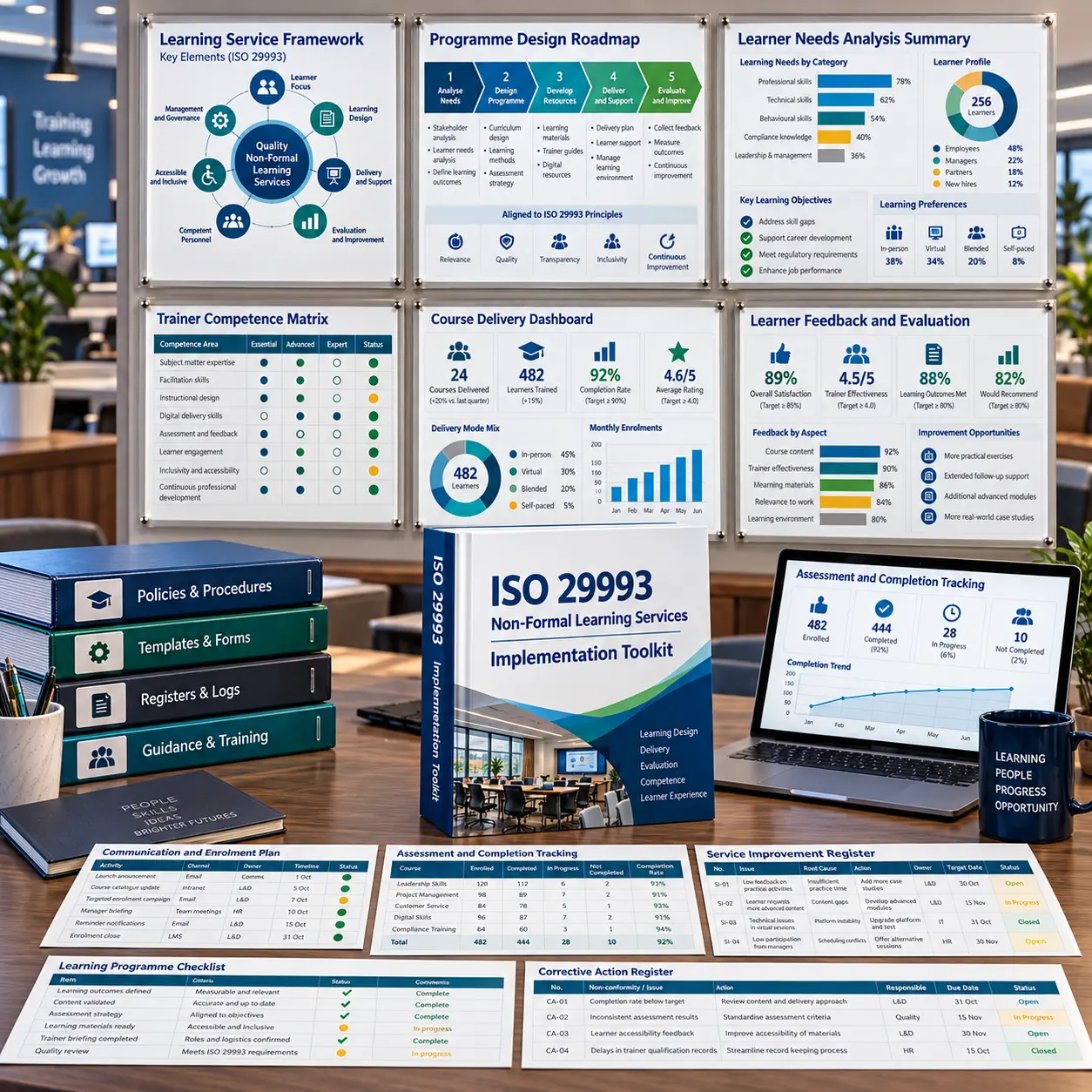
The ISO 29993:2017 Non Formal Learning Services Implementation Toolkit provides a comprehensive, easy to use set of premium templates and professionally structured implementation resources to help learning service providers design, deliver, monitor, evaluate, and continually improve learning services outside formal education.
Aligned with ISO 29993:2017, the toolkit translates service requirements for non formal learning into practical policies, procedures, registers, checklists, matrices, reports, trackers, and presentations. It supports learning service governance, portfolio definition, provider information, learner and sponsor enquiries, proposals and pre acquisition disclosures, learning needs analysis, entry level assessment, measurable learning outcomes, curriculum and session design, learning materials, assessment strategy, facilitator competence, outsourced delivery, physical and digital learning environments, enrolment, accessibility, course delivery, learner progress, achievement, feedback, complaints, evaluation, continuous improvement, invoicing, records, and programme closeout.
ISO 29993 Toolkit Value & Pricing
Implementing consistent learning service controls can be demanding because effective service quality depends on accurate public information, learner and sponsor requirements, needs analysis, measurable outcomes, curriculum design, facilitator competence, learning materials, assessment validity, accessibility, delivery coordination, learner support, feedback, complaints, evaluation, records, and continual improvement across multiple delivery modes.
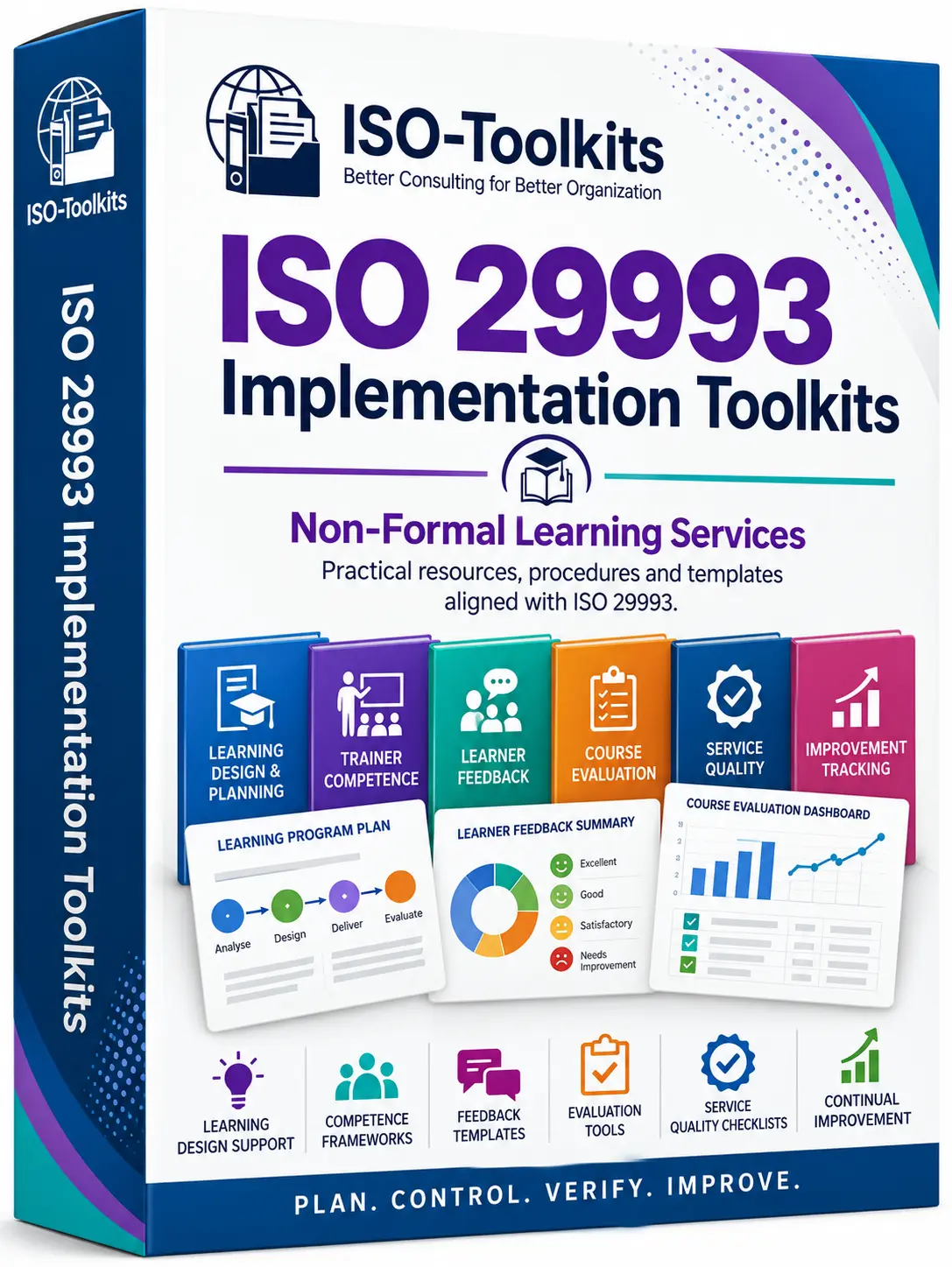
The ISO 29993:2017 Non Formal Learning Services Implementation Toolkit provides a comprehensive collection of easy to use templates and structured implementation documents in Word, Excel, and PowerPoint formats. It helps learning service providers accelerate implementation, standardize programme design and delivery, improve learner and sponsor communication, strengthen facilitator and assessment controls, support digital and blended learning, and maintain stronger evidence for evaluation, improvement, and service consistency.

ISO 29993 Toolkit Document Index
Below is the structured list of documents included in the package. Expand each part to review the files before downloading the index file.
 Part 1. Enterprise Learning Service Governance and Programme Initiation
 Enterprise Learning Service Quality Policy.docx ISO 29993 Implementation Charter.docx Learning Service Roles and Accountability Procedure.docx
 Learning Service Sites Units and Offerings Register.xlsx Enterprise Learning Service RACI Matrix.xlsx ISO 29993 Implementation Roadmap and Action Tracker.xlsx
 Enterprise Learning Service Implementation Kickoff.pptx
Part 2. Learning Service Scope, Portfolio and Gap Assessment
ISO 29993 Learning Service Scope and Applicability.docx Multi Site Learning Service Gap Assessment Plan.docx ISO 29993 Requirements and Evidence Matrix.xlsx Learning Service Portfolio and Delivery Mode Register.xlsx Multi Site ISO 29993 Gap Assessment.xlsx Implementation Gap Remediation and Priority Register.xlsx Learning Service Scope and Readiness Review.pptxPart 3. Provider Information and Marketing Accuracy
Learning Service Provider Information Disclosure Procedure.docx Learning Service Public Description and Information Template.docx Provider Public Information Completeness Checklist.xlsx Course Catalogue Claims and Accuracy Verification.xlsx Facilitator Qualification Publication and Approval Register.xlsx Learning Service Website and Brochure Revision Log.xlsx Provider Information and Marketing Review.pptxPart 4. Learner and Sponsor Enquiries and Service Requests
Learning Service Enquiry and Sponsor Requirement Review Procedure.docx Learner and Sponsor Learning Service Request Form.docx Learner and Sponsor Enquiry Register.xlsx Customer Learning Request Context and Logistics Checklist.xlsx Learning Service Feasibility and Response Tracker.xlsx Learner and Sponsor Requirements Alignment Workshop.pptxPart 5. Learning Service Proposals and Pre-Acquisition Disclosures
Learning Service Proposal and Quotation Template.docx Pre Acquisition Learning Service Information Sheet.docx Learning Service Terms and Conditions Template.docx Learning Service Proposal Content and Compliance Checklist.xlsx Learning Objectives Methods and Assessment Proposal Matrix.xlsx Pre Acquisition Disclosure and Acknowledgement Register.xlsx Proposal Approval Pricing and Revision Tracker.xlsx Learning Service Proposal and Contract Review.pptxPart 6. Learning Needs Analysis and Stakeholder Consultation
Learning Needs Analysis Procedure.docx Organizational Learning Needs Analysis Report.docx Individual Learner Needs Analysis Questionnaire.docx Sponsor Business Goals and Learning Needs Matrix.xlsx Learner Needs Skills Gaps and Preferences Register.xlsx Stakeholder Consultation and Requirement Validation Log.xlsx Learning Needs Analysis Findings and Approval Tracker.xlsx Learning Needs Analysis and Sponsor Validation Workshop.pptxPart 7. Learner Starting Level and Learning Outcomes Definition
Learner Starting Level and Prerequisite Assessment Procedure.docx Learning Outcomes and Success Criteria Specification.docx Learner Prior Knowledge and Competence Baseline.xlsx Entry Requirements and Eligibility Checklist.xlsx Learning Needs to Measurable Outcomes Traceability Matrix.xlsx Learning Outcomes and Assessment Criteria Register.xlsx Learning Outcomes and Entry Level Alignment Review.pptxPart 8. Learning Service Design, Curriculum and Session Architecture
Learning Service Design and Development Procedure.docx Course Curriculum and Learning Pathway Specification.docx Session Plan and Learning Activity Design Template.docx Learning Outcomes to Content and Learning Method Matrix.xlsx Curriculum Modules Session Sequence and Duration Plan.xlsx Learning Service Design Review and Approval Checklist.xlsx Curriculum Change and Version Control Register.xlsx Curriculum and Learning Experience Design Review.pptxPart 9. Learning Materials and Instructional Content Management
Learning Material Development and Quality Review Procedure.docx Trainer and Learner Material Standard.docx Course Material and Learning Resource Master Register.xlsx Learning Material Accuracy Accessibility and Relevance Checklist.xlsx Content Approval Copyright and Licensing Register.xlsx Learning Material Revision Distribution and Withdrawal Log.xlsx Learning Content and Material Readiness Review.pptxPart 10. Learning Assessment Strategy and Instrument Design
Learning Assessment Method Selection and Design Procedure.docx Learner Assessment Plan and Scoring Guideline.docx Learning Outcome to Assessment Method Traceability Matrix.xlsx Assessment Instrument and Rubric Development Register.xlsx Assessment Validity Consistency and Fairness Checklist.xlsx Assessment Item Review and Approval Log.xlsx Learning Assessment Design and Readiness Review.pptxPart 11. Facilitator Competence, Selection and Performance Monitoring
Learning Facilitator Competence and Selection Procedure.docx Facilitator Role Profile and Competence Criteria.docx Facilitator Observation and Performance Review Procedure.docx Facilitator Qualification and Experience Register.xlsx Facilitator Subject Matter and Delivery Competence Matrix.xlsx Facilitator Observation Feedback and Improvement Log.xlsx Facilitator Authorization and Professional Development Tracker.xlsx Facilitator Competence and Delivery Readiness Review.pptxPart 12. Learning Support Personnel and Outsourced Delivery Control
Learning Support Staff Competence and Responsibility Procedure.docx External Facilitator and Learning Service Provider Control Procedure.docx Learning Support Role and Competence Register.xlsx Approved External Facilitator and Service Provider Register.xlsx Outsourced Service Scope and Quality Requirements Matrix.xlsx External Delivery Performance and Corrective Action Log.xlsx Learning Support and External Provider Review.pptxPart 13. Physical Learning Environment and Resource Readiness
Learning Environment Suitability and Accessibility Procedure.docx Training Venue and Equipment Pre Session Release Procedure.docx Training Room Facility and Safety Readiness Checklist.xlsx Learning Environment and Equipment Asset Register.xlsx Training Resources Allocation and Condition Inspection.xlsx Venue Issue Resolution and Contingency Log.xlsx Learning Facility and Resource Readiness Review.pptxPart 14. Digital, Remote and Blended Learning Delivery
Digital and Blended Learning Delivery Procedure.docx Learning Platform Access Data Privacy and Technical Support Procedure.docx LMS Virtual Classroom and Digital Tool Readiness Checklist.xlsx Online Learner Access and Technical Support Register.xlsx Digital Learning Content and Interaction Quality Checklist.xlsx Online Delivery Disruption and Recovery Log.xlsx Remote and Blended Learning Readiness Review.pptxPart 15. Learner Enrolment, Accessibility and Pre-Course Information
Learner Enrolment and Pre Course Information Procedure.docx Enrolled Learner Information and Orientation Pack.docx Learner Accessibility and Learning Support Request Form.docx Learner Enrolment and Sponsor Authorization Register.xlsx Enrolled Learner Information Distribution Checklist.xlsx Learner Accessibility Language and Support Arrangements Register.xlsx Enrolment Changes Withdrawal and Waitlist Log.xlsx Learner Orientation and Course Information Briefing.pptxPart 16. Learning Service Scheduling, Coordination and Delivery
Learning Service Operation and Session Delivery Procedure.docx Course Delivery and Facilitator Briefing Plan.docx Classroom and Virtual Session Delivery Observation Form.docx Course Schedule Session and Facilitator Allocation.xlsx Pre Session Material Venue and Technology Checklist.xlsx Learning Session Delivery and Deviation Log.xlsx Facilitator Session Handover and Activity Completion Register.xlsx Learning Service Delivery Kickoff and Operations Review.pptxPart 17. Learner Participation, Progress Monitoring and Support
Learner Participation and Learning Progress Monitoring Procedure.docx Learner Guidance Additional Support and Intervention Plan.docx Learner Attendance Participation and Engagement Register.xlsx Learning Outcome Progress and Formative Feedback Tracker.xlsx Learner Difficulty and Support Intervention Log.xlsx Learning Delivery Adjustment and Approval Register.xlsx Learner Progress and Support Intervention Review.pptxPart 18. Learner Assessment, Achievement and Results Communication
Learner Assessment Execution and Result Verification Procedure.docx Learning Achievement and Outcome Assessment Report.docx Course Completion Record and Statement of Achievement Template.docx Learner Assessment Result and Rubric Scoring Register.xlsx Learning Outcome Achievement and Completion Matrix.xlsx Assessment Appeal Recheck and Correction Log.xlsx Learner Result Approval and Communication Register.xlsx Learner Achievement and Assessment Results Review.pptxPart 19. Learning Service Monitoring and Sponsor Feedback
Learning Service Monitoring and Feedback Collection Procedure.docx Sponsor and Learner Feedback Questionnaire.docx Session Observation and Service Conformity Checklist.xlsx Learner Satisfaction and Feedback Analysis.xlsx Sponsor Objectives and Delivery Performance Review.xlsx Learning Service KPI and Delivery Quality Dashboard.xlsx Learning Service Monitoring and Stakeholder Feedback Review.pptxPart 20. Learning Service Evaluation, Complaints and Improvement
Learning Service Evaluation and Effectiveness Procedure.docx Learning Service Complaint and Resolution Procedure.docx Learning Service Evaluation and Improvement Report.docx Learning Outcome and Service Evaluation Matrix.xlsx Learner and Sponsor Complaint Resolution Register.xlsx Evaluation Findings Corrective Action and Effectiveness Tracker.xlsx Course Revision and Continuous Improvement Register.xlsx Learning Service Evaluation and Improvement Review.pptxPart 21. Invoicing, Service Records and Programme Closeout
Learning Service Invoicing and Payment Information Procedure.docx Learning Service Records Retention and Access Procedure.docx ISO 29993 Implementation Closeout and Sustainment Plan.docx Training Service Fee Invoice and Payment Reconciliation.xlsx Invoice Detail Agreement and Delivery Verification Checklist.xlsx ISO 29993 Service Conformity and Record Audit Checklist.xlsx Enterprise Implementation Closeout and Management Review Actions.xlsx Enterprise Learning Service Management Review and Closeout.pptxReview the complete file index, preview free sample templates, or check the purchase and payment guide.
ISO 29993 Toolkit Package & Download Information
| Date File Updated | 08/06/2023 |
| File Format | doc, docx, xls, xlsx, ppt, pptx |
| No. of files | 107 File; 10 Folders |
| File download size | 10.12 MB (rar). |
| Language |
 English |
| Purchase code | ISO29993-Toolkits |
Ready to Implement ISO 29993:2017?
Start with the complete ISO 29993 non formal learning services toolkit or review the free sample before purchasing.
The ISO 29993 toolkit helped us organize our learning services around the full learner journey rather than separate course administration documents.
The provider information, course catalogue, marketing accuracy, revision, and disclosure templates made our public information review much more systematic.
The enquiry, sponsor requirement, proposal, pricing, and pre acquisition information tools helped our sales and learning teams work from the same requirements.
The needs analysis, learner baseline, prerequisites, measurable outcomes, and traceability matrices improved how we connect sponsor needs with course design.
The curriculum, learning pathway, session design, material quality, accessibility, copyright, and revision control templates were practical for instructional design.
The assessment strategy, scoring, rubric, validity, fairness, and approval records gave us a more consistent approach to learner assessment.
The facilitator qualification, competence, observation, authorization, and professional development records helped us standardize trainer approval across programmes.
The outsourced facilitator, support staff, venue, equipment, LMS, virtual classroom, data privacy, and technical support tools fit well with our blended delivery model.
The enrolment, orientation, accessibility, support, waitlist, attendance, progress, formative feedback, and intervention tools improved learner support.
The schedule, facilitator allocation, pre session readiness, delivery observation, deviation, handover, and completion records strengthened our operational control.
The learner achievement, result approval, appeals, sponsor feedback, KPI, and service monitoring tools helped us connect delivery evidence with evaluation.
The complaint, evaluation, corrective action, course revision, invoicing, record retention, conformity audit, management review, and closeout tools gave us a clear sustainment framework.