
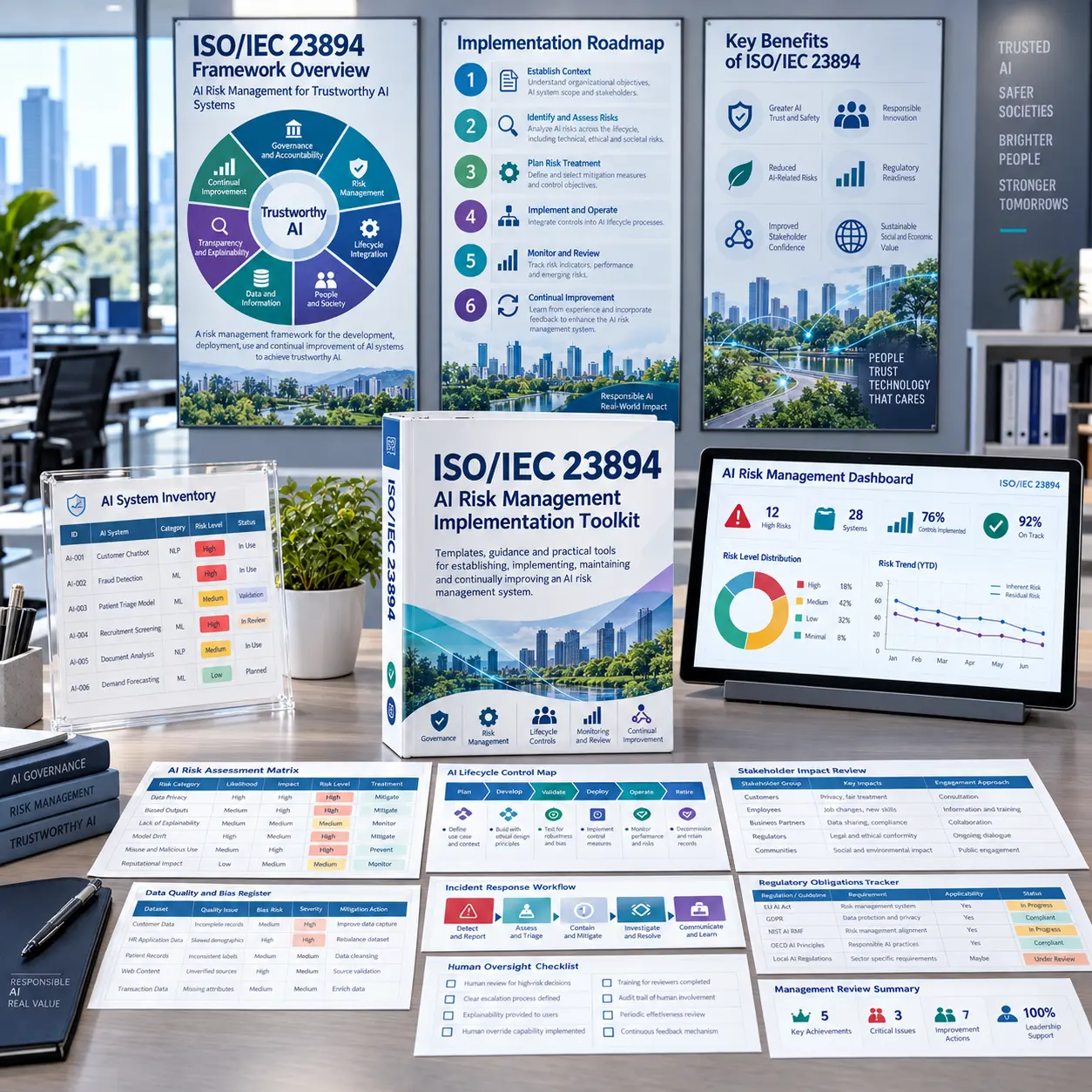
ISO/IEC 23894:2023 Artificial Intelligence Risk Management Implementation Toolkit
The ISO/IEC 23894:2023 Artificial Intelligence Risk Management Implementation Toolkit provides a comprehensive, easy to use set of premium templates and professionally structured implementation resources to help organizations identify, analyse, evaluate, treat, monitor, communicate, and continually improve risk management for artificial intelligence systems and AI enabled products, services, and business processes.
Aligned with ISO/IEC 23894:2023, the toolkit translates AI risk management guidance into practical policies, procedures, registers, matrices, checklists, workbooks, plans, and presentations. It supports enterprise AI risk governance, scope and integration, organizational context, risk criteria and appetite, AI system inventory, lifecycle ownership, stakeholder consultation, risk identification and scenarios, data quality and provenance, model reliability and uncertainty, fairness and bias, privacy and security, AI misuse, explainability, transparency, human oversight, inherent and residual risk analysis, treatment planning, control implementation, validation and release assurance, third party AI, deployment changes, drift monitoring, incident management, management review, independent review, system retirement, lessons learned, and lifecycle closeout.
ISO/IEC 23894 Toolkit Value & Pricing
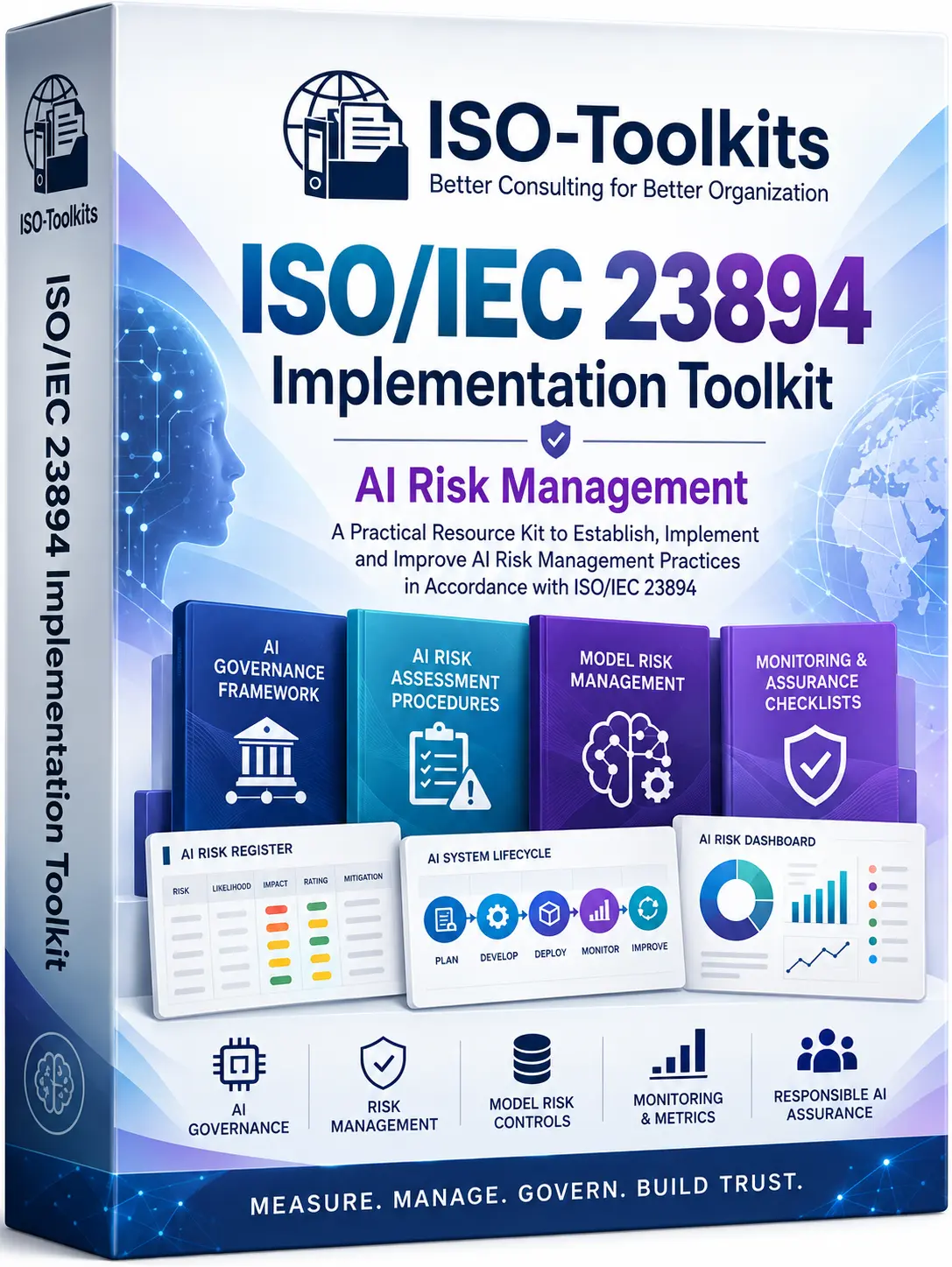
Implementing effective AI risk management can be demanding because organizations must coordinate governance, intended use, affected parties, risk criteria, data provenance, model performance, uncertainty, fairness, privacy, cybersecurity, misuse, transparency, human oversight, third party dependencies, deployment changes, control validation, monitoring, incidents, and retirement across the AI lifecycle.
The ISO/IEC 23894:2023 Artificial Intelligence Risk Management Implementation Toolkit provides a comprehensive collection of easy to use templates and structured implementation documents in Word, Excel, and PowerPoint formats. It helps organizations accelerate AI risk management implementation, standardize assessment and treatment methods, improve traceability between risks and controls, strengthen responsible AI governance, manage lifecycle and supplier risk, and maintain stronger evidence for internal review, management decisions, monitoring, incident response, and continual improvement.

ISO/IEC 23894 Toolkit Document Index
Below is the structured list of documents included in the package. Expand each part to review the files before downloading the index file.
 Part 1. Enterprise AI Risk Governance and Programme Initiation
 Enterprise AI Risk Management Policy.docx ISO IEC 23894 Implementation Charter.docx AI Risk Governance and Decision Authority Procedure.docx
 Enterprise AI Risk Governance RACI Matrix.xlsx AI Risk Programme Readiness Assessment.xlsx AI Risk Implementation Roadmap and Action Register.xlsx
 Enterprise AI Risk Management Kickoff.pptx
Part 2. AI Risk Management Scope, Integration and Gap Assessment
AI Risk Management Scope and Applicability Statement.docx AI Risk Management Integration and Tailoring Plan.docx ISO IEC 23894 Guidance Alignment Matrix.xlsx AI System and Business Process Scope Register.xlsx AI Risk Framework Gap Assessment.xlsx Gap Remediation and Implementation Priority Register.xlsx AI Risk Framework Gap and Scope Review.pptxPart 3. AI Organizational Context, Objectives and Interested Parties
AI Risk Context and Objectives Assessment.docx AI Stakeholder and Affected Party Analysis Plan.docx AI Strategic Objectives and Risk Dependencies Matrix.xlsx AI Stakeholder Expectations and Potential Harms Register.xlsx AI Legal Regulatory and Contractual Obligations Register.xlsx AI Internal External Context and Assumptions Register.xlsx AI Risk Context and Stakeholder Workshop.pptxPart 4. AI Risk Criteria, Appetite and Assessment Methodology
AI Risk Assessment Methodology.docx AI Risk Appetite Tolerance and Acceptance Criteria.docx AI Risk Escalation and Decision Procedure.docx AI Risk Impact and Likelihood Scoring Matrix.xlsx AI Risk Evaluation and Acceptance Threshold Register.xlsx AI Risk Category Taxonomy and Definitions.xlsx AI Risk Review Triggers and Assessment Frequency Matrix.xlsx AI Risk Criteria and Scoring Alignment Workshop.pptxPart 5. AI System Inventory, Intended Use and Lifecycle Context
AI System Intended Use and Operating Context Profile.docx AI System Lifecycle and Risk Ownership Plan.docx Enterprise AI System Inventory and Risk Tiering Register.xlsx AI Use Case Intended Use and Excluded Use Matrix.xlsx AI System Architecture Data Flow and Dependency Register.xlsx AI Lifecycle Stage Risk Owner and Control Matrix.xlsx Enterprise AI System Inventory and Lifecycle Review.pptxPart 6. Risk Communication, Consultation and Affected Party Engagement
AI Risk Communication and Consultation Plan.docx AI Stakeholder Feedback and Grievance Handling Procedure.docx AI Risk Communication and Reporting Matrix.xlsx AI Stakeholder Consultation and Feedback Log.xlsx AI Risk Concern Escalation and Response Register.xlsx AI Risk Communication and Consultation Workshop.pptxPart 7. AI Risk Identification and Scenario Development
AI Risk Identification and Scenario Analysis Procedure.docx AI Risk Scenario and Harm Description Template.docx AI Risk Source and Threat Scenario Register.xlsx AI Failure Mode Misuse and Foreseeable Harm Analysis.xlsx AI Objective to Risk Source Traceability Matrix.xlsx AI Risk Event Cause and Consequence Register.xlsx AI Risk Identification Workshop Action Log.xlsx AI Risk Identification and Scenario Workshop.pptxPart 8. AI Data Quality, Provenance and Dataset Risk Assessment
AI Data Risk Assessment and Provenance Procedure.docx Training Validation and Production Data Assessment Report.docx AI Dataset Inventory and Data Lineage Register.xlsx Data Quality Representativeness and Integrity Risk Matrix.xlsx Dataset Consent Usage Rights and Restrictions Register.xlsx Data Drift Contamination and Leakage Risk Register.xlsx AI Data Risk and Dataset Quality Review.pptxPart 9. AI Model Design, Reliability and Uncertainty Risks
AI Model Risk Analysis and Assumptions Report.docx AI Model Reliability and Operating Limits Specification.docx AI Model Failure Mode and Performance Risk Register.xlsx Model Validation Confidence and Uncertainty Matrix.xlsx Out of Distribution and Edge Case Risk Register.xlsx Model Robustness Stress and Adversarial Test Plan.xlsx AI Model Risk and Uncertainty Review.pptxPart 10. Fairness, Bias and Human Impact Risk Assessment
AI Fairness and Bias Risk Assessment Procedure.docx AI Human and Societal Impact Assessment Report.docx Affected Group and Disparate Impact Risk Matrix.xlsx Bias Sources and Mitigation Register.xlsx Fairness Evaluation Metrics and Test Results.xlsx Human Impact and Stakeholder Harm Register.xlsx AI Bias Fairness and Human Impact Review.pptxPart 11. Privacy, Security and AI Misuse Risk Assessment
AI Privacy Security and Misuse Risk Assessment Procedure.docx AI Adversarial Misuse and Abuse Scenario Assessment.docx AI Privacy and Sensitive Data Risk Register.xlsx AI Model Data and API Security Risk Matrix.xlsx Prompt Injection Data Leakage and Model Abuse Threat Register.xlsx AI Security and Privacy Risk Treatment Tracker.xlsx AI Privacy Security and Misuse Risk Review.pptxPart 12. Explainability, Transparency and Human Oversight Risks
AI Transparency and Explainability Risk Assessment.docx Human Oversight Intervention and Escalation Procedure.docx AI Explanation Needs and Limitations Matrix.xlsx Human Oversight and Override Responsibility Register.xlsx Automation Bias and Human Factors Risk Checklist.xlsx AI User Disclosure and Transparency Control Register.xlsx AI Transparency and Human Oversight Review.pptxPart 13. AI Risk Analysis, Existing Controls and Uncertainty Evaluation
AI Risk Analysis and Control Effectiveness Procedure.docx AI Quantitative Qualitative Risk Analysis Report.docx Enterprise AI Risk Register.xlsx AI Inherent Risk Likelihood and Impact Assessment.xlsx Existing AI Controls and Effectiveness Evaluation.xlsx AI Risk Uncertainty and Confidence Register.xlsx AI Risk Analysis and Control Effectiveness Review.pptxPart 14. AI Risk Evaluation, Prioritization and Acceptance
AI Risk Evaluation and Prioritization Report.docx AI Risk Acceptance and Exception Approval Record.docx AI Risk Evaluation and Priority Register.xlsx Risk Criteria Threshold and Residual Risk Comparison.xlsx AI Risk Acceptance Decision and Approval Log.xlsx Unacceptable Risk and Management Escalation Tracker.xlsx AI Risk Evaluation and Acceptance Board Review.pptxPart 15. AI Risk Treatment Planning and Control Implementation
AI Risk Treatment Plan.docx AI Risk Control Design and Implementation Procedure.docx AI Risk Transfer Avoidance and Residual Risk Decision Record.docx AI Risk Treatment Options and Control Selection Matrix.xlsx AI Risk Treatment Action Owner and Due Date Register.xlsx AI Control Implementation and Evidence Tracker.xlsx AI Residual Risk Reassessment and Approval Log.xlsx AI Risk Treatment Plan and Investment Review.pptxPart 16. AI Risk Control Validation, Testing and Release Assurance
AI Risk Based Verification and Validation Plan.docx AI Risk Control Validation and Release Assurance Report.docx AI Risk to Test and Control Traceability Matrix.xlsx AI Test Scenarios Edge Cases and Acceptance Criteria.xlsx AI Adversarial Robustness and Safety Test Results.xlsx AI Control Effectiveness and Defect Closure Register.xlsx AI Release Risk Gate and Authorization Checklist.xlsx AI Risk Validation and Release Readiness Review.pptxPart 17. Third-Party AI, Models and Supplier Risk Management
Third Party AI Risk Due Diligence Procedure.docx AI Supplier Risk Allocation and Assurance Agreement.docx Third Party AI Model and Service Provider Register.xlsx AI Supplier Assurance and Contractual Risk Assessment.xlsx External Model Data And Dependencies Risk Matrix.xlsx Supplier Risk Review and Corrective Action Register.xlsx Third Party AI Risk and Supplier Assurance Review.pptxPart 18. Deployment, AI System Changes and Risk Reassessment
AI Deployment Risk Readiness and Rollback Plan.docx AI Model Data and Use Case Change Risk Procedure.docx AI Deployment Risk Approval and Go Live Checklist.xlsx AI Model Version Configuration and Risk Baseline Register.xlsx AI Change Request and Risk Impact Assessment.xlsx Material Change and Risk Reassessment Trigger Log.xlsx AI Deployment and Change Risk Gate Review.pptxPart 19. Operational Risk Monitoring, Drift and AI Incident Management
AI Continuous Risk Monitoring and Review Procedure.docx AI Risk Incident Investigation and Response Plan.docx AI Model Performance Degradation and Fallback Procedure.docx AI KRI KPI and Risk Threshold Monitoring Dashboard.xlsx AI Data Drift Model Drift and Change Detection Log.xlsx AI Incident Near Miss and Harm Register.xlsx AI Risk Incident Root Cause and Corrective Action Tracker.xlsx AI Risk Monitoring Alerts and Reassessment Schedule.xlsx AI Operational Risk and Incident Review.pptxPart 20. AI Risk Reporting, Internal Review and Lifecycle Closeout
Enterprise AI Risk Reporting and Management Review Procedure.docx AI Risk Management Independent Review and Improvement Plan.docx AI System Retirement and Residual Risk Closeout Procedure.docx ISO IEC 23894 Risk Process Review Checklist.xlsx AI Risk Report and Management Decision Register.xlsx AI Risk Management Performance and Improvement Dashboard.xlsx AI Risk Findings Actions and Lessons Learned Register.xlsx AI Retirement Data Disposal and Risk Closeout Checklist.xlsx Enterprise AI Risk Management Review and Closeout.pptxReview the complete file index, preview free sample templates, or check the purchase and payment guide.
ISO/IEC 23894 Toolkit Package & Download Information
| Date File Updated | 11/08/2024 |
| File Format | doc, docx, xls, xlsx, ppt, pptx |
| No. of files | 107 File; 10 Folders |
| File download size | 10.12 MB (rar). |
| Language |
 English |
| Purchase code | ISO23894-Toolkits |
Ready to Implement ISO/IEC 23894:2023?
Start with the complete ISO/IEC 23894 AI risk management toolkit or review the free sample before purchasing.
The ISO/IEC 23894 toolkit helped us connect enterprise governance, AI inventory, risk criteria, lifecycle owners, controls, and management reporting within one consistent framework.
The scope, context, stakeholder, legal obligation, potential harm, appetite, tolerance, and acceptance templates made our initial AI risk framework much more systematic.
The AI system inventory, intended use, excluded use, architecture, data flow, lifecycle, risk owner, and control matrices were very practical for portfolio governance.
The scenario analysis, misuse, foreseeable harm, data lineage, provenance, representativeness, drift, contamination, and leakage tools strengthened our risk identification.
The model reliability, operating limits, failure modes, uncertainty, edge cases, robustness, stress testing, and adversarial test records improved technical risk review.
The fairness, bias, affected group, disparate impact, human impact, privacy, sensitive data, API security, and misuse templates improved responsible AI assessment.
The explainability, transparency, oversight, intervention, override, automation bias, disclosure, and user control records were especially useful for high impact AI use cases.
The inherent risk, residual risk, existing control effectiveness, confidence, prioritization, acceptance, exception, and management escalation tools improved decision governance.
The treatment plan, control selection, action owner, evidence, reassessment, validation, release gate, robustness, and safety test templates strengthened deployment assurance.
The third party AI due diligence, supplier assurance, external model, dependency, contractual risk, corrective action, and supplier review tools improved procurement governance.
The deployment readiness, rollback, version baseline, material change, risk reassessment, drift, KRI, KPI, incident, root cause, and corrective action records improved operational monitoring.
The management review, independent review, performance dashboard, lessons learned, retirement, data disposal, residual risk closeout, and handover templates gave us a clear lifecycle framework.